Get

In Your Inbox

Catster is reader-supported. When you buy via links on our site, we may earn an affiliate commission at no cost to you. Learn more.

How to Tell What Kind of Animal Killed Your Cat: 10 Vet-Reviewed Signs to Look For

Share

coyote on the dirt road

We all know that cats are natural hunters, but they can also become prey to other animals at times. The thought of such an incident is difficult to bear, but understanding the risks and knowing how to recognize the signs can help you protect your feline companion.

While it depends on your location, it’s good to know which animals are apt to attack and what the signs are if something happens to your feline friend. If you’re faced with the unfortunate task of dealing with the loss of your cat due to an animal attack, it’s natural to want answers. There are a few ways that you can tell which animal was responsible. In this guide, we list animals that commonly attack cats and the signs that point to specific species.

divider cats oct 2024

What to Do When Your Cat Is Killed by a Wild Animal

Losing your cat in such a way can be a deeply heartbreaking and traumatic experience. If you’ve discovered your cat under these circumstances, it’s natural to feel overwhelmed. While nothing can ease the pain of the loss, understanding what happened may provide some closure. Here’s a compassionate step-by-step guide to help you determine what kind of animal might have been involved.

  • Look for physical evidence: This can include bite marks, claw marks, or tufts of fur. If you find any, take a close look at them, and try to identify the type of animal they belong to.
  • Examine the body carefully: Take note of any unusual wounds or injuries. This can help rule out certain animals.
  • Check for environmental evidence: This can include footprints or scat (droppings). You can try to identify the type of animal based on this evidence.
  • Talk to witnesses: If anyone saw the incident, they may be able to provide valuable information about what happened and who (or what) was responsible.
  • Call in a professional: If you’re still unsure what killed your cat, you can always call a professional (such as a veterinarian or wildlife biologist) to help you investigate. A necropsy can be performed to determine the cause of death. This should be requested as soon as possible before the body starts to decompose.

What Animals Attack Cats?

Several predators may attack and even kill cats, including coyotes, snakes, foxes, and raccoons. To determine which animal killed your cat, it is essential to look at the evidence and think of the most common predators in your location. The type of wounds inflicted, the body’s location, and the remains’ condition can all give clues as to which predator is responsible.

To help determine the culprit, first take a close look at the wounds. If they are puncture wounds, they were likely caused by teeth. If the wounds are lacerations or contain bone fractures, they were likely caused by claws. Next, look at where the body was found. If it was in an open area with no cover, the cat was likely killed by a coyote or fox, as they often drag their prey out into the open to consume it.

If the body was found in thick brush or under a deck or porch, they were likely killed by a dog, as they prefer to take their prey into hiding to eat it.

The 10 Animals That Most Commonly Attack & Kill Cats

1. Coyotes

Coyote sitting in stone
Image Credit: Spykerf1, Pixabay

Coyotes are part of the Canidae family, and you can find them all over the United States. They live in packs and alone, and they have been known to prey on cats, especially during the season when they are trying to feed their young.

You must watch out for lone coyotes and those that run in packs during this time. Coyotes can run at speeds of 40 miles per hour (or 64 kilometers per hour), so a cat would have difficulty outrunning one.

If your cat has been attacked and killed by a coyote, it’ll be pretty easy to tell. However, if you’re unsure, you can talk to the local animal control officers to find out. If you suspect there are coyotes in your area, it’s best to keep your cat inside or only let them out in a fully enclosed area that coyotes can’t get into.

Coyotes typically leave puncture wounds on a cat’s head or neck. Cats that coyotes have attacked are often left with their abdominal cavity open and the organs cleared out.


2. Snakes

black and brown snake trying to climb
Image Credit: Vikas Shankarathota, Unsplash

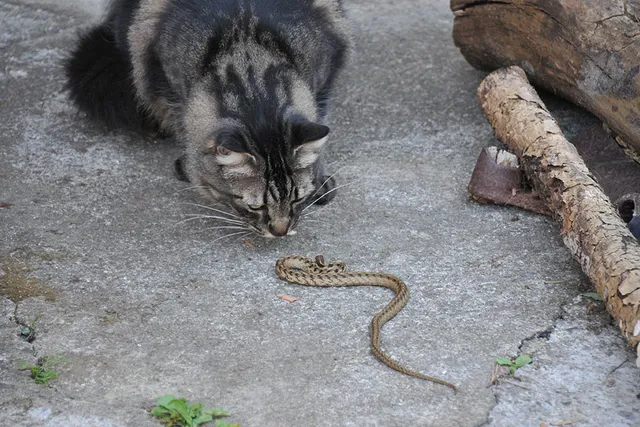
Snakes are more of a threat in warm weather than cold weather but can be dangerous in either climate. Rural areas are more likely to have more snakes than suburban neighborhoods, but they can be found in many habitats. Cats are curious animals, and your cat will quickly approach a snake to see what it is. Unfortunately, the snake could strike before your pet realizes it’s a threat.

Although some snakes aren’t venomous, it’s best to take them to a vet immediately anytime you suspect your cat of being bitten by a snake. If a snake bites your pet, you’ll see two puncture marks, and in most cases, the area will be swollen and bleeding. Take your cat to the vet right away for treatment.

If the snake is poisonous, it is a medical emergency, and the cat might display vomiting, neurological signs, respiratory distress, bleeding, weakness, tachycardia, salivation, seizures, limb paralysis, respiratory paralysis, sloughing of skin/tissue, and sudden death.


3. Skunks

Striped skunks in the yard
Image Credit: Karel Bock, Shutterstock

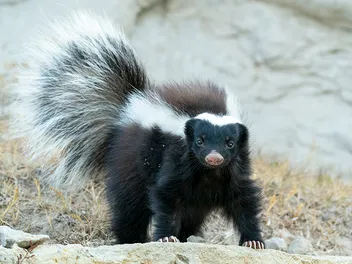
Often, a run-in with a skunk will only leave your cat incredibly stinky. However, their spray can damage their eyes, and their claws can cause lacerations.


4. Raccoons

raccoon on grass
Image Credit: edbo23, Pixabay

Raccoons will leave bite and claw marks behind. Usually, they are located over the entire body.


5. Wolves

wolf mouth, wolf teeth
Image Credit christels, Pixabay

Wolves are also a part of the Canidae family and kill cats because they are opportunistic hunters. Wolves may attack cats if they are unable to find other food sources.

As with coyotes, you can tell if a wolf kills your cat just by the damage left behind. The best way to protect your cat from wolves is to not let them out as much during the winter season and keep a close eye on them.


6. Foxes

fox standing on snow
Image Credit: AlainAudet, Pixabay

Like coyotes, foxes leave puncture and bite wounds around the face and head.


7. Scorpions

Image Credit: Pixabay

While all scorpions are venomous, they are not usually deadly. Scorpions tend to avoid using the sting because it takes a lot of body energy to produce venom. Most of the time they only use their venom for two reasons: to defend themselves or to kill large prey. While scorpions don’t prey on cats, cats are curious and may play them. If the scorpion feels threatened, it will strike with its tail, which has venom in it.

Even inside your home, your cat can run across a scorpion if you live in an area where they are commonly found. Scorpions are more likely to be found inside your home during the rainy season.

Stung cats may drool, have abnormal heart rate or dilated pupils, or even present tremors.  Most cats will hide after they are stung. The area will be painful, raised, and swollen. If you get your cat to the vet right away, it is unlikely that they will die, but if you are not around to assist them in time, the site wound will be the only sign that a scorpion killed your cat.


8. Porcupines

a porcupine is walking around in the dirt
Image Credit: Jeffrey Hamilton, Unsplash

Porcupines are herbivores, so they are not predators. However, they have quills all over their body, which they raise when feel threatened and could harm your cat if they get too close to one. The quills can be very painful, and while the porcupine won’t go out of its way to attack your cat, it will defend itself if it feels your cat is threatening it.

The sign that a porcupine killed your cat is pretty apparent. You’ll find quills sticking in the cat’s body. However, this is an unlikely scenario, as it will require a great many quills and for the wound to get infected or otherwise prevent your cat from feeding. If you find that your (alive) cat got stabbed by a porcupine, please take them to the vet as soon as possible.


9. Birds of Prey

white tailed eagle flying
Image Credit: Albert Beukhof, Shutterstock

There are also a few birds of prey that could kill a cat. Hawks, eagles, and owls have razor-sharp talons. However, birds of prey attacks on cats don’t happen often. Rodents are more likely to be carried away by large birds, so you probably don’t have anything to worry about. That said, while they don’t often attack adult cats, birds of prey like owls, hawks, and eagles could go after tiny kittens.

Hawks and eagles will leave talon marks behind. Owls kill their prey by picking it up and dropping it from high elevations. Birds of prey usually fly away with their food. Therefore, it is more likely that you won’t find a body.


10. Dogs

Image Credit: BORINA OLGA, Shutterstock

You probably already know that some dogs can kill cats. Large dogs with fierce prey drives are the ones that most often attack cats, but almost any medium-sized dog can hurt or kill a cat. While a dog is less likely to eat a cat than a coyote, some dogs have aggression problems, and others simply have a strong prey drive.

divider cats oct 2024

Final Thoughts

Losing your cat to a wild predator is devastating, but identifying the predator can prevent other animals from seeing the same fate. Hopefully, this article can help you determine what animal killed your cat and what to do next. Cats that roam outside are unfortunately at high risk of predator attacks.

The only way to keep your cat safe from outdoor predators is to keep them indoors or within cat-proof enclosures. If you feel that any of these animals are in your area and a danger to your cat, it’s best to keep your pet indoors. Never try to control or capture a wild animal on your own, since you could be injured in the process.


Featured Image Credit: Joshua Wilking, Unsplash

Want content like this delivered to you?

Sign Up For Our Newsletter

News, insights, expert advice, and everything cat

* By submitting, you agree to our Terms & Conditions and Privacy & Cookies Policy.


How useful was this post?

Click on a star to rate (you can leave written feedback after clicking submit)

Help us improve Catster for pet parents!

Your feedback really matters.

What did you like about this post? Also how can we improve it?

Join the conversation

11 Responses

  1. A stray momma has 2 kittens under my daughter's old fort, momma doesn't get near humans, didn't even know the kittens were there until they approached my son n law, not afraid, very sweet. They kept following us humans, appeared to be about 3 or 4 weeks old. Today we didn't see the runt, I went into the fort because they were staying towards the back and there is no floor, I found the runt, but although it's the most horrible thing I've ever seen in my life, we are pretty sure it was a racoon as we see them take the baby ducks that hang around and we back up to woods. Poor little thing, head and front legs and back legs only. No blood, no body. It's pitiful, as we were waiting for them to get weaned and planned to adopt both. We are keeping the brother inside for now, and feeding per vet instructions. (Northeast Florida)

    1. Hi Jen, so sorry to hear about this kitten's outcome. Thanks for protecting the brother, and thank you very much for reading us.

  2. We had four kittens in a covered box with a hole in it for access. Bricks on top so it wouldn't be disturbed by the wind.
    This morning found two front legs of one kitten, and the hindquarters on a patio chair. Inside the box, the other three were dead. One kitten had the internal organs eaten; another with head missing. Not a lot of blood. Box had not been overturned.
    Read through all the predators in this article, and can't determine what killed the kittens.

    1. So sorry to hear about this, Skip Palma. It depends on the kind of wildlife in your area. It is best to do that research with local wildlife organizations or even biology or zoology universities, as they can give you a more detailed clue. Condolences.

  3. Found a cat stripped of its hide. Couldn't even tell at first it was a cat.
    The night before I heard loud screeching, that wasn't from any cat I've ever heard. The next day I saw this cat laying in my yard.
    Just yesterday I saw a cat with its hide pealed back on its left side. The cat was still alive and not bleeding.
    I feed stray cats. I used to have about ten. now I only have three.
    I live in the country. We have bear, coyotes, bobcat, fishers, and almost everything. I once saw a mtn. lion.

  4. I live on 40 acres little rock California I have 15 cats most rescued from desert where they were dumped most are fixed but I have lost two of the last week think it might be coyotes not sure or dogs I've been seeing in the area but what kills a cat and leaves the body only marks are from reare end of cat I've had cats disappear but never if I own the bodies till now

    1. Hi Troy, one possibility would be if the cats had an unfortunate encounter with a venomous snake, there are a few rattlesnake species in the area, it could also be a scorpion or a black widow spider. Thanks for rescuing and fixing the cats, please receive our condolences about the lost ones.

  5. I've seen adult cats with their hair removed from their throats and they seem to live. Many adult cats disappear. Tiny kittens have been attacked by something that wrings their necks. I do not know what animal does this. Many kittens and some adult cats do not eat and die from starvation and thirst no matter what attempts are made. I am curious what is killing them. I saw raccoon and skunk but live out in a gentleman's farm area.

    1. Thanks for reading us Sofia, sorry to hear about cats and kittens being attacked by some wild creature in your area. ????You could contact wildlife services in your area and we recommend you send them some images of the injuries which might help narrow down your investigation.

      1. We found our dear grey and white tabby cat. Tundra, in our neighbors yard this Saturday morning. No signs of blood and the body was intact. We live in IL, a suburb of Chicago. Her fur seemed like there may have been saliva matting it down in a few places, but no marks or blood found. I believe a predator probably got her, maybe suffocated her, but we are trying to determine what predator would kill a cat then not eat. We are devastated over the loss of Tundra. She was an emotional support animal for my youngest son. I'm just trying to help bring some closure for him, but not sure we will ever know

        1. We’re so sorry to hear about the loss of Tundra. Losing a beloved cat, especially one who was such an important emotional support, is truly heartbreaking. Based on the description: no visible injuries, but some saliva-matted fur; it’s rare but not impossible a predator like a coyote or fox may have suffocated her and left the body behind, which sometimes happens if they’re startled or interrupted. While the exact cause may remain unknown, it’s clear she was deeply loved and brought great comfort to her family. Our hearts go out to you.
          Here are some suggested readings, we hope can support you through these hard times:
          https://www.catster.com/lifestyle/cope-with-losing-a-cat/
          https://www.catster.com/lifestyle/what-to-do-when-cat-dies/
          https://www.catster.com/lifestyle/how-do-you-heal-loss-of-a-cat/
          https://www.catster.com/lifestyle/cat-loss-quotes/

Leave a Reply

You’re very welcome to leave a comment or question. Please know that all comments must meet our community guidelines, and your email address will NOT be published. Let’s have a positive and constructive conversation.


Talk With A Vet Online

Peace of mind,
anywhere, anytime

Affordable vet advice

Do Cats Cause Schizophrenia? Scientists Find a Link – Here’s What It Means

Being a fierce advocate (and occasional recipient of) mental health support and awareness, the term ‘crazy’ is not one I like to fling...

One in 100 Cats Gets Diabetes – Here’s How to Catch It Early

One in every 100 cats develops diabetes.1 That’s not a rare, unlucky condition reserved for cats with obvious health problems. It’s common enough...

Dramatic Rescue Turns Into Dramatic Reunion

What started as a routine call for the RSPCA became a heroic, five-hour rescue featuring one trapped and traumatized cat, an emotional family...

Ask Dr. Paola – Help! How Do I Know if it’s Ear Mites! (May 4, 2026)

Welcome to our “Ask Dr. Paola” series, where every Monday we bring expert advice straight from Dr. Paola Cuevas (MVZ) to help our...

More related

Does Dry Cat Food Cause Urinary Problems? Vet-Reviewed Precautions & Prevention Tips

You may have read conflicting information about whether or not dry cat food causes urinary problems. The truth is, urinary problems are the...

Cataracts in Cats: Vet Approved Causes, Signs & Treatment Options

Have you looked into your cat’s eyes recently, only to see a cloudy spot? If so, this may be a cataract. Cataracts aren’t...

Korat Cat vs Russian Blue: Main Differences (With Pictures)

Korats and Russian Blues share a striking resemblance, even though the countries they hail from are more than 3,000 miles apart. Both breeds...

How to Find Cat Urine Without a Blacklight: 5 Simple Methods

Cat urine has a distinct, pungent smell that seems like it never goes away—because, sometimes, it doesn’t! Usually, it doesn’t seem to matter...

Keep reading

5 Best Spots to Pet a Cat: Vet Approved Tips

Cats are unique, fascinating creatures that have captured our hearts for generations. While some felines crave constant attention and physical touch, others are more reserved and only accept petting on their terms. To ensure that your cat feels comfortable and...

cat sitting on owners lap

Why Do I Need to Clean My Cat’s Litter Box? 10 Vet Reviewed Reasons & Cleaning Tips

As a cat owner, you know that cleaning the litter box is definitely the least pleasant chore associated with caring for your feline friend. However, keeping your cat’s litter box clean is also one of the most important things you...

cat-pooping-outside-the-litter-box

Why Does My Cat’s Tail Twitch? 6 Vet-Reviewed Reasons

Cat ownership would be a lot easier if our pets could tell us their thoughts. However, until someone develops a cat-to-human translator, we have to use context clues and our pet’s body language to decipher their moods. A cat’s tail...

A-curled-cats-tail-close-up

Sphynx Cat Health Problems: 6 Vet-Reviewed Issues

Sphynx cats first came about in the 1960s as a result of a genetic mutation. Ever since cat owners have been in love with the unique look and personable nature of the hairless breed. Like other purebred cats, Sphynx cats...

Catster_Health Problems of Sphynx

What Are Cats Scared Of? 8 Vet-Reviewed Feline Fears & How to Help 

Cats are highly attuned to their environment and are sticklers for routine. This sensitivity can make them easily startled by certain objects, sounds, and situations, and it all comes down to a cat’s natural instinct for self-preservation and unease surrounding...

scared cat hiding behind the drawer

Can Cats Eat Dog Treats? Vet-Approved Nutrition Facts & FAQ

If your cat accidentally got into your dog’s treats, it’s normal to be a little alarmed. The good news is that, in most cases, it’s safe for your cat to chomp on a dog treat now and again. They’re not...

Can Cats Eat Dog Treats

Why Does My Cat Try to Bury Her Food? 3 Vet-Reviewed Reasons for This Behavior

Domestic cats sometimes act a little strange. Whether having a five-minute case of the zoomies or refusing to come out and meet your friend who popped by to say hi, it can be hard to predict what our cats will...

cat caching

Hookworms in Cats: Vet Reviewed Causes, Signs & Care

Your cat has just been diagnosed with hookworms, and you’re curious about where they got them, how you are supposed to care for your cat, and how to prevent them from getting hookworms again in the future. Well, hookworms are...

Abyssinian cat check by vet

Love Cats? So Do We! Join the Catster Community

Stay informed with expert pet care insights delivered straight to your inbox! Discover professional guidance on animal behavior, feeding tips, trusted product picks, and much more.


Sign up for the Catster Email Newsletter

Stay informed with expert pet care insights delivered straight to your inbox! Discover professional guidance on animal behavior, feeding tips, trusted product picks, and much more.