Get

In Your Inbox

Catster is reader-supported. When you buy via links on our site, we may earn an affiliate commission at no cost to you. Learn more.

Acupuncture for Zazzles: Dr Karyn & Holistic Treatments for Cats
Share

It doesn't get much more zen than this.

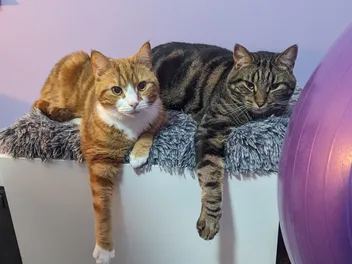
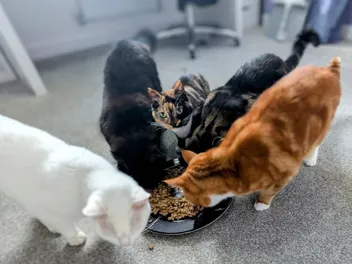
Hi, I’m Dr. Karyn! Read my introduction to learn more about me and meet my five hilarious cats: Clutch, Cyril, Alex, Zelda, and Zazzles.

Acupuncture has been around for thousands of years; at least as far back as 300 B.C.E. when Chinese emperor Huangdi wrote the text known as “The Yellow Emperor’s Classic of Internal Medicine”, but possibly even earlier.1 The 5300-year-old mummified remains of a man found in the Italian Alps showed tattoo markings and corresponding bone impressions that archaeologists believe may have served as markers for needle treatments, meaning that acupuncture is not just ancient, it may also have multiple origins.

Until recently, most Traditional Chinese Medicine practices were treated with derision by the modern medical community, seen as old fashioned and outdated. So what has changed?

Apart from the thousands, if not millions, of anecdotal success stories, a greater understanding of how acupuncture actually works has allowed this non-invasive technique to find a place in mainstream medicine.

The Basics of Acupuncture

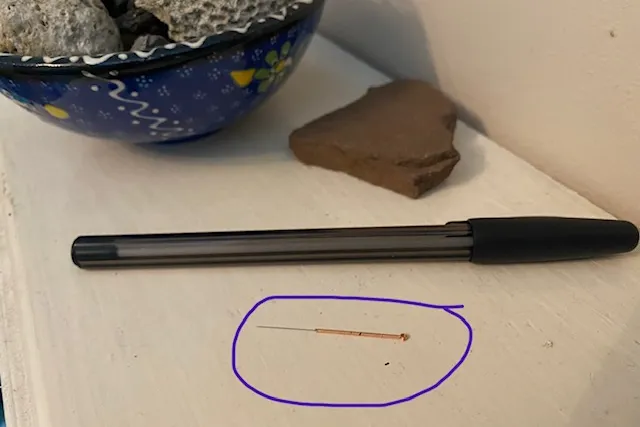
In the briefest possible terms, traditional acupuncture uses ‘dry’ needles placed at certain locations along meridians to manipulate and unblock ‘Qi’ (pronounced ‘chee’) – the body’s life force energy. These meridians correlate to different parts of the body, though not every point along that meridian affects those body parts.

Meridian Abbreviation Meridian Abbreviation
Heart HT Small Intestine SI
Lung LU Liver LR
Stomach ST Gallbladder GB
Kidney KI Bladder BL
Pericardium PC Spleen SP
Large Intestine LI Triple Energizer TE
Extra Meridians
Conception Vessel CV Governor Vessel GV

We now appreciate that meridians may actually link back to tissue differentiation during embryonic development, while Qi could be another way of describing nerve pathways, tissue planes, and energy transfer. From here, it becomes easier for dedicated scientists to appreciate how this ‘alternative’ therapy might actually work.

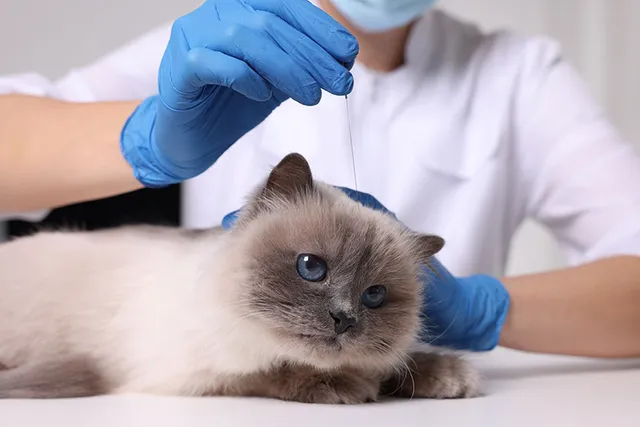
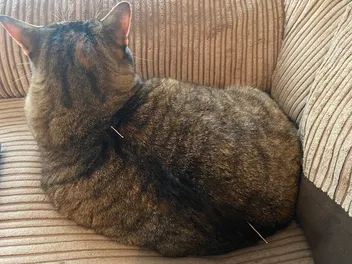
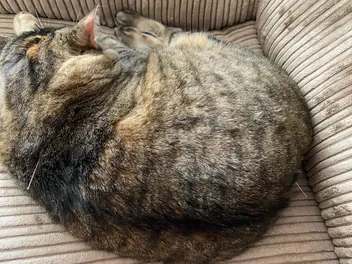
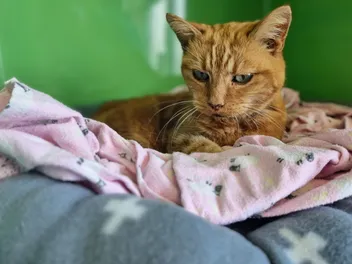
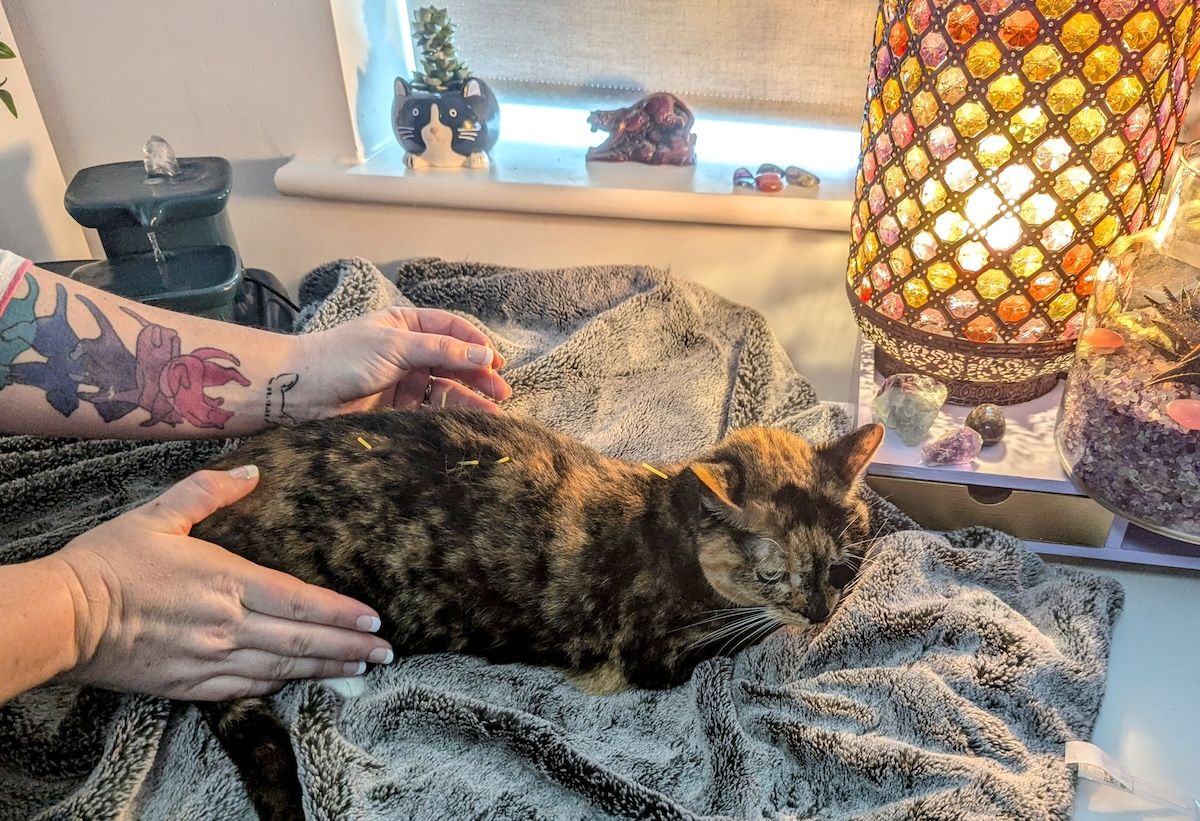
Zazzles relaxing into acupuncture

Embracing Holistic Treatment for Pets

After attending a course on veterinary acupuncture, I became obsessed with using this technique in practice. Although most of my acupuncture patients were of the canine variety, feline acupuncture arguably has a greater potential for success. Cats have been found to respond more strongly to acupuncture, and there have been promising results in its use in managing feline asthma.

I have been using acupuncture at home on my Labrador, Bailey, whose joints are feeling their age. Recently, I decided to introduce Zazzles, our timid tortie, to this treatment and I was astounded with the results! When we rescued Zazzy eight years ago, we became aware of a poorly healed fracture on one of her hind legs. She has coped with this very well, but recently she has started to limp, so we decided it was time to get started on a pain management plan. Being quite a nervous girl, I wasn’t sure how she would respond to this unusual form of stimulation, but far from being afraid, she actually rolled over purring!

It’s a little too soon to know how well the treatments are going to work, but at least I know that there’ll be no problem repeating them!

Don’t Try This At Home!

Obviously, acupuncture isn’t something you can do at home on your own pets, but you can try some acupressure and massage.

As the name suggests, acupressure involves using targeted pressure over specific areas, such as those used for acupuncture, to achieve similar results without a needle. It is a technique that just about anyone can use to help relieve tension, provide pain relief, and soothe their pets at home. In addition, if you have a cat that suffers with respiratory issues like asthma, there are a couple of pressure points you may like to try:

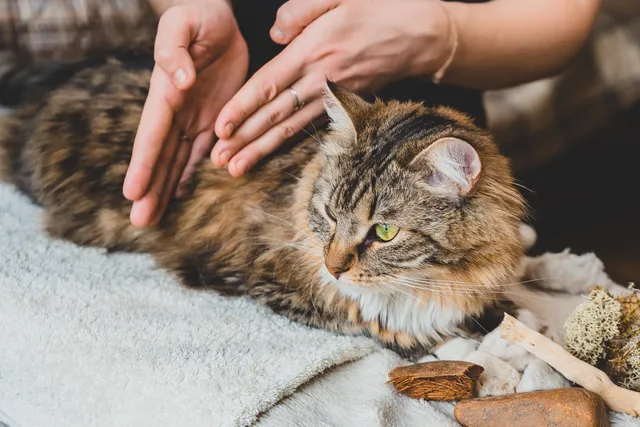
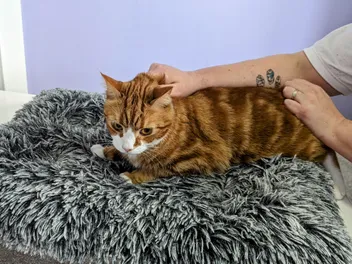
Acupressure points with Alex

Massaging a cat is pretty straightforward, with very little difference between it and regular stroking. The main thing to be aware of is applying firmer pressure either side of the spine with the palm of your hand, as well as focusing on the neck and shoulders. The only trouble you’re likely to run into is when you try to stop!

Feline massage is all about flat pressure and slow strokes.

If you think your cat may benefit from acupuncture, talk to your vet. Not all vets and veterinary practices will offer this service, so you may need to look around. Rest assured that, far from being a stressful experience, most cats find acupuncture to be quite relaxing!

This article is a part of Dr. Karyn's series with her five hilarious cats.

Dr Karyn's paw print signature

Want content like this delivered to you?

Sign Up For Our Newsletter

News, insights, expert advice, and everything cat

* By submitting, you agree to our Terms & Conditions and Privacy & Cookies Policy.


How useful was this post?

Click on a star to rate (you can leave written feedback after clicking submit)

Help us improve Catster for pet parents!

Your feedback really matters.

What did you like about this post? Also how can we improve it?

Join the conversation

Leave a Reply

You’re very welcome to leave a comment or question. Please know that all comments must meet our community guidelines, and your email address will NOT be published. Let’s have a positive and constructive conversation.


Catster's Digital Magazine is Back!

Vet-approved health & behavior advice

Real cat stories & community features

The Original Space Invaders – Why Zero Respect for Personal Boundaries Is a Good Thing

Cats have a reputation for being independent, and in many ways they are. But anyone who has tried to work at a laptop...

How Cats Are Helping to Cure Cancer

When most people think about medical breakthroughs, they picture scientists in laboratories and clinical trials involving human patients. Few would imagine that the...

Ask Dr. Paola – My Cat Loves Eating Grass, But It Makes Her Vomit! (June 29, 2026)

Welcome to our “Ask Dr. Paola” series, where every Monday we bring expert advice straight from Dr. Paola Cuevas (MVZ) to help our...

Learning to Speak Cat with Anthony Smith

Many cat lovers know me through Learn to Speak Cat and Cattitude – Doggonit, cartoons that explore the often mysterious, occasionally mischievous, and...

More related

How to Tell Your Cat’s Age in Human Years (With Chart, Vet-Reviewed)

Nearly 50 million American households have at least one cat.1 It’s easy to see why they are so popular. Felines are more independent...

Stomach Cancer in Cats: Our Vet Explains the Causes, Signs & Care

Your cat is losing weight and withdrawn, so you schedule a veterinary appointment. Your veterinarian suggests several diagnostic tests that point to your...

10 Best Cat Bowls in the UK in 2026 – Reviews & Top Picks

Buying a cat bowl can seem like an ordinary, simple task. However, as well as deciding on the best material and whether you...

Napoleon Cat Breed Info: Pictures, Facts & Traits

The Napoleon cat (aka The Minuet) is a wonderful companion. Originally named after the French conqueror for their short legs, this breed is...

Keep reading

Can Cats Eat Cornbread? Health Facts & FAQ

It’s a constant temptation to occasionally give our cats some of our food just as a little treat. After all, a lot of the time, they seem to love our food as much as we do! Unfortunately, not all people...

Can Cats Eat Cornbread

How to Calm a Scared Kitten: 7 Vet-Reviewed Methods

Bringing home a new cat is a magical time for you, but have you ever stopped to think about how it might appear to your kitten? After all, they’ve just been carried into a strange new environment by an unknown...

scared kitten hiding

8 Common Litter Box Issues & How to Fix Them

It’s a common myth that cats always use their litter boxes without issue. For the most part, cats indeed learn to use a litter box rather quickly, but this doesn’t mean that you’ll never encounter problems with your cat going...

orange cat beside litter box

Do Cats Eat Squirrels? Vet-Verified Risks & Considerations

Cats are quirky animals, and you never know what they are going to do next. They don’t follow the pack or do what humans want them to do. So, even when we provide our kitties with an abundantly nutritional diet,...

squirrel-in-the-trees

How Long to Quarantine a Cat With Ringworm? Vet Reviewed Facts You Need to Know

If you’re petting your cat and notice a strange, circular sore on its skin, you probably wonder what it could be. This round lesion is a tell-tale sign of a ringworm infection, which is a zoonotic fungal infection common in...

tired sick cat lying on bed

When Do Kittens Open Their Eyes? Vet-Reviewed Facts & FAQ

Did you know that kittens are born deaf and blind? In fact, newborn kittens enter the world with their eyes entirely shut, and they don’t open their eyes until they are 1-2 weeks old. In this article, we will discuss...

Snowshoe Lynx Point Siamese kittens

Can Cats Eat Salmon Skin? Vet Reviewed Facts & Health Guidelines 

Salmon is an all-time favorite treat for many cats thanks to its tantalizing aroma, but can cats eat salmon skin? As long as the salmon is thoroughly cooked (plain, not with seasonings) and your cat doesn’t have a sensitive stomach,...

Can Cats Eat Salmon Skin

How to Keep Cat Claws Dull Safely: Vet-Approved Tips

What’s that old saying—when you love someone, you have to love everything about them. Well, that’s definitely put to the test when you see your cat scratching. When you own a cat, you have to accept that scratching is normal...

cat claws when kneading

Love Cats? So Do We! Join the Catster Community

Stay informed with expert pet care insights delivered straight to your inbox! Discover professional guidance on animal behavior, feeding tips, trusted product picks, and much more.


Sign up for the Catster Email Newsletter

Stay informed with expert pet care insights delivered straight to your inbox! Discover professional guidance on animal behavior, feeding tips, trusted product picks, and much more.