Acupuncture for Asthma in Cats: Pros, Cons & Effectiveness (Vet Answer)

In this article
Feline asthma is a relatively common condition, one that is possibly more common than we realize. There are some breeds, such as the Siamese, that may be more susceptible to this condition, but any breed can be affected, with most diagnosed around the age of 4–5 years old. For many cats, the clinical signs of asthma are mild and can be controlled with medication. For others, this inflammatory airway disease can be debilitating and life threatening.
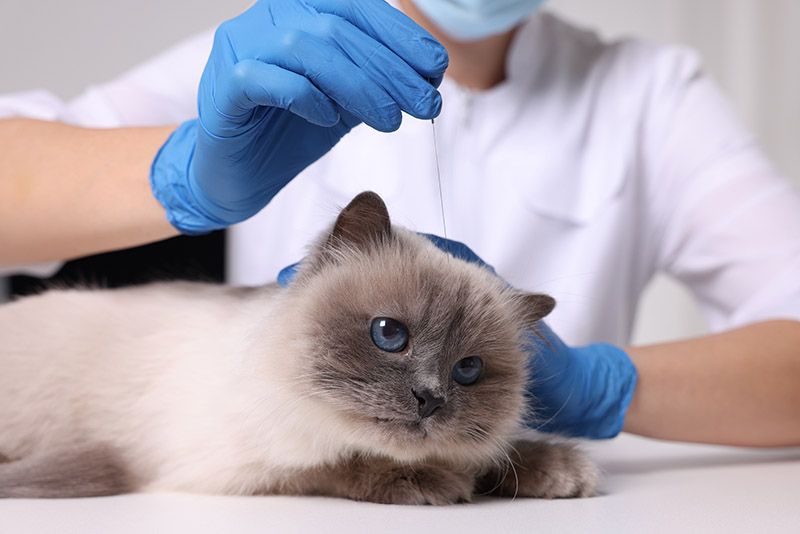
There have been many advancements made in the treatment and management of feline asthma, but some owners are looking for help from a more ancient method: acupuncture.
A practice widely used in ancient Chinese medicine for over 3,000 years, acupuncture may actually have even earlier origins, with the well-preserved glacier mummy more than 5,000 years old showing signs suggestive of a needling procedure.
Today, the therapeutic benefits of acupuncture are being recognized and incorporated into mainstream human therapies, and now, veterinary medicine too. But can it really help treat asthma? Let’s find out.

What Is Feline Asthma?
Although not strictly an allergy-based condition, the easiest way to think about asthma is by picturing an allergic reaction. The first time an allergen comes into contact with the lungs, there is a mild reaction, and in most individuals, the reaction does not get any worse. The immune system of some individuals will have an exaggerated reaction, becoming hypersensitized to the allergen, so that the next time it encounters it, the reaction is excessive, resulting in swelling from all the inflammatory cells that are flocking to the area.
When this happens in the lungs, the smaller airways become narrowed, sometimes blocked, by the swelling and mucous secretions, making it extremely difficult to draw enough oxygen deep into the lungs.
Although allergens like dust and pollen are the main triggers for asthma, it is likely that episodes may also be brought on by overexertion or by inhaling noxious fumes.
Asthma is difficult to diagnose, as there is no specific test for it, and there are a number of other conditions that produce similar clinical signs. Diseases like bronchitis, pneumonia, certain parasites, and even hairballs all need to be ruled out before a diagnosis is made, as the treatment for asthma can make some of these conditions worse.
Corticosteroids to suppress the hypersensitivity reaction are the mainstay for asthma treatment, either given as oral tablets, inhaled, or both. Bronchodilators may also be used to help open up the smaller airways. Minimizing environmental allergens with frequent vacuuming, air purifiers, and washing of bedding is also important for managing the disease.

How Can Acupuncture Help Treat Feline Asthma?
Acupuncture has become increasingly popular as an adjunctive therapy for treating and managing a range of conditions, most notably pain and arthritis. However, there is scope for using this method for systemic disease.
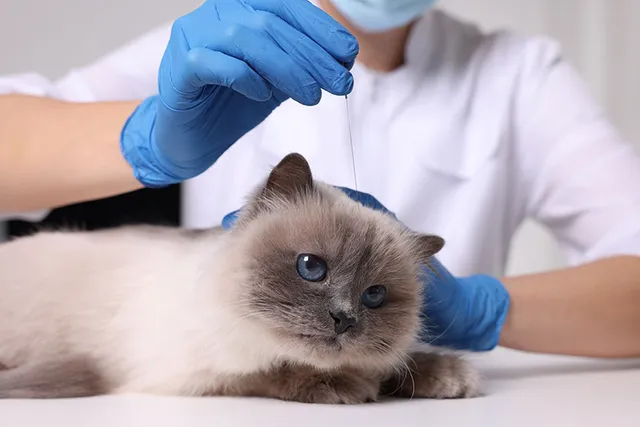
When used in a veterinary setting, acupuncture often uses a combination of the traditional acupuncture points, which correspond to certain physiological and anatomical features, as well as more direct tender or trigger points, which are more applicable when treating pain.
Obviously, we can’t be introducing needles into, or even close to, the lungs, so the principle behind using acupuncture to treat asthma is by using points along pathways, called meridians, that correlate to distant structures. The primary aim of acupuncture when treating an asthmatic patient is neuromodulation, leading to a reduction of the hypersensitivity reaction that causes the clinical signs.
Although scientific research in this area is not extensive, acupuncture is becoming increasingly recognized as an effective treatment to incorporate into the medical management of the feline asthmatic. Numerous documented cases spanning the last 30 years have demonstrated that acupuncture has been used successfully in the management of feline respiratory disease, including asthma, resulting in fewer episodes of respiratory distress and reduced doses of medication.

Benefits
What Are the Benefits of Using Acupuncture for Asthma in Cats?
Downsides
What Are the Downsides of Using Acupuncture for Asthma in Cats?

Conclusion
Once dismissed as superstitious alternative medicine, the measurable benefits of acupuncture are being increasingly recognized and incorporated into modern medical techniques in both human and veterinary settings. Cats tolerate the application of acupuncture surprisingly well, often showing strong, positive responses to its use.
With minimal risks and the potential to help manage numerous health problems, acupuncture is certainly an option worth exploring. Corticosteroid therapy remains the cornerstone of asthma treatment, but as an immunosuppressive drug, it carries the risk of harmful side effects when used at high doses for long periods. Although we do not recommend replacing medication with acupuncture, if its use allows us to manage the asthmatic cat with lower doses of steroids, this is something to be considered.
Featured Image Credit: New Africa, Shutterstock
Expert cat care, straight to your inbox
News, insights, and useful advice, delivered to you.

No spam — unsubscribe anytime.
By signing up, you agree to our Terms & Conditions and Privacy & Cookies Policy.
How useful was this post?
Click a star to rate. You can leave written feedback afterwards. (We read all feedback.)
Dr. Karyn Kanowski BVSc MRCVS (Veterinarian)
Dr. Karyn comes from Queensland, Australia, and has lived in the UK for the past 10 years. In 2010, she graduated from The University of Queensland School of Veterinary Science and also has a Bachelor’s degree in Zoology. She is passionate about using evidence, experience, and owner collaboration to provide the best solutions for pets, and believes in making reliable information about animal health accessible to all. Dr. Karyn shares her home with five cats, four dogs, and one husband. When she is not in the scrubs, she spends her time writing, gardening, and cleaning up pet hair!