Sometimes I Scruff: Thoughts On a Controversial But Practical Technique

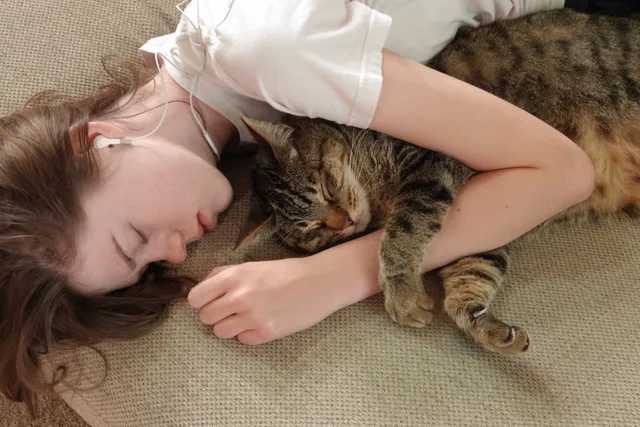
Hi, I’m Dr. Karyn! Read my introduction to learn more about me and meet my five hilarious cats: Clutch, Cyril, Alex, Zelda, and Zazzles.
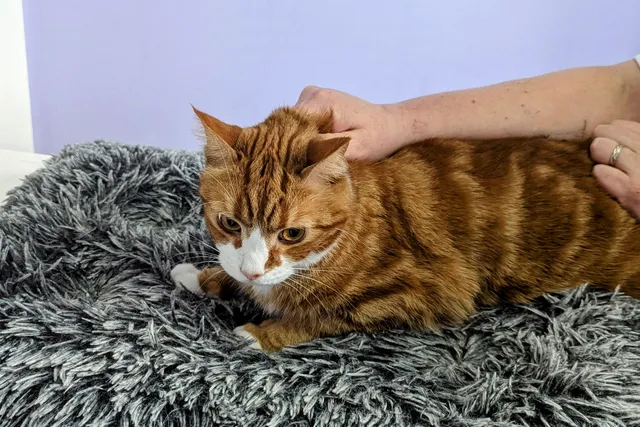
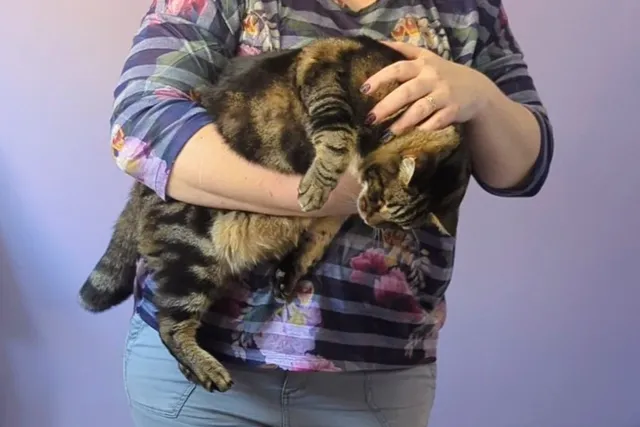
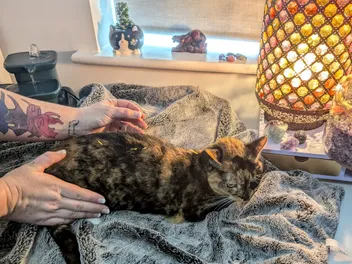
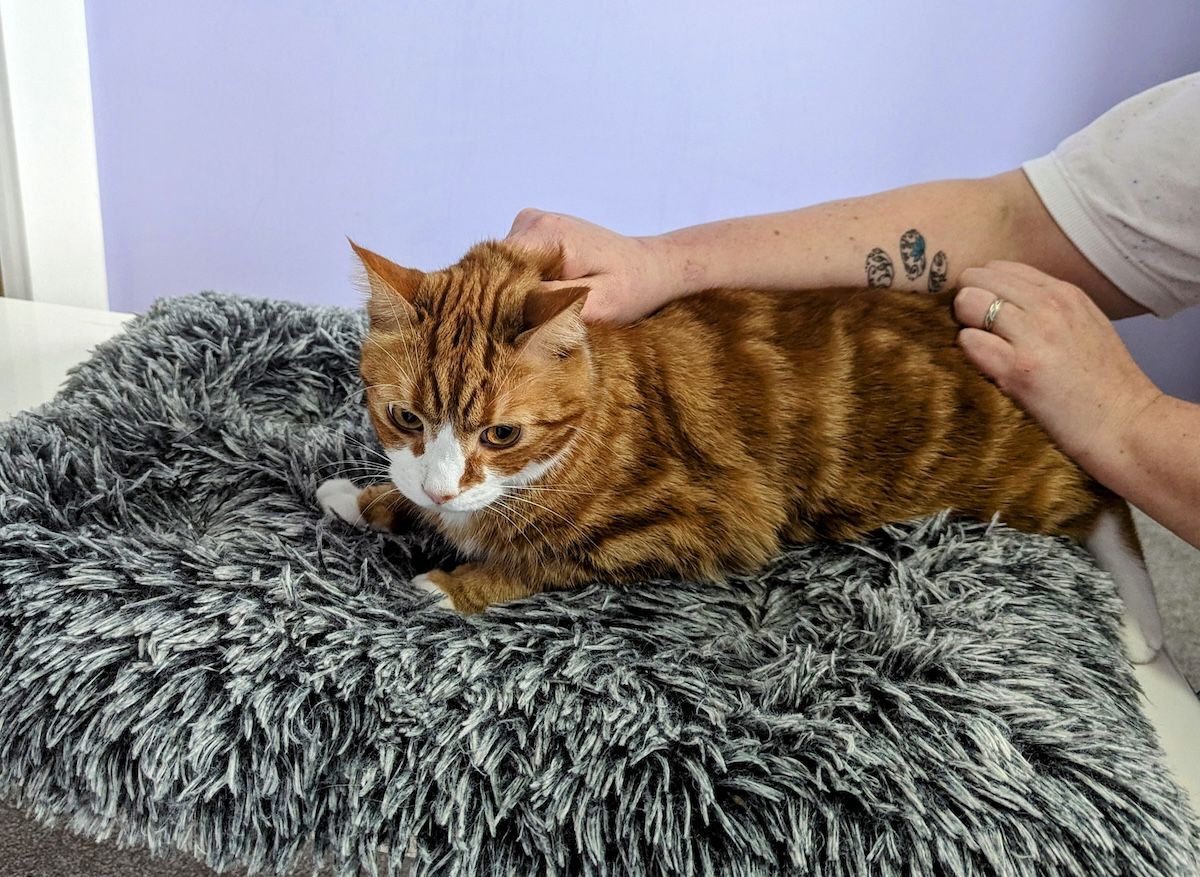
Disclaimer: The images used in this article are to demonstrate scruff-holding. The cats in the images have been handled carefully, spoiled rottenly, and given ridiculous amounts of chicken for agreeing to pose for me. They were given space and opportunity to leave whenever they had enough, and their welfare remains my top priority.
It wasn’t all that long ago that it was commonplace to see cats held, restrained, even carried by the scruff of their neck. We would see mother cats carrying their kittens in this way, so how could it possibly be harmful? And for the most part, our cats didn’t seem to mind…or did they?
In recent years, animal behaviorists have come to realize that rather than making them feel calm and relaxed, picking a cat up by the scruff may actually trigger feelings of fear, stress, and helplessness, resulting in the floppy reaction we often see. Sure, this might make them easier to handle, but does that make it okay?
There are a number of movements and organizations aiming to minimize or stop the use of the scruff hold in veterinary practice, and while this is an admirable goal, it is not always realistic or practical. Some animal workers have vowed to never scruff a cat, no matter the circumstances, which I often found challenging in practice. Even the International Cat Care organization acknowledges that using a scruff hold to restrain a cat is sometimes necessary, as described in their Scruff Free Campaign Pledge:
"International Cat Care’s ‘scruff-free’ campaign is focused on avoiding the routine use of scruffing as a means of restraining a cat, which unfortunately is still practised all too frequently. Our campaign refers specifically to the routine use of scruffing when handling cats. There may be exceptional circumstances in which there is a real and imminent risk of injury to a person where very brief heavy restraint, such as scruffing, may be necessary. However, these occasions should be rare and exceptional, never ever routine."
What I often found frustrating was when I needed to quickly and safely perform a procedure, give an injection, or examine an injury on a fractious, aggressive cat, and my supporting staff would flat-out refuse to use a scruff hold. This would inevitably result in a more protracted, stressful, and dangerous approach to a problem that could have easily been addressed by briefly applying an effective form of restraint.
So although it may not be popular, I strongly believe that, in certain circumstances, a scruff hold is the best and safest form of restraint.

The Lesser of Two Evils
I don’t necessarily believe that ‘the ends justifies the means’ when it comes to scruffing a cat, but I do believe that it is sometimes the ‘lesser of two evils’. Yes, scruffing a cat may be an unpleasant cause of stress, discomfort, and helplessness for a cat, but if the alternative means:
- Getting the cat back in the following day after being given a sedative at home
- Spending more time trying to towel wrap an already-distressed feline
- Risking injury to cat or human
- Using sedatives or general anesthetic for something that should take less than 30 seconds
- Costing an owner hundreds of dollars to remove a thorn, remove a loose claw, or remove a small patch of matted fur
- I will choose the option that causes the least amount of distress to all involved. And sometimes, that means I scruff.
When Is Scruffing Okay?
Rather than have a blanket rule of ‘no scruffing, ever’, I would much rather have some guidelines laid out so that people know when scruffing is and isn’t appropriate, and how to safely scruff hold a cat. So that’s what I’m going to do.
| Do NOT Scruff | Consider Scruffing |
| If it is more convenient For grooming or clipping claws For anything taking longer than around 30 seconds If the cat violently reacts to having the scruff area handled If there is injury to the scruff region To carry a cat from one place to another To make medicating easier | If other cat friendly handling techniques have not been, or are unlikely to be, successful If the cat is at risk of injuring itself or others If the assessment or procedure will be very brief If you need to quickly move the cat to a safe place (cage/carrier) If all other methods of giving medication have failed |
How To Correctly Scruff Hold A Cat
If you are not confident and swift in your approach, you are unlikely to be successful, so make sure that you are ready to hold your cat firmly, and ensure you have your next step already planned.
If possible, start by rubbing the cat’s scruff. This avoids startling them by just grabbing the scruff, and allows you to assess whether or not they are particularly sensitive in this area. If the cat resents being touched over their neck or shoulders, you should not attempt the scruff hold, as this will only make the situation worse.

For the scruff-hold to be effective, you need to have a firm grip of a handful of the scruff - do not pinch the skin, or just pick up a tiny section. This will be more painful, and will not give you any control.
There are three main positions you will then need:
The carry: Never lift a cat by the scruff without placing a hand under their chest or behind their bottom. If you can do so safely, cradle them against your body to give them some extra security.

The hold: This is when you are restraining the cat to allow someone to do or check something quickly or safely. Keep the head out of the way of the other person, and use your other hand to secure the front legs at the level of the elbow.
The medicate: Ideally, this should also be a 2-person maneuver, with the second person keeping the front legs from getting involved. Use your non-dominant hand to hold the scruff and tilt the head back as far as possible. This will make it easier to pull the lower jaw down and administer the medication.

This method of medicating a cat should only be used for short-term or one-off treatments. If your cat is on long-term medication, scruffing them on a daily basis will only reinforce their resentment towards being medicated, so you need to find an alternative method.
Sometimes I Scruff
Not everyone will agree with me, and that’s okay. But I do think that sometimes we can cause more stress and harm by avoiding the scruff hold, when briefly using this unpopular technique is actually the best method.
I absolutely agree that it should not be used often, or to carry out lengthy procedures, but I do think that it is more practical and realistic to say avoid using the scruff hold, rather than saying never.

This article is a part of Dr. Karyn's series with her five hilarious cats.
Expert cat care, straight to your inbox
News, insights, and useful advice, delivered to you.

No spam — unsubscribe anytime.
By signing up, you agree to our Terms & Conditions and Privacy & Cookies Policy.
How useful was this post?
Click a star to rate. You can leave written feedback afterwards. (We read all feedback.)
Dr. Karyn Kanowski BVSc MRCVS (Veterinarian)
Dr. Karyn comes from Queensland, Australia, and has lived in the UK for the past 10 years. In 2010, she graduated from The University of Queensland School of Veterinary Science and also has a Bachelor’s degree in Zoology. She is passionate about using evidence, experience, and owner collaboration to provide the best solutions for pets, and believes in making reliable information about animal health accessible to all. Dr. Karyn shares her home with five cats, four dogs, and one husband. When she is not in the scrubs, she spends her time writing, gardening, and cleaning up pet hair!