What Causes Sudden Fever in Cats? Our Vet Explains Causes, Signs & FAQ

One of the most frustrating things we face as pet owners is when our furry family members don't feel well, especially when we don't know why. Fevers can be especially difficult to diagnose and treat because there often isn't an external sign of the problem beyond a lethargic kitty. Let's examine what can cause a fever in our cats and what you can do about it.

What Is a Fever?
A fever, at its core, is simply an elevated body temperature. It can be hard to tell if a cat has a fever simply by looking at them or touching them because their normal body temperature is higher than ours. You can expect your healthy cat's temperature to be between 100.5 and 102.5 degrees Fahrenheit (38.1 and 39.2 degrees Celsius) 1.
A fever is a normal phenomenon where the body gets exposed to something that triggers an inflammatory response. Many pathogens can be destroyed with an elevated temperature, and your cat's immune defenses may work better, but you can also have problems develop, ranging from lethargy to widespread blood clotting issues.
What Causes Sudden Fever in Cats?
Unfortunately, there's no one-size-fits-all reason for why cats develop fevers. Depending on your location, certain infections are more common than others, such as specific fungal or viral infections often cropping up in places.
Some of the major categories for causes of fevers include:
Bacterial infections may be one of the more common causes of fevers worldwide. Your cat could have a bacterial infection in their bladder or kidneys, an infected wound, or even a tooth root abscess.
Viral infections in cats may wax and wane, which means the signs come and go. They can come on quite suddenly. Feline leukemia virus (FeLV), feline infectious peritonitis (FIP), and feline immunodeficiency virus (FIV) are all important considerations in a febrile cat.
Certain parasites can trigger a fever. Fleas and ticks carry different illnesses, such as Cytauxzoonosis. While many cats are asymptomatic for Toxoplasmosis, it can cause disease in cats and people.
If your cat's immune system starts to attack itself, it can trigger a fever. Immune-mediated anemia and thrombocytopenia can be devastating.
It's important to note that sometimes cats will have a transient fever. Stress or trauma will sometimes elevate your cat's temperature. For example, if your cat feels great at home and your veterinarian detects a mild fever during a physical exam, it could be nothing to worry about.
Vaccines can cause fevers. This change is normally temporary and usually goes away soon after your cat is vaccinated, but you'll want to mention it to your veterinarian for further evaluation.
One term you might hear is “fever of unknown origin”. This condition is a fever with no readily discernible cause.

Why Does My Cat Have a Fever?
If you're suspicious that your cat might have a fever, it's important to look at what they may have been exposed to. Do they go outdoors, especially unsupervised? Are they on flea and tick prevention, even if they're indoor kitties?
You'll want to contact your veterinarian for an appointment as soon as possible or speak to your local emergency hospital about getting an exam.
Signs of Fever in Cats
You might touch your cat and think they feel warm, but that's not a very good, effective way to determine a fever since cats are naturally warmer than we are. You'll want to look for certain changes, including:
- Decreased appetite
- Decreased energy
- Weakness
- Tachypnea (elevated respiratory rate)
- Tachycardia (elevated heart rate)
- A delayed skin tent (gently lifting the skin on the neck and setting off it rebounds quickly when released)
- Pale gums
- Visible parasites
- New swellings could be a mass, abscess, lymph nodes, or something else entirely

How Do I Care for a Cat With a Fever?
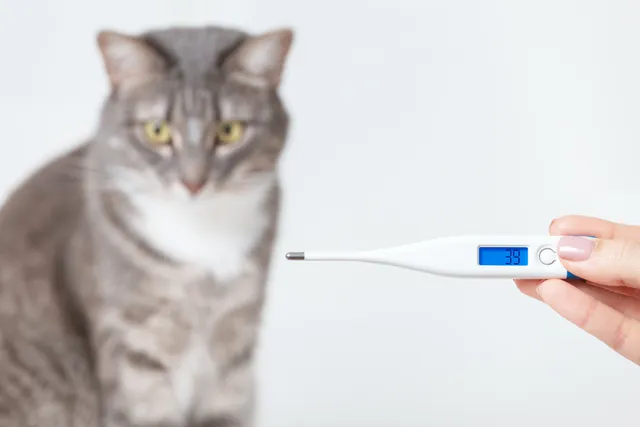
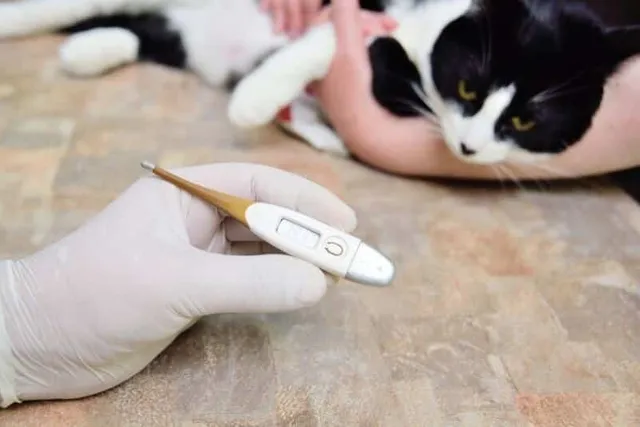
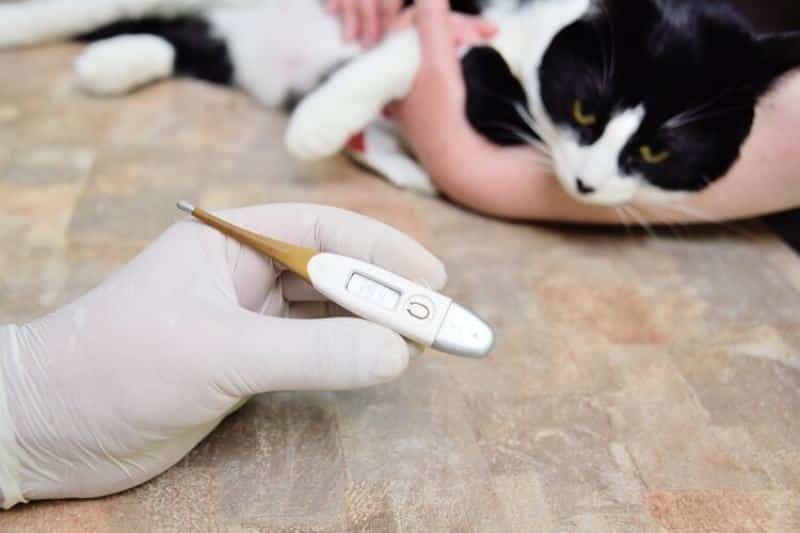
You'll need to take your cat's temperature to determine if your cat has a fever. While you can do this at home, having your veterinary team perform this test is often safest. The most surefire way to take a temperature is rectally with a thermometer; most cats resist that. You do not want to damage their delicate rectal tissues accidentally.
Your veterinarian will examine your cat and look for some of the signs we associate with a fever, but they will also be looking your cat over from nose to tail for any signs of abnormalities. They may focus their exam on one area where they detect something unusual. In many cases, your vet will recommend certain tests:
- Blood work helps assess red and white blood cell changes, as well as biochemical shifts
- Feline leukemia/FIV testing to rule out these infectious agents
- A urinalysis helps check for evidence of a UTI or kidney infection
- X-rays or ultrasounds can image organs for size changes, stones, fluid accumulations, and more
- Cultures may look for bacterial infections
These tests are not all-inclusive; sometimes, your veterinarian may still be left without a concrete answer.
Treatment will depend on what your veterinarian can determine or suspect. Your veterinarian will outline supportive care, such as fluid therapy (under the skin or IV) or dietary management.
An anti-inflammatory medication may be utilized to help control your cat's temperature. In some cases, steroids are necessary, such as autoimmune conditions. With infections, a non-steroidal anti-inflammatory drug might be used.
Antibiotics, antivirals, and antifungal medications all have their use, depending on the problem. Talk to your veterinarian about any difficulties you might face in medicating your cat. Do you need a flavored liquid compounded by a pharmacy to help you give your cat an antibiotic, or are oral medications entirely out of the question? Your vet might have an injectable option. For example, Convenia is often used as an antibiotic for certain bacterial infections in cats.
You might need to stimulate your cat to eat. You can try adding tuna water to your cat's food. Your veterinarian might suggest a high-calorie prescription diet that is tasty and nutritious while your cat doesn't feel well. There are also appetite stimulant medications, such as Elura.
Frequently Asked Questions
Is a Fever in Cats an Emergency?
Yes, a fever is considered an emergency in cats. Prolonged fevers can contribute to bone marrow suppression, blood clotting disorders, and brain swelling. Your veterinarian needs to assess your cat to help determine if there is a small problem that your cat's body will take care of with minimal support or something requiring hospitalization and round-the-clock care.

Can a Cat Recover from a Fever on Its Own?
In some cases, your cat's elevated body temperature will resolve on its own. This case is especially true for transient changes such as stress. Unfortunately, other conditions need immediate medical treatment.
Conclusion
There are a variety of reasons for sudden fevers in cats. But no matter the reason, it can be a scary experience if you do not know what to do. If you suspect a fever, you'll want to talk to your veterinarian as soon as possible for an exam and possible diagnostics.
Related Reads:
Sources
Featured Image Credit: Evgeniy Kalinovskiy, Shutterstock
Expert cat care, straight to your inbox
News, insights, and useful advice, delivered to you.

No spam — unsubscribe anytime.
By signing up, you agree to our Terms & Conditions and Privacy & Cookies Policy.
How useful was this post?
Click a star to rate. You can leave written feedback afterwards. (We read all feedback.)
Dr. Samantha Devine DVM (Veterinarian)
Samantha Devine is a practicing veterinarian who loves to share her experience with animal species and their health. Whether it's a guinea pig question or a pressing matter about something your cat ingested, she strives to provide clear answers. She is passionate about preventative care and firmly believes in the old adage, "An ounce of prevention is worth a pound of cure."
Dr. Devine has been practicing veterinary medicine for over 12 years and has spent a great deal of that time writing online to educate pet owners. In addition to general practice small animal medicine, she has worked with horses. zoo animals and aquatic species. She enjoys all aspects of preventative medicine, from nutrition to vaccines.
Dr. Devine received her degree from the Virginia Maryland Regional College of Veterinary Medicine.