What Do Cats Think of Humans? Inside the Mind of Cats (Vet-Verified)


In this article
Cats are curious and mischievous little creatures. Has yours ever stared at the wall with such voracity that you’re confident they’re seeing something you can’t? Or how about when they activate their turbo boosters and peel out of the litter box at top speed, scattering litter particles throughout your home? While we can’t know for sure the driving forces behind such behaviors, experts can make a guess, which is what they often do when it comes to feline behaviors and emotions.
If you’re like most cat owners, you’ve probably wondered what your kitty thinks about you. Do they love you as strongly as you love them? Do they think of you as their servant? While experts cannot say for sure what your cat thinks of you, they can make educated guesses, and the consensus is that cats form social bonds with their human caregivers that resemble the relationships they form with familiar cats. Read on to learn more about what science has to say about the inner workings of a cat’s mind.

What Does My Cat Think of Me?
Experts in feline behavior have differing opinions about what our cats think of humans.
Cats Don’t Treat Us Differently
John Bradshaw, the author of Cat Sense, recently shared with National Geographic that no research currently shows that cats have a separate box they put us in when they communicate with us 1. Dogs, on the other hand, have been thoroughly examined, with research showing they view humans differently than they do themselves. When dogs see a human, their behavior changes right away. The way they play with their owners is very different from the way they play with other dogs.
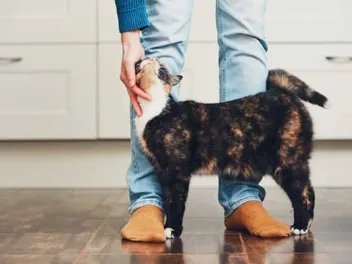
Bradshaw says that cats know we’re bigger than them, but they don’t change their behaviors much when they socialize with us compared to communicating with other cats. For example, the behaviors they engage in with us—walking with an upright tail, rubbing at our legs, and grooming us—are the same things cats do to one another.
This has led some researchers to suggest that cats may interact with humans in ways similar to how they interact with familiar cats

Cats Develop Mother/Baby Attachments With Their Caregivers
A 2019 study found that cats can form attachment styles toward their caregivers that are comparable in structure, but not identical, to those seen in human infants and dogs
Cats Love Their Caregivers
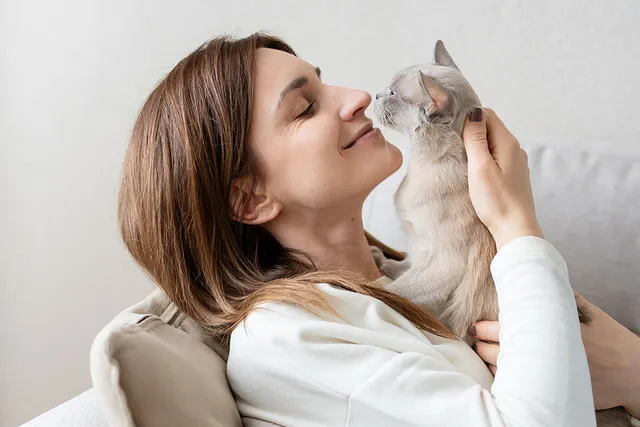
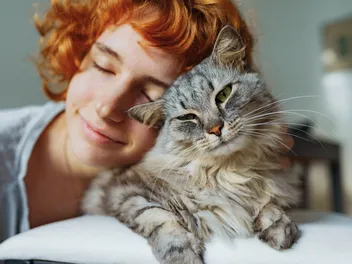
Cats naturally show affection toward their human caregivers, who feed, look after, and play with them. They let us know this in their own subtle (and not-so-subtle) ways. They have their own way of showing affection toward their caregivers through a range of affiliative behaviors, and if you know what to look for, you’ll be able to tell when they’re trying to tell you they love and appreciate you.
Signs your cat loves you include:


What Do Cats Think About?
Cats possess a distinct kind of intelligence, allowing them to navigate their environment, form social bonds, and adapt to daily routines.
The World Around Them
Perhaps one of the most interesting aspects of feline intelligence is their capacity for object permanence. This refers to a cat’s ability to understand that when something (or someone) isn’t in their direct view, it still exists. This was an essential skill for your cat’s wild ancestors, who relied on their hunting skills for survival. Giving up on the hunt because the prey disappeared would certainly not have been very beneficial.

Their Humans
While your spoiled kitty likely doesn’t have to hunt for their next meal, their capacity for object permanence will come into play when you’re away from home. They’re, therefore, likely to tThey may notice your absence and respond behaviorally to changes in routine, which some owners interpret as missing them.
The Past
Studies show that cats have a pretty impressive memory. Their short-term memories aren’t particularly useful for long (10 to 30 seconds), though their capacity for long-term memories appears to have repeat value for the future. For example, this study found that a cat’s short-term memory fades within 10 to 30 seconds, and their ability to find hidden objects disappears entirely after one minute.
Cats’ short-term memory varies depending on context, while their long-term memory plays an important role in learning from past experiences.

The Very Near Future
While it’s generally believed that cats live in the present and not in the future, they can still predict what may happen…to an extent.
Cats are creatures of habit, so they sometimes know when certain events will occur based on specific cues. For example, if you have your pet’s food in a particular drawer, they’ll know it’s almost food time when they hear you open the drawer. This is why cats often come running as soon as they hear a can opening; they associate the noise of the lid being peeled back with their meal.
Your cat likely also knows when you leave for work and may also have a rough idea of when you’ll be home.
Why Do We Know So Little About Cat’s Brains?
Dogs are relatively simple to study as they can be toted to a laboratory and remain content being the subject of research. Cats, however, are highly territorial creatures. Their behavior can be modified extensively by the environment they’re in. For example, your kitty may have an entirely different personality at home than they do at the veterinary clinic. The same applies if you move a test subject to a lab—the behavior you’ll see isn’t typically reflective of their normal behaviors.
Additionally, cats are under-researched due to the stigma surrounding them. Cats have been unfairly vilified throughout human history. For example, they were feared and thought to indicate the presence of evil during the 16th century.
Other potential reasons why there are so few cats in research include:
Final Thoughts
Cats tend to interact with humans using the same social behaviors they use with familiar cats. Research suggests they can form meaningful attachment bonds with their caregivers, though these bonds are best understood as feline social attachments rather than direct equivalents to human parent–child relationships
Sources
Featured Image Credit: evrymmnt, Shutterstock
Expert cat care, straight to your inbox
News, insights, and useful advice, delivered to you.

No spam — unsubscribe anytime.
By signing up, you agree to our Terms & Conditions and Privacy & Cookies Policy.
How useful was this post?
Click a star to rate. You can leave written feedback afterwards. (We read all feedback.)
For Chantelle, writing and animals are the two driving forces in her life. Growing up on the Canadian prairies surrounded by pets, she now shares her home with five cats, two guinea pigs, and a bearded dragon. Chantelle, her husband, and their child pride themselves on being dedicated pet parent, even spending a fortune on wall-mounted cat shelves to provide their cats with an indoor jungle gym. When she's not snuggling with her cats or photographing their humorous moments, Chantelle is exploring the Rocky Mountains, rewatching her favorite Netflix series, and reading up on various random subjects.