Do Pets Affect Intimacy Between Pet Parents? 2026 Survey Results
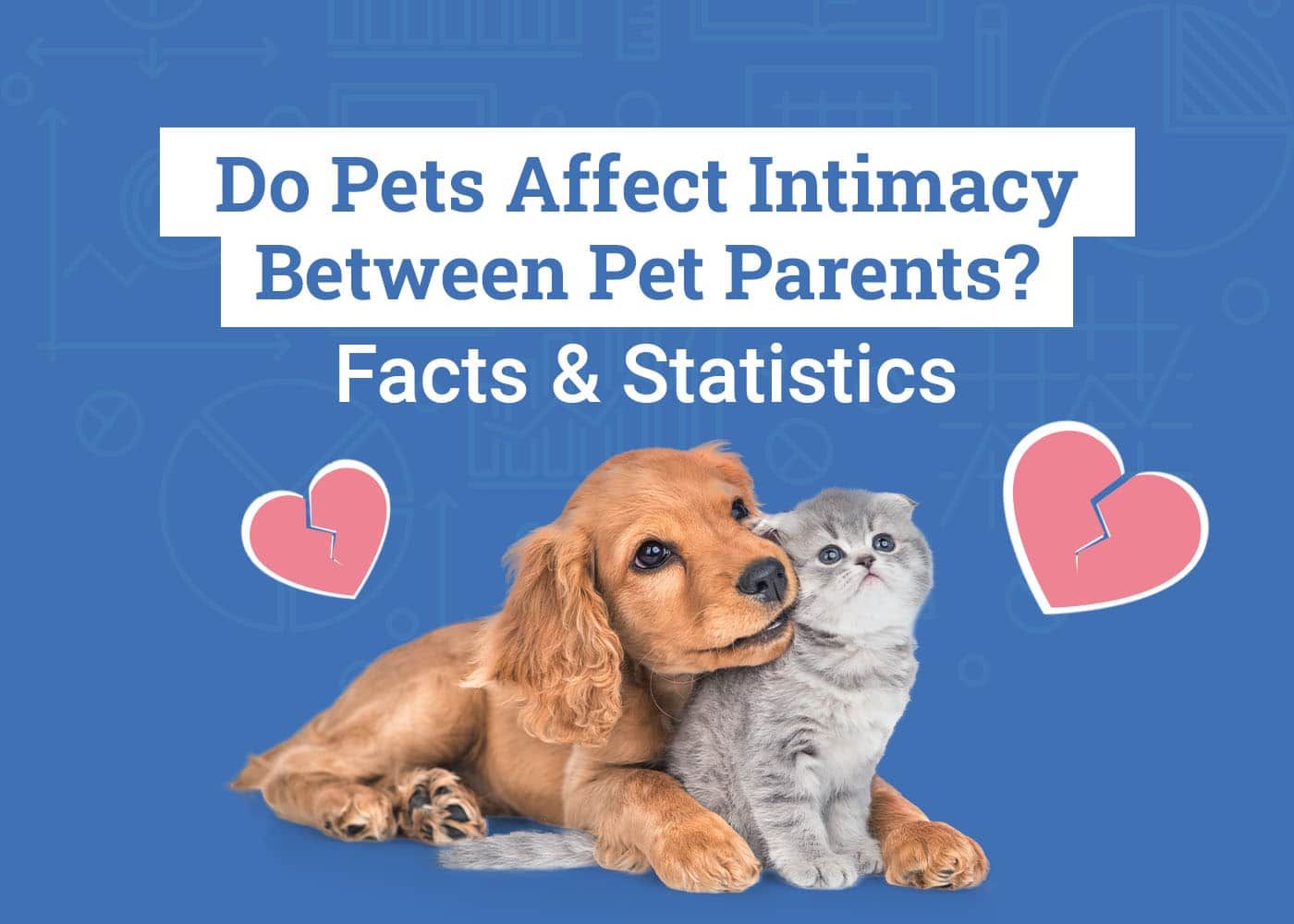
Thanks to several factors, including the recent Covid-19 pandemic, pet ownership worldwide has increased significantly.1 The millennial generation, in particular, leads the charge, with many of these young people initially choosing pet parenthood over human children. Pet owners know there’s no replacing the bond with our animals, but what happens when it’s time to look for love of the human variety?
If you’re a single pet parent looking for love, you might wonder how your dog or cat will impact your relationship with a human partner. While we may not have all the answers you’re looking for, we did take the time to survey over 1,000 pet parents about how their animals affect the intimacy and closeness of their long-term relationships. Keep reading to learn what we discovered and what it could mean for your future love life.

Do Pets Affect Intimacy & Closeness Between Pet Parents?
Only 6% of respondents say their pets frequently hinder or interfere with them and their partner's intimate or alone time.
Almost half, 44%, say their pet never hinders or interferes with them and their partner's intimate or alone time.
One-third of pet parents surveyed said they occasionally feel that their pet receives more love and attention than they give each other.
One out of four pet parents who responded said they rarely feel that their pet receives more love and attention than they give each other.
Only 5% of respondents feel that they are in competition with their pet for their partner’s love, time, attention, affection, care, and appreciation.
Almost one-quarter (24%) of respondents feel that they are not in competition with their pet for their partner’s love, time, attention, affection, care, and appreciation.

The Results: Getting Intimate
1. 6% of respondents say their pets frequently hinder or interfere with them and their partner's intimate or alone time
A small percentage of pet parents surveyed reported that their pets don’t make it easy for their humans to spend special time together! This interference ranged from cats that meow angrily outside the bedroom door while their pet parents are together to those who try to join in on the cuddle session. A few pet parents reported more dramatic incidents, like dogs and cats who tried to bite or scratch one or both human partners during and after alone time.

2. 44% say their pet never hinders or interferes with them and their partner's intimate or alone time.
Happily, almost half of the pet parents reported they could enjoy time with their human partners without interference from their fur kids. And it’s not just because the pets aren’t in the bedroom either. One of the survey questions asked where the pet sleeps within the house.
Most pet owners we surveyed allow their pets to sleep in the bedroom, often in the bed with them. Single pet owners can rest assured that finding a special someone doesn’t always mean giving up their dog or cat snuggles at night.
Who Gets More Love?
3. 33% say they occasionally feel that their pet receives more love and attention than they give each other.
Roughly one-third of those who responded to our survey felt that their pets occasionally attracted more attention than they did in their relationships. However, many also stated they didn’t mind when their partner paid more attention to the pet. Pet parents sometimes felt even more affection toward their human partners when they witnessed their love for a pet.
Some felt it was only appropriate to provide more attention to the pet since they viewed them as their “kid.” Other pet parents admitted to feeling jealous of their partner's attention to the dog or cat, while some reported mixed emotions on the subject.

4. 25% say they rarely feel that their pet receives more love and attention than they give each other
One in four of the pet parents surveyed reported that they rarely feel their pet commands the most attention in their relationship. While we didn’t ask them to specify why this is the case, it could be an interesting area for further study. Does every member of the family receive equal amounts of love, or do the humans not feel like they’re in competition with the pets? What other factors could be at play here?
Stiff Competition
5. 5% of respondents feel that they are in competition with their pet for their partner’s love, time, attention, affection, care, and appreciation.
A small percentage of those who participated in our survey reported feeling competitive with a pet for their human partners’ attention. Likely, these are also those who reported being jealous of the attention their partner gives their pet. Many pet parents admitted that their pets play favorites between them and their partner, which may be a factor in the responses to this question.
Another factor to consider is whether one or both partners entered the relationship with pets. If one partner owned the pet before the other joined the family, the new partner could feel more jealousy or competitiveness. The opposite could be true if the pet instantly falls for the new partner!

6. 24% of respondents feel that they are not in competition with their pet for their partner’s love, time, attention, affection, care, and appreciation.
Slightly less than a quarter of survey participants felt that there was no competition with their pet for attention and love. These two numbers suggest that most pet parents in long-term relationships feel some competition, but the results typically fall between the two extremes. Again, there are likely a variety of reasons for this number.
Are pet parents who describe themselves as “co-pawrents” less likely to feel competition? As we mentioned in the introduction, many millennial couples choose to get a pet before starting a human family. Do couples who adopt or buy a pet together feel less competition for attention?
They say knowledge is power, so if you’re a single pet parent, it appears that you or your partner may feel some competition with your dog or cat. Knowing this ahead of time may make it easier for you to navigate these potential relationship hurdles.
Our Methodology

How We Conducted Our Survey
Our survey was conducted using social media and Pollfish. Of the 1,005 responses, 800 were received on Pollfish, and the remaining 205 came from social media.
Who Did We Survey?
The results of this survey were based on responses from 1,005 U.S. citizens between the ages of 18-65. All are current pet owners who are either married or living with a partner. Dog owners were more heavily represented than cat parents, which may reflect the fact that dogs are the more popular pet worldwide. Two-thirds of survey participants were dog owners, with the remaining 32% identifying as cat owners.

Who Are Their Pets?
A slight majority of pet owners from our survey own female pets— 55%. Forty-seven percent own male pets. Rescue pets were most heavily represented in our data, with 34% of owners surveyed reporting this as the method their pets joined the family. The next most common, at 21%, was receiving a pet as a gift. The other pets were found as strays (15%,) born into the family (12%,) or purchased from a breeder (11%.)
What Did We Ask?
In addition to gathering general information about pets and their parents, we also asked questions to categorize pet owners, such as how long they have owned their pet, which partner is the primary pet caregiver, and how many hours per day they spend with their pet.
Other questions probed the nature of the pet-human relationship, such as who makes financial decisions for the pet and who disciplines the pet. We also asked whether the human partners disagreed about finances, discipline, or where the pet sleeps. Additional survey questions included whether pets behaved differently around human partners and specific incidents of trouble surrounding the pet parents’ alone time.
To help us answer the big dilemma of whether pets affect intimacy and closeness between pet parents, we asked questions such as who the pet parents would rather cuddle with and who they first think about when they get home from work.
Now, The Big Question…
For one of our final questions, we posed a hypothetical scenario; if your human partner issued an ultimatum, would you break up with them or give up your pet for adoption? Overwhelmingly, our survey participants chose their pets over their partners. It seems there really is no comparison to the unconditional love we get from our pets.
Fair Use Statement
Featured Image Credit: Ground Picture, Shutterstock
Expert cat care, straight to your inbox
News, insights, and useful advice, delivered to you.

No spam — unsubscribe anytime.
By signing up, you agree to our Terms & Conditions and Privacy & Cookies Policy.
How useful was this post?
Click a star to rate. You can leave written feedback afterwards. (We read all feedback.)

Elizabeth Gray is a lifelong lover of all creatures great and small. She got her first cat at 5 years old and at 14, she started working for her local veterinarian. Elizabeth spent more than 20 years working as a veterinary nurse before stepping away to become a stay-at-home mom to her daughter. Now, she is excited to share her hard-earned knowledge (literally--she has scars) with our readers. Elizabeth lives in Iowa with her family, including her two fur kids, Linnard, a husky mix and Algernon, the worldʻs most patient cat. When not writing, she enjoys reading, watching all sports, and spending time outdoors with her family.