Cat Brain vs Human Brain: Differences Explained (With Infographic)


In this article
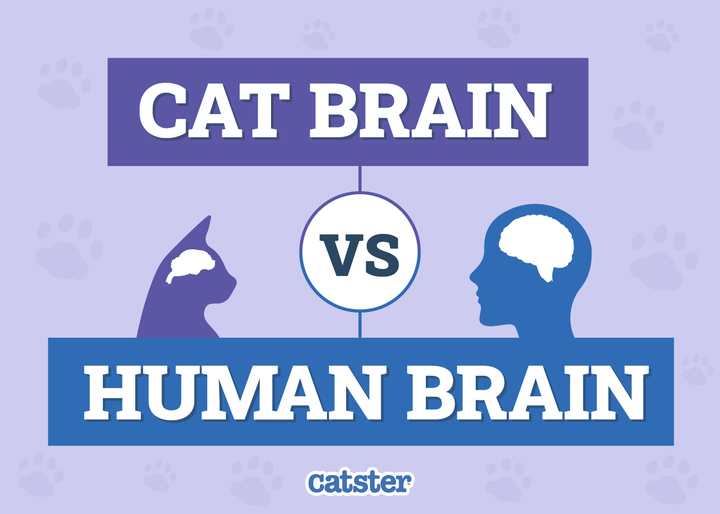
When we see our cat do something that is just too human, we have to wonder what’s going on inside their heads. After all, cats are pretty intelligent creatures, and they have the brains to match. But have you ever wondered what the differences are between a cat’s brain and a human’s brain? This article looks at some of the similarities and differences between our brains and our favorite pets’ brains. Then, we’ll dive a little bit into how intelligent cats are compared to humans and see how they measure up.

At a Glance

Overview of Human Brains

Human Brain Structure
The human brain is made of many parts. There are several different sections, or lobes, of the brain, each with a different function. We use the cerebrum to think, remember things, and make choices. Other parts of the brain are dedicated to processing sensory information. Many of our involuntary processes—like breathing and digesting food—are controlled by the brainstem.
The Senses and the Human Brain
The brain needs information to function properly, and that information comes from our senses. As humans, our brains rely on some senses more than others. Our most important senses are sight and hearing. When we see, our brain interprets the light that enters our eyes to create a three-dimensional “map” of our surroundings in a part of the brain called the visual cortex. However, the human brain is highly flexible and can adapt to changes in senses. For example, people who experience blindness from birth or at a young age still use the visual cortex to “picture” locations. But instead of using it to process sight, they process sound and touch instead.
Overview of Cat Brains

Cat Brain Structure
Cats’ brains have all the same basic parts as human brains, but that doesn’t make them the same. Some parts of the brain—like the olfactory bulb—are larger relative to overall brain size in cats. Others are smaller, including the prefrontal cortex, the part of the brain where humans do much of their thinking and reasoning. Cats have about 250 million neurons in their brains, as compared to 100 billion neurons in a human brain, so they are overall smaller.
The Senses and the Cat Brain
One of the most studied parts of a cat’s brain is their ability to process sensory details. Sensory input comes from all over the body—like the eyes, nose, and nerve endings—and is processed by the brain, just like in humans. But cats rely on sight differently from humans. They have much more developed hearing and smell than we do. They also have developed senses in ways that are different from us. For example, cats have clusters of nerves just under the skin around each of their whiskers. These nerves send enough information to the brain that cats can use their sense of touch to move safely in very low-light conditions. They can create detailed spatial representations of their surroundings with this information and even tell the texture of whatever their whiskers brush against.

How Does the Cat Brain Measure Up?
Of course, brain structure and sensory capabilities are physical properties, but they don’t necessarily tell us how smart a cat is. Intelligence is a tricky thing to gauge, and scientists often break it down into component parts to help gauge what cats can understand. Two of the most commonly studied attributes are problem-solving skills and memory.
Memory
Cats have both short-term and long-term memories, just like humans. Even without getting into a scientific lab, you probably know that your cat is great at remembering locations and routines. Cats often wake up at the same time each day, expect to be fed at the same time each day, and know their humans’ schedules as well as anyone in the house. They’re also great at getting around their house and territory. Cats are also able to recognize words such as their name and other words that interest them and have a receptive vocabulary of several dozen human words. Cats also pass the object permanence test—that means that they can remember that something exists when it’s out of sight and even reason about where an object might have gone if it moves.
Problem-Solving
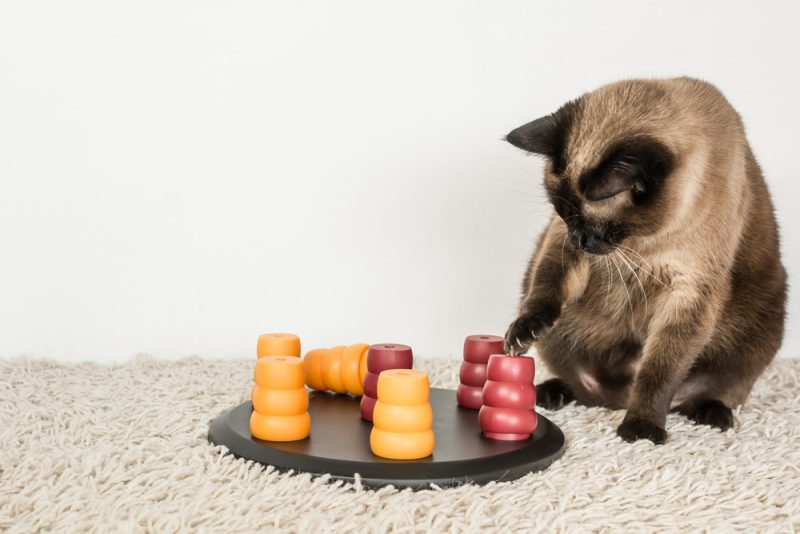
Cats are generally good at problem-solving when sufficiently motivated. One of the most famous ways to study problem-solving in cats is by using a puzzle box. In these studies, a cat or other animal is placed inside a box and is required to take certain actions (like pulling on a string or pushing a button) to get out of the box. Sometimes, food is used as a reward. Then the cat’s put back into the box to see if they’ve learned the secret and can get out faster. Unsurprisingly, some types of puzzle boxes are picked up more quickly than others—for instance, cats are usually able to figure out how to pull a string pretty fast! But overall, these boxes show that cats are capable of associative learning, learn from their mistakes and that some cats are much better than others.
These kinds of tests are all child’s play to a human, of course. Even young children usually have a knack for solving problems similar to puzzle boxes in minutes. Humans can also solve much more complex problems and even solve abstract problems (like pen and paper math) with only a little bit of education.
Conclusion
Cats are constantly surprising us, and their brains are no different. The field of research on cats’ brains is still developing, so there’s a lot we don’t know. But there’s enough research out there to show us that even if a cat’s never going to think like a human, there’s a lot to respect about our good feline friends.
See Also:
Sources
https://www.livescience.com/23709-blind-people-picture-reality.html
https://www.pbs.org/newshour/science/which-are-smarter-cats-or-dogs-we-asked-a-scientist
https://dss.ncf.edu/neuro/2019/04/08/whiskers-in-cats-an-introduction/
https://news.cornell.edu/stories/2002/05/meow-isnt-language-enough-manage-humans
Featured Image Credit: You are free to use this image but we do require you to link back to Catster.com for credit
Expert cat care, straight to your inbox
News, insights, and useful advice, delivered to you.

No spam — unsubscribe anytime.
By signing up, you agree to our Terms & Conditions and Privacy & Cookies Policy.
How useful was this post?
Click a star to rate. You can leave written feedback afterwards. (We read all feedback.)
Chelsea Flake Mortensen is a writer with a passion for cats. Growing up, she spent quite a bit of time around cats, along with a variety of other interesting pets. Chelsea holds a BA in English and Creative Writing from Brigham Young University.