Do Cats Learn From Their Mistakes? Feline Assimilation Facts


In this article
People develop and grow from making mistakes and learning from them, but can the same be said for cats? Do cats learn from their mistakes? The answer is not entirely clear.
Like other animals, cats do not use human logic. They are survivalists and act on instinct. However, after having their basic needs met and given proper training and guidance, cats can be encouraged to learn acceptable behaviors. The same is true for discouraging negative behaviors.
When cats are kittens, we may allow bad behaviors because they seem cute. However, those behaviors can become problems as the animals grow into adulthood. So, knowing how cats learn and how to train them is crucial for helping them learn from their mistakes.

How Cats Learn
If we understand how our cats learn, we can influence their behavior and better look out for their welfare. Remember, cats learn from their owners in part. That means it is just as important for us to understand how our actions may be contributing to the behaviors exhibited by our cats.
Having the knowledge and proper training tools is critical to the harmony between you and your cat. Some of the ways that cats learn are from things in their environment, exposure to stimuli, conditioning, and observation.

Habitat
Cats learn over time the things in their environment that are or are not important to them. They eventually ignore the things that are harmless to them. A cat may fear a particular sound until they realize that it doesn’t affect them in any way. It can then be ignored.
Senses
After repeated exposure to certain stimuli, cats will have an increased positive or negative reaction. A cat may view an animal in a negative way, which creates a reaction any time they see that specific animal or one that is similar.
Conditioning
Three types of conditioning contribute to a cat’s learning process, which can assist them in learning from their mistakes.
Classical Conditioning: This is learning through association. For example, you opening the refrigerator to get their food excites them because they know they are going to get fed. The opening of the refrigerator door creates the same feelings as food does. This learning process is reliant on repeatedly associating the sound of the fridge door with getting food.
Operant Conditioning: This is behavior that is “controlled” by reinforcement and punishment. These responses will have an impact on behavior depending on the consequences of each. It's more likely that a behavior will be repeated if the consequence is positive for the cat, and the probability of it being repeated is less likely if the consequences are negative for the cat. For example, a cat that gets a treat when sitting in a certain cat tree is more likely to return and spend more time on it. A cat that has been scared by a dog while sitting at the same cat tree might avoid it in the future.
Behavior is molded by the following:
The connection to the behavior and response needs to be immediate for the cat to learn the association of the consequences with their behavior.
Observational Learning: This is learning by watching others. Adult cats and kittens have been known to learn behaviors from other cats—for example, jumping on the counter. There are differing opinions as to whether the “follower” cat is learning directly from the “tutor” cat or just drawing the “follower” cat’s attention to the counter.
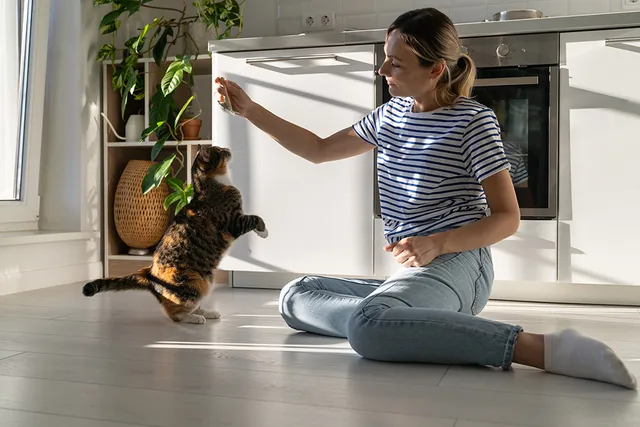
It is important that you know the different ways that cats learn. Having this knowledge will help make training a positive experience for both of you.

Top 10 Cat Breeds That Are Easy to Train
While all cats have individual personality traits, some cat breeds are easier to train than others. Here are the top 10 cat breeds that are known for trainability:
- Abyssinian: These cats are outgoing and friendly and enjoy direct involvement with their owners. This breed is known to learn to do tricks, walk on a leash, and play fetch.
- American Shorthair: These are even-tempered, silver tabby cats. Their calm personalities and learning abilities make them favorites for acting and modeling.
- Bengal: This cat breed is a descendant of the Asian Leopard Cat. They are good-looking, energetic cats and enjoy spending time with their owners.
- Japanese Bobtail: Highly active and social, these cats love spending time together and make great family pets.
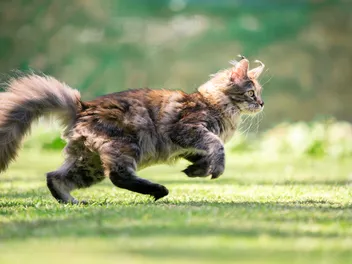
- Maine Coon: Referred to as “gentle giants,” these cats have easygoing personalities and are said to be resilient and quick to learn new tricks.
- Ocicat: A cross of Abyssinians with Siamese, they are full of excitement and curiosity. Ocicats are “people cats” and want to be close to their owners.
- Pixiebob: A breed that is quiet and confident, they enjoy involvement and are eager to please. Although they look like mini bobcats, DNA tests prove they are not descendants of wildcats.
- Siamese: A socialite that loves attention, the Siamese is playful and eager to please.
- Somali: Intelligent like their relative, the Abyssinian, this breed can be taught to play fetch and enjoys playing games.
- Turkish Van: A breed that enjoys strong bonds with their owner, the Turkish Van loves attention and is eager and willing to play a game of fetch.
Conclusion
There are many factors that can assist cats in learning from their mistakes. While some cats are better at remembering their mistakes than others, cats in general are intelligent and have the potential to learn. But you might need to offer them some assistance every once in a while.
Sources
https://www.animalfate.com/do-cats-learn-from-their-mistakes/
https://www.animalfate.com/do-cats-know-when-they-are-in-trouble/
https://www.nationalgeographic.com/animals/article/animals-cats-training-pets
https://www.yourcat.co.uk/cat-advice/train-your-cat/how-do-cats-learn-part-1/
https://www.uh.edu/news-events/stories/2017/november/11012017Buckner-Animal-Cognition.php
Featured Image Credit: bookwurmee, Pixabay
Expert cat care, straight to your inbox
News, insights, and useful advice, delivered to you.

No spam — unsubscribe anytime.
By signing up, you agree to our Terms & Conditions and Privacy & Cookies Policy.
How useful was this post?
Click a star to rate. You can leave written feedback afterwards. (We read all feedback.)
Christian started writing for a local newspaper as a teenager, and he's been involved in the publishing industry for most of his adult life. Combining his love of writing with a passion for animals, he is currently the Director of Editorial at Pangolia and the Editor-in-Chief at Catster.
Christian lives in the Philippines with his wife, son, and four rescue cats: Trixie, Chloe, Sparky, and Chopper.