How Smart Are Cats? Here’s What Science Says


In this article
Measuring the intelligence of an animal can be difficult. After all, they can’t answer written questions on an IQ test. Instead, we are left with behavior studies, looking at the anatomy of their brains, and of course, observation. Even with these findings, it’s still nearly impossible to compare the intelligence of different species. That’s because different species have evolved their intelligence to do different things. So, let’s start by saying cats are the smartest species there is at being cats. Most researchers say that a cat’s cognitive ability is equivalent to that of a human toddler, but let's dive in for more details.

What Do We Know About How Smart Cats Are?
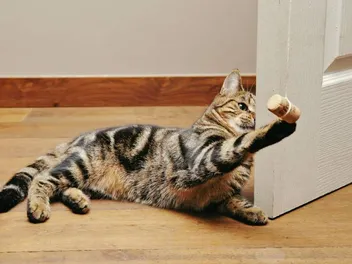
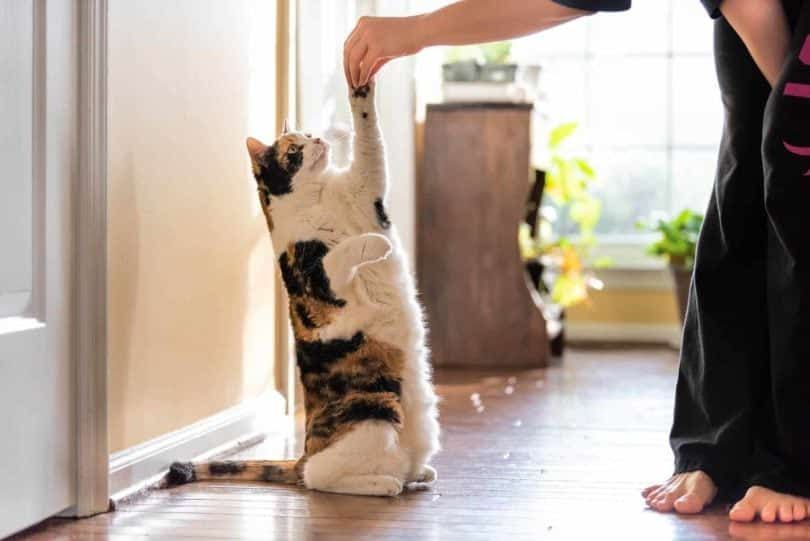
Rather than measuring a cat’s IQ, researchers instead have to look at cognitive ability when measuring intelligence in animals. Cognition, or cognitive ability, is how an animal gathers information, makes decisions, and then acts on those decisions. What we know is that cats have the cognitive ability to 1:
How developed are these abilities? Most researchers say that a cat’s cognitive ability is equivalent to that of a human toddler.

How Smart Are Cats Compared to Dogs?

It’s the age-old debate: Who’s smarter, cats or dogs? The truth is both in their own way. For example, cats have evolved and adapted their intelligence in the wild to be amazing hunters. A cat can outhunt a dog any day of the week. On the other hand, dogs, being social animals, are often better at learning commands and taking cues from the humans and other animals around them. It’s in their best interest to exist amicably in a group, whereas a cat may prefer solitude and not want to answer to another all of the time.
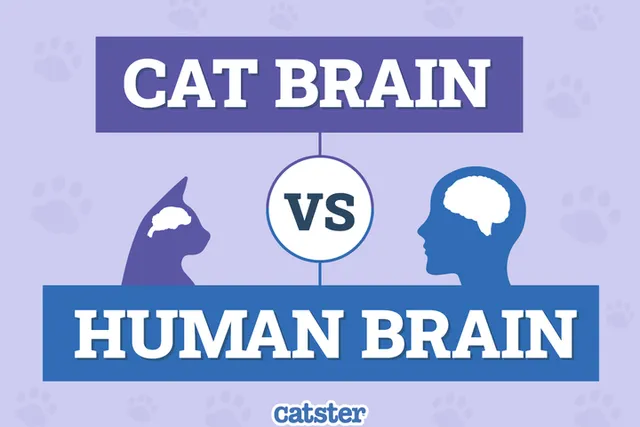
Comparing a cat’s intelligence to a dog’s is really like comparing apples and oranges. Both species have areas they excel and areas they may need a little work. But, if you’re looking for something a little more quantifiable, a 2017 study published in the journal Frontiers in Neuroanatomy might provide some food for thought.
The study's main author, neurologist Suzana Herculano-Houzel, has spent the last 10 years examining how brains work in humans and animals. She focuses on neurons because they are the fundamental building blocks of information processing in the brain. The more neurons an animal has, generally the more cognitively ability there is available to them.
To gain insight into the neuron counts of dogs and cats, the researchers examined three brains: one from a domestic cat, another from a Golden Retriever, and a third from a mixed-breed small dog.
Despite their size differences, both dogs’ brains contained approximately 500 million neurons—more than double the 250 million neurons found in the cat's brain. This discrepancy in neuron count led the researchers to speculate that dogs have intelligence levels comparable to raccoons and lions, whereas domestic cats' intelligence is more akin to that of bears.
What does this mean? Only that dogs are set up to have a higher intelligence than cats, but it’s really unknown to what extent a dog uses those neurons. So, while they may have more neurons available, that doesn’t mean they’re utilizing any more than a cat does. Instead, it seems more important to look at areas where either animal shines and not try to compare.
How to Know if Your Cat Is Smart

Since you can't count the number of neurons in your cat's brain nor rely on other scientific methods to assess their intelligence, you must resort to an at-home experiment. While this won't be the most scientific approach, it will still allow your beloved cat to show off their problem-solving skills.
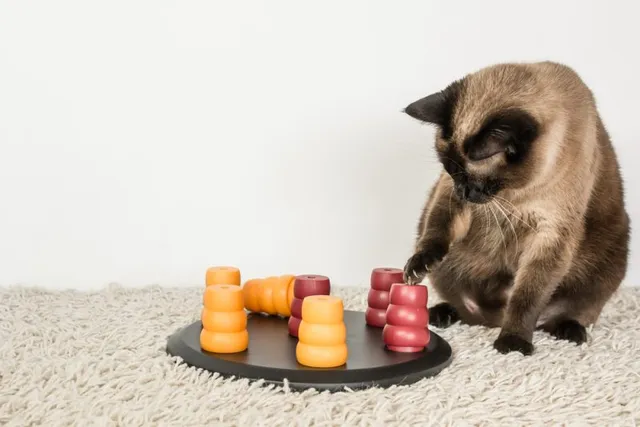
First, know that assessing your cat's intelligence mainly involves observing different aspects of their behavior. For example, you can test their problem-solving skills using interactive toys or puzzles. A cat that quickly grasps these challenges is undoubtedly quite astute!
Next, find a way to test their memory. For example, you could hide your cat's favorite toy under a cup. If your cat recognizes that their toy is still there and returns to the cup to look for it the next time, they have passed the test with flying colors.
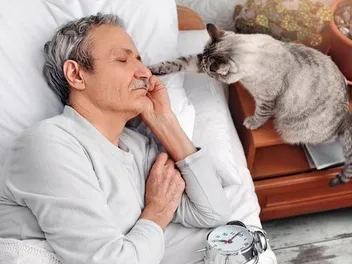
Lastly, while the way that your small feline interacts with you isn't necessarily a direct indicator of their intelligence, it's still a good sign that they are attuned to your emotions. Indeed, cats that respond to human emotions are often perceived as having higher cognitive abilities. A cat that tries to comfort you when you’re sad or joins in the celebration when you're happy is likely aware of your emotions.

Bottom Line
Your feline friend is smart, there’s no doubt about that. But even with science, it's hard to gauge how smart cats truly are. While it's true that dogs may have a slight advantage in terms of the number of neurons in their brains, animal intelligence manifests in various ways, and scientists are still struggling to decipher all these subtleties. Moreover, every cat has their own individuality, and “intelligence” can fluctuate among individuals. Perhaps we should simply recognize the unique qualities and behaviors that make our feline companions nothing short of extraordinary.
Sources
Featured Image Credit: Andriy Blokhin, Shutterstock
Expert cat care, straight to your inbox
News, insights, and useful advice, delivered to you.

No spam — unsubscribe anytime.
By signing up, you agree to our Terms & Conditions and Privacy & Cookies Policy.
How useful was this post?
Click a star to rate. You can leave written feedback afterwards. (We read all feedback.)
Genevieve is both a biologist and a science writer, driven by her deep love for capuchin monkeys, pumas, and kangaroos. Her dedication to wildlife has taken her across the globe, from Bolivia and Guatemala to Canada and Australia, working and volunteering at various rehabilitation centers. As a Canadian living in Argentina, Genevieve starts her days with horses and cows greeting her from the plains outside her home office. She is the proud parent of three rescued dogs—Lemmy, Nala, and Pochi—and an energetic kitten named Furiosa. The opportunity to share her passion and expertise in animal care brings her great satisfaction.