Get

In Your Inbox

Catster is reader-supported. When you buy via links on our site, we may earn an affiliate commission at no cost to you. Learn more.

Siamese Cat Health Problems: 7 Vet-Reviewed Issues


Share

Catster_Health Problems of Siamese Cat

Siamese cats are among the most popular cat breeds in the United States. They are intelligent, vocal, affectionate, and have dog-like personalities. They are also strikingly beautiful with piercing blue, almond-shaped eyes. With these amazing characteristics, it’s no wonder they are one of the most sought-after cats.

If you’re on the lookout for a Siamese cat, you should familiarize yourself with common health problems that Siamese cats are genetically predisposed to. In this article, we’ll dive deeper into common health issues for you to keep in mind. We’ll start with non-serious issues and work our way down to more severe health problems.

divider 2 cats

The 7 Common Siamese Cat Health Problems:

1. Asthma

Asthma is when airways become inflamed. Some veterinarians refer to this condition as feline bronchitis. Siamese cats are more prone to developing asthma, as well as overweight kitties. The condition usually strikes between 2–8 years of age, and the signs are a dry cough, shortness of breath, and wheezing. If your Siamese has a cough for a month or more, it’s wise to take your kitty in for examination.

If you are concerned about the health and well-being of your pet, seek veterinary advice for the best course of action.

If you need to speak with a vet but can't get to one, head over to PangoVet. It's an online service where you can talk to a vet online and get the advice you need for your pet — all at an affordable price!

PangoVet_Mention-in-Content for PangoVet2 save money


2. Nystagmus

Nystagmus, or convergent strabismus, is a condition where the eyes become crossed or flicker from side to side, and it’s common in Siamese cats. In some cat breeds, this condition is considered a birth defect. However, the Siamese is exempt from being classified as having a birth defect with the condition.

A Siamese cat pet owner may figure that their cat cannot see well with this condition, but surprisingly, they can see just fine. Their brains sort out the extra information, enabling the cat to see one unified image. The condition is not serious and causes no serious problems. No treatment is necessary for this condition.


3. Feline Hyperesthesia Syndrome

This congenital syndrome causes sensitivity to your Siamese cat’s skin, often on your cat’s back or in front of the tail. While not serious, your cat’s reaction to the syndrome poses compulsive disorders, like excessive licking or scratching of the area. Your cat may even bite you when you go to touch the sensitive area. A tale-tell sign is if your cat’s back ripples when touched, and the pupils may dilate.

Some veterinarians feel this syndrome is more of a compulsive disorder, and some feel it may even be a sign of a seizure disorder. Other potential causes need to be ruled out first to get an accurate diagnosis, such as spinal arthritis or skin conditions. If no other reasoning is present, the condition can be managed with medication, and your Siamese can go on to live a normal, happy life.

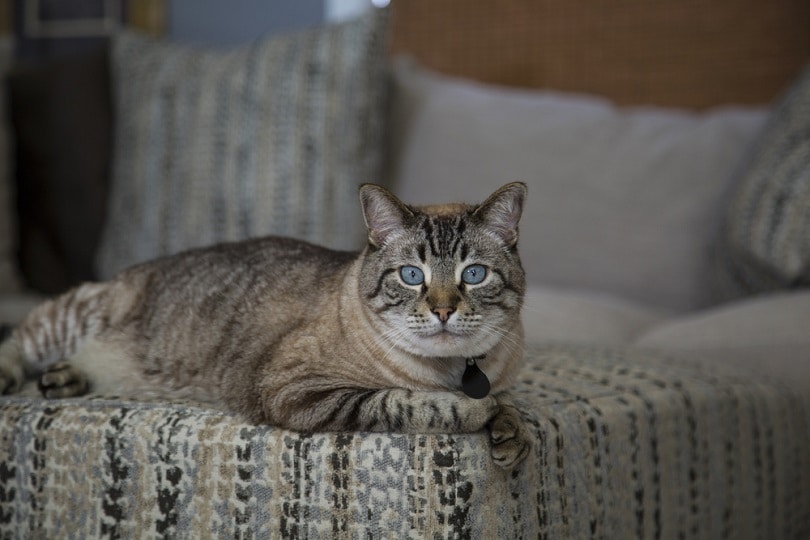
tabby point siamese cat laying down
Image by: Gridsanakawin Tumdee, Shutterstock

4. Amyloidosis

Amyloidosis is an inherited predisposition in Siamese cats. Amyloids are a type of inert protein, and the term “amyloidosis” refers to a condition in which these proteins are deposited into various organs throughout the body that may disrupt the normal function of those organs, including the kidneys, liver, and intestines.

This condition could lead to organ failure and is hard to diagnose. The condition can only be treated to reduce inflammation, and there’s no method for prevention.


5. Megaesophagus

Megaesophagus is an enlargement of the esophagus. The esophagus is responsible for transferring food and water from the mouth to the stomach, and when the esophagus is enlarged, it can cause unpleasant symptoms for your Siamese cat, including vomiting, weight loss, bad breath, nasal discharge, a cough, hunger, or a lack of appetite. The condition is usually congenital for Siamese cats rather than acquired later in life.

The condition is usually idiopathic, which means the underlying cause is unknown. X-rays are normally used to diagnose megaesophagus, along with other tests, such as blood work and an esophagoscopy. Treatment usually involves treating the underlying cause, but with a congenital cause, the prognosis is poor due to frequent bouts of pneumonia.

Lazy Flame Point Siamese
Image by: Erica Halstead, Shutterstock

6. Progressive Retinal Atrophy

Progressive Retinal Atrophy (PRA) is a group of degenerative cells that affect the eyes’ photoreceptor cells in the retina. It is inherited in Siamese cats and causes various levels of vision loss. Ultimately, the condition causes total blindness, and there is no cure.

PRA is caused by a recessive gene, and even if a kitty has normal parents, the kitty can still develop PRA because the parents could be carriers. The disease can start at 1½–2 years of age, but it can also occur in cats as young as 2–3 weeks old.

Night blindness is the first sign, with total blindness following within 2–4 years of onset. Responsible breeders will use a genetic test before breeding and affected cats should not be used to prevent the disease from developing in the offspring.


7. Cancer

Siamese cats are prone to certain multiple cancers, and early detection is key. Some Siamese cats may not develop cancer until later in life, but some develop cancer at a young age. Chemotherapy and surgical treatment can save your cat’s life, making early detection crucial to your cat’s survival.

Here is a list of certain cancers that the Siamese cat is prone to:
  • Lymphoma: Lymphoma causes the body to produce abnormal white blood cells, which are found throughout the body. Lymphoma can be detected through a simple blood test, and treatment with chemotherapy is usually very successful with early detection.
  • Mast Cell Tumors: There are two types of mast cell tumors: cutaneous and visceral. Cutaneous mast cell tumors are a form of skin tumor and are usually found on the neck, head, or limbs. Cutaneous mast cell tumors look like raised, hairless bumps. If you notice any kind of bump, lump, or abrasion, it’s critical to have your Siamese examined by your vet. The tumor can be removed, and if caught early, your Siamese cat can live a normal and healthy life. Visceral mast cell tumors affect the internal organs such as the liver, spleen, and intestines. The prognosis is not promising. After treatment, a cat with this cancer will live for about a year.
  • Intestinal Cancer: Intestinal cancers can affect either the small or large intestine. Gastrointestinal lymphoma and intestinal adenocarcinoma are more common types of intestinal cancers. This is an aggressive form of cancer that will often metastasize to the lymph nodes. Blockages can occur in the intestine, causing vomiting, diarrhea, weight loss, and loss of appetite. Surgery and chemo are the forms of treatment, and long-term survival can occur in some cases.
Siamese elder cat sick with cancer has a feeding food tube attached to its nose to stomach
Image by: SUJITRA CHAOWDEE, Shutterstock

divider 2 cats

Conclusion

Disease and sickness can occur in any cat breed, but now that you know the specific diseases common in Siamese cats, you can keep an eye out for any abnormalities, whether behavioral or visible.

If you notice your Siamese is lethargic, not eating, and especially has vomiting or diarrhea, it’s vital to take your feline in for an examination. Remember that early detection is key for the overall well-being of your Siamese.


Featured Image Credit by: Sergey Nivens, Shutterstock

Want content like this delivered to you?

Sign Up For Our Newsletter

News, insights, expert advice, and everything cat

* By submitting, you agree to our Terms & Conditions and Privacy & Cookies Policy.


How useful was this post?

Click on a star to rate (you can leave written feedback after clicking submit)

Help us improve Catster for pet parents!

Your feedback really matters.

What did you like about this post? Also how can we improve it?

Join the conversation

2 Responses

  1. Beautiful cats but we should never breed any animals as there are way too many cats that need a home. I never wanted any particular cat nor would I ever get one. way too many cats needing homes. I have cats simply cos to give them a home otherwise I would go without. For me breeding animals is not helping the average cat we see each day who can and do make beautiful pets and each have their unique personality. Plus is it fair to get a cat just so you can make money from it as basically that is what it is as a true animal lover would never breed any animal when there are heaps to be homed. That is my opinion.

Leave a Reply

You’re very welcome to leave a comment or question. Please know that all comments must meet our community guidelines, and your email address will NOT be published. Let’s have a positive and constructive conversation.


Talk With A Vet Online

Peace of mind,
anywhere, anytime

Affordable vet advice

Do Cats Cause Schizophrenia? Scientists Find a Link – Here’s What It Means

Being a fierce advocate (and occasional recipient of) mental health support and awareness, the term ‘crazy’ is not one I like to fling...

One in 100 Cats Gets Diabetes – Here’s How to Catch It Early

One in every 100 cats develops diabetes.1 That’s not a rare, unlucky condition reserved for cats with obvious health problems. It’s common enough...

Dramatic Rescue Turns Into Dramatic Reunion

What started as a routine call for the RSPCA became a heroic, five-hour rescue featuring one trapped and traumatized cat, an emotional family...

Ask Dr. Paola – Help! How Do I Know if it’s Ear Mites! (May 4, 2026)

Welcome to our “Ask Dr. Paola” series, where every Monday we bring expert advice straight from Dr. Paola Cuevas (MVZ) to help our...

More related

Can Cats Eat Anchovies? Vet-Reviewed Facts & FAQ

Cats love meaty treats, and anchovies are no different. In fact, anchovies are a moderately healthy food that many cats love. They make...

What Exactly Is Osteochondrodysplasia in Cats? Our Vet Explains the Causes, Signs & Care

Osteochondrodysplasia is a genetic condition seen in the Scottish Fold breed, also called Scottish Fold Disease. To break this long word down for...

Ivy Settling In: Some of My Favorite Memories

Welcome to the Wednesday Cats of Catster! Every week, we share a story from one of our cat-loving Catsters. This week is about...

Sentry Calming Collar for Cats Review 2026: Pros, Cons & FAQ

Review Summary The Sentry Calming Collar for cats works under the premise of cat pheromone science. Simply put, mother cats produce a pheromone...

Keep reading

9 Foods With Potassium for Cats: Vet-Reviewed Advice

Potassium is an essential mineral that helps maintain a healthy heart, muscles, and neurological function. Without potassium, a cat’s body would be completely out of whack. Thankfully, potassium is abundant in several food sources, even for an obligate carnivore. In...

cat eating canned tuna

Why Does My Cat Have Bumps on Their Skin? 8 Common Reasons

It can be scary to notice a lump on your cat’s skin. Immediately, your mind rushed to the worst-case scenario—but don’t jump to conclusions yet! There are plenty of reasons that your cat may have a bump on their skin...

female veterinarian examining cat on the table

Does Cold Weather Kill Fleas on Cats? Vet Approved Advice

Do fleas die in winter or cold weather? According to Athens Animal Wellness Center1, fleas can survive for up to 5 days in temperatures as low as 46 degrees Fahrenheit. That means unless you keep your house at sub-50 temperatures,...

close up flea on a cat

Why Do People Hate Cats? What Science Tells Us (Vet-Reviewed)

Cat lovers think that their favorite animals can generally do no wrong. People who adore felines often find them loving, attentive, playful, and adaptable. They love cats’ independence and sweet companionship and feel honored that such self-sufficient and intelligent creatures...

red flame point siamese in the grass

Can Cats Drink Soda? Vet Approved Nutrition & Safety

Are you a soda lover who can’t go a day without a big, tall glass of your favorite fizzy drink? If you’re also a cat owner, maybe you’ve seen your cat drink some leftover soda you left in a glass....

Can Cats Drink Soda

How to Keep Cats Off Kitchen Counters: 10 Effective Vet-Approved Tips & Tricks

Cats are curious creatures that love to explore their surroundings. However, this sometimes means that they get into things that they shouldn’t or end up in strange places, though most often, it means they won’t stay off the kitchen counters....

Black and white domestic cat lying on modern kitchen

Cat Blood Types: How to Find Out (Vet-Approved Guide)

If you’ve ever given blood before or had surgery, you probably know your blood type. Humans have four blood groups—A, B, AB, and O. These groups can be Rh positive or negative, which means you can have one of eight...

vet sampling cat's blood

Why Do Cats Lick Themselves So Often? 11 Vet-Reviewed Reasons for This Behavior

Grooming is an important part of any cat’s day. Indeed, cats may spend up to half their awake time grooming themselves. Mother cats also lick their kittens as part of their bonding process, and cats who enjoy each other’s company...

cat licking close up

Love Cats? So Do We! Join the Catster Community

Stay informed with expert pet care insights delivered straight to your inbox! Discover professional guidance on animal behavior, feeding tips, trusted product picks, and much more.


Sign up for the Catster Email Newsletter

Stay informed with expert pet care insights delivered straight to your inbox! Discover professional guidance on animal behavior, feeding tips, trusted product picks, and much more.