How Much Time Should You Spend With Your Cat? Vet-Approved Advice


We all have busy lives, so we’re constantly trying to carve out time to spend with our family and friends and still have quality alone time.
When you own a cat or multiple cats, you need to spend time with them too. But how much time do your cats actually need with you?
Cats should have a minimum of 20 minutes of one-on-one time with their owners daily. That said, it depends on your cat’s personality and how much you interact with them throughout the day.
We have tips on the best ways to ensure that your cat is enjoying quality time with you and how to divide your time if you have more than one kitty.

How Much Time Should You Spend With Your Cat?
Most of the time that you spend with your cat will typically just happen naturally throughout the day: when you wake up, every time you feed them, and when they curl up next to you or on your lap. These are all examples of spending quality time with your cat. Still, beyond these interactions, your cat needs more.
A 2023 study found that a domestic cat’s quality of life was significantly higher the more often they played with their owner. The longer time the owner spent with the cat and the more games were played, the stronger the bond was.
Overall, it is recommended that owners play with their cats for a minimum of 20 minutes daily. But the more you play with them, the happier your cat will be and the stronger the bond between you will be.

Examples of Playtime With Your Cat
Cats need an environment that makes them feel safe, but they should also be able to play, run, jump, and stretch. All this can typically be accomplished with scratching posts and cat trees, as cats are quite capable of playing independently.
That said, you should always set aside time to play with your cat, which starts by ensuring that you have the right toys.
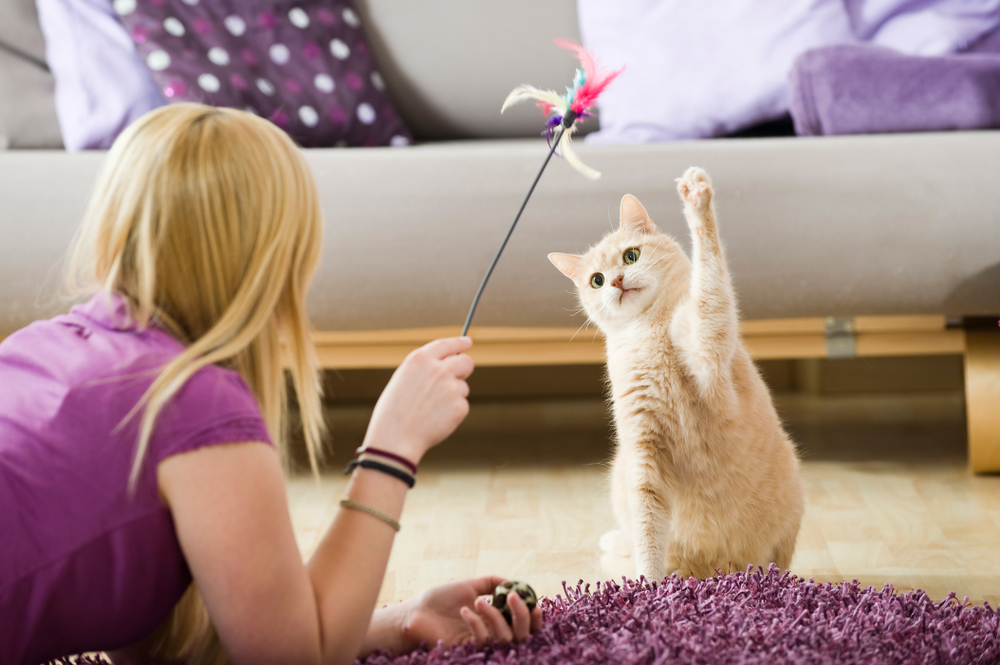
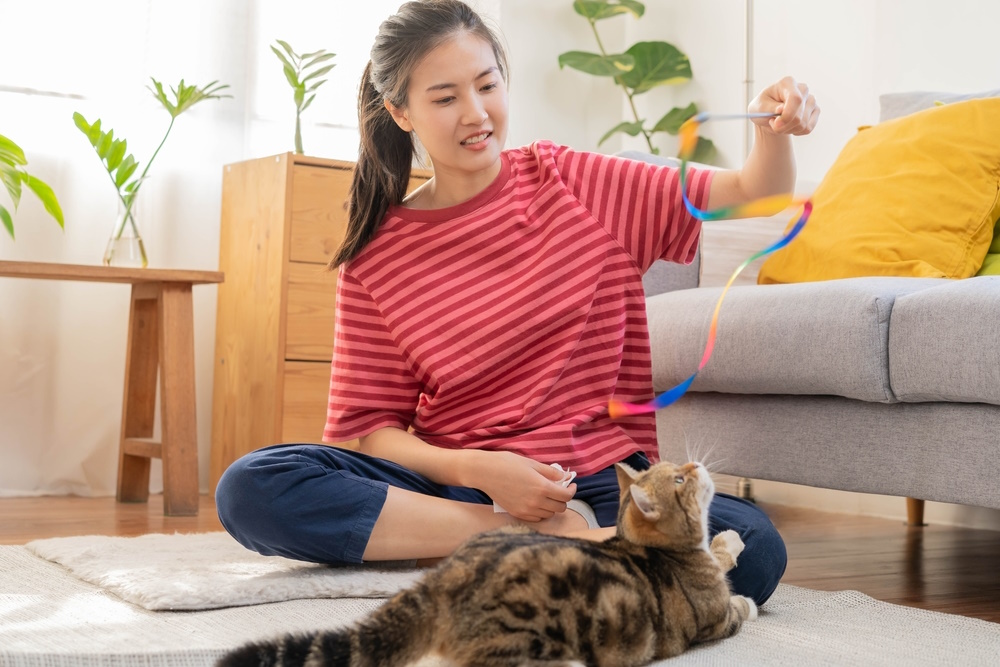
For independent play, try catnip toys, crinkle balls, cat springs, etc. You should also get toys that you can manipulate while playing with your cat. These can include wand toys, or you can have a toy mouse and put it under blankets or pillows so your cat hunts and pounces on it. Any kind of hide-and-seek toy gets most cats quite excited!
If your cat plays with you but seems done after a few minutes, don’t force it. Let your cat choose when they want to play. If you use laser toys, keep in mind that while many cats love these, they can be frustrating because the cat can’t physically catch anything. To avoid this issue, you will need to occasionally step in and toss a treat right at the beam when your cat pounces on it while you simultaneously turn it off, thus giving your cat the feeling of a successful hunt or win.
When playing with your cat, it helps to picture how a cat’s ideal prey acts, with scurrying and stopping motions, darting movements, etc.
Showing Them Affection
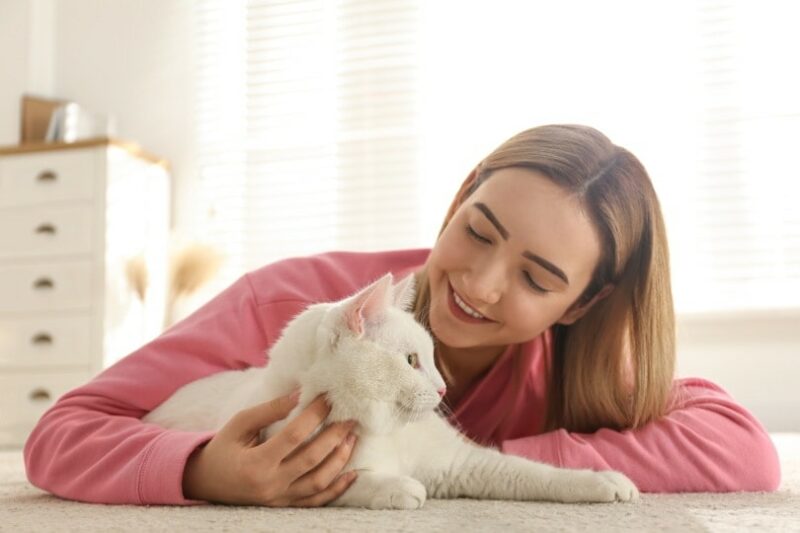
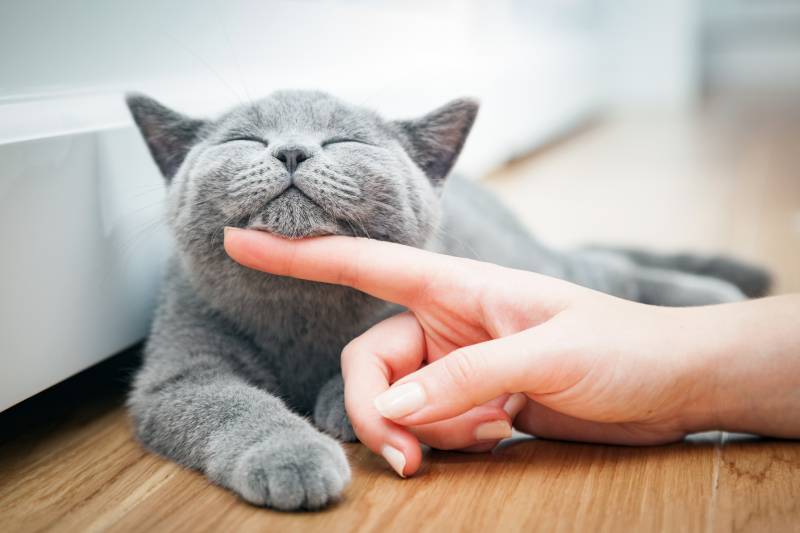
Just petting your cat, giving them cheek scritches, and allowing your lap to be used as a bed count as spending quality time with your pet.
Remember, never force affection on your cat. Some felines aren’t all that cuddly or lap cats, so you need to find different ways to show them love. Your cat will definitely let you know what they don't like, which must be respected. It pays to remember that all cats are individuals, each with a unique personality.
What If You Have Multiple Cats?
Having more than one cat can help some cats from feeling lonely when you’re gone. Of course, this is a case-by-case situation, as not all cats do well with another feline in the home.
You should try to spend as much one-on-one time as you can with all your cats, with plenty of petting and playing, but if the cats are buddies, they will do most of their playtime together. This can help if you don’t always have the time to play with your cats, but you might not have as strong a bond with any of them as you would with a single cat.

What Are the Signs That Your Cat Isn’t Getting Enough Attention?
Cats are not shy about letting us know when they want something. But we need to be able to decipher their signals. A typical situation is when you’re trying to get something done, and your cat starts doing things that you might consider annoying. They will lie on your laptop while you’re using it or jump on the table or counter while you’re working there.
Sometimes, cats will reach out a paw to you as you walk by—some will even hit your legs! Rubbing your legs and meowing and looking at you are also signs that your cat wants something, especially your attention.
Remember that your attention serves as encouragement for your cat, so any behavior that successfully gets your attention will be likely repeated more frequently in the future. Think of cats as children who will do things that they know they aren’t supposed to do but do them, anyway. Negative attention is better than no attention at all.
So, ensure that you give attention and enrichment to your cat before they start misbehaving. Cats love pushing things off of shelves and clawing up your furniture, and they will do it more often if it attracts your attention. Try only engaging with them when they use their designated scratcher or play with their toys, and they will do those activities more often.
Do Cats Get Separation Anxiety?

While dogs are known to be prone to separation anxiety, cats can develop it too. It isn’t quite as noticeable, but it can definitely occur if you’re away from home often. It also depends on the cat’s personality.
Signs of cats experiencing separation anxiety might include:
If you suspect that your cat might be experiencing separation anxiety, you should consult with a vet.
Conclusion
You might want to try adding your cat’s playtime to your schedule if you find yourself frequently overlooking it. Plan on a 5- to 10-minute play session every night around 8:00 p.m., for example.
How much time you spend with your cat is up to them, though. Some cats just look to you for the bare necessities, while others will be quite demanding of your time.
As long as you’re treating your cat with respect, giving them the things that they require (food, water, litter box, etc.), and playing with and petting them, you should have yourself a happy and content kitty.
Featured Image Credit: Africa Studio, Shutterstock

Expert cat care, straight to your inbox
Vet-reviewed advice, behavior tips, and the best of Catster. Free, and you can unsubscribe anytime.
By signing up, you agree to our Terms & Conditions and Privacy & Cookies Policy.
Kathryn was a librarian in a previous lifetime and is currently a pet writer. When she was a child, she hoped to work in ZOOs or with wildlife in some way, thanks to her all-consuming love for animals. Sadly, she's not strong in the sciences, so she fills her days with researching and writing about all kinds of animals and spends time playing with her adorable but very naughty tabby cat, Bella. Kathryn is hoping to add to her family in the near future – maybe another cat and a dog.
Join the conversation
Ask a question, share your story, or send private feedback.