Do Cats Kill Rats? Vet-Reviewed Facts & Efficacy


In this article
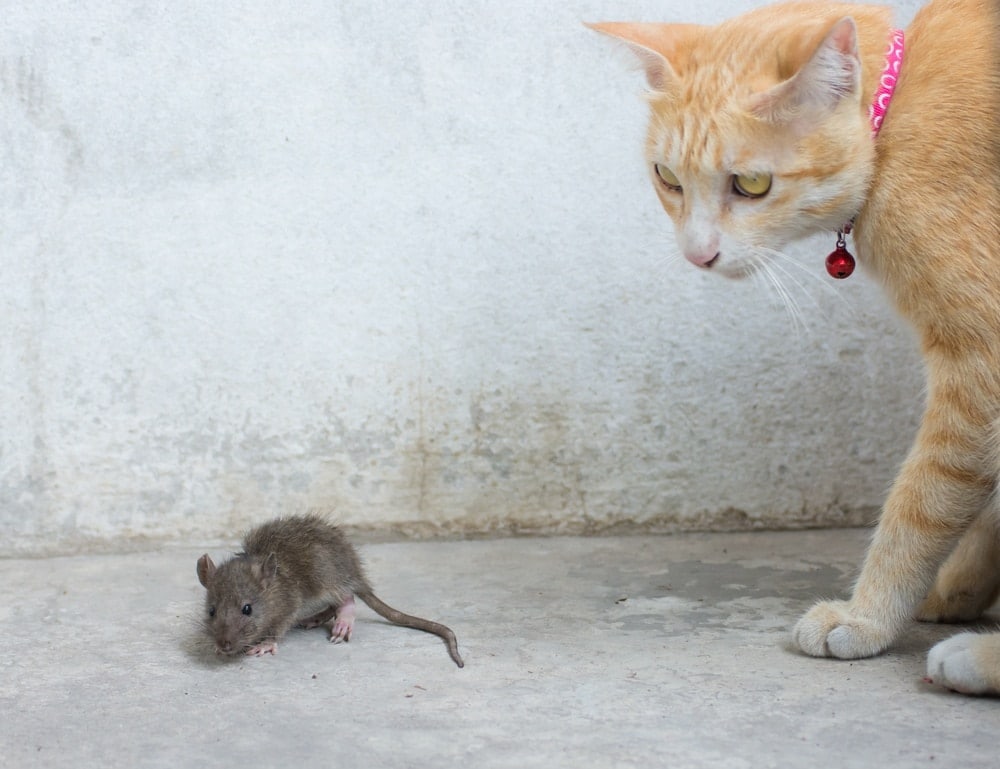
Cats are well-known for their hunting prowess, but some cats are more talented at this skill than others. When humans began farming several thousand years ago, they depended on cats to protect their harvest from rodents. This relationship eventually led to cats starting to share their lives with humans. If you’re wondering if cats are good at catching and killing rats, it's a lot more complicated than a simple yes or no, as we'll discover.

Cats as Predators
Cats have been prized for their ability to kill vermin for thousands of years, and it’s thought that it is one of the main reasons that they became tamed in the first place. African Wildcats were first found near human settlements due to the presence of mice, and the cats were gradually tamed by farmers who saw the benefits of having a cat around to help control vermin.
While the ability to catch mice was a useful skill back then, modern-day cats, both feral and house cats allowed to roam outside, are now responsible for killing multiple types of wildlife. But does that include rats?
A study completed in 2013 estimated that free-ranging domestic cats kill between 1.3 and 4.0 billion birds each year across the US (except for Alaska and Hawaii).1 Cats also killed anywhere from 6.3 billion to 22.3 billion mammals in the same area. Mammalian prey are mainly mice, voles, shrews, squirrels, and rabbits.
It’s important to note that feral, unowned cats contribute to most of these numbers, with an estimate of around 69% of the mortalities being due to feral cats. So, we know that cats are efficient predators. But if you’re thinking about taking in a feral cat to help control rats on your farm, will it be an effective strategy?

Cats Are Used for Rat Control
In Washington, D.C., Blue Collar Cats, part of the Humane Rescue Alliance, releases feral cats from their shelter that can’t be rehomed to help control rodent populations. These cats aren’t used to human interaction, so once they’ve been trapped and given the veterinary care they need, including neutering or spaying, they’re not suited to be adopted as house cats.
Instead, the feral cats are put to work to control the rodent population for local businesses. Cats are provided with shelter, food, water, and basic care. Plenty of businesses are thrilled with how having a Blue Collar Cat has helped reduce the rodent population, including rats, around their properties.
Blue Collar Cats doesn’t advocate withholding food to encourage cats to hunt rodents; it is an ineffective method and cruel to the cats too. Most cats will hunt whether they’re hungry or not, it’s an innate instinct. So, while certain areas use cats to control rat populations, how effective are cats at killing rats?
Are Cats Effective at Killing Rats?
There’s only one scientific study that we can find that looks at the effectiveness of cats in killing and controlling rat populations. The results show that cats aren’t all that great at killing rats. The study, titled Temporal and Space-Use Changes by Rats in Response to Predation by Feral Cats in an Urban Ecosystem, examined the relationship between a colony of around 130 rats and a group of feral cats.2
Over 79 days, they found that while the cats spent much time around the rat colony, they didn’t often interact with them. There were only 20 incidents of the cats stalking rats, three attempted kills, and only two actual kills. Both kills resulted from a cat finding where a rat was hiding rather than actively stalking them out in the open.
The lead researcher, Michael H. Parsons, said that as the rats adjusted to the presence of the cats, they adapted their behavior by spending more time hiding in their burrows than roaming outside. He suggests that when this happens, observers assume they see fewer rats because the cats killed several of them. However, the rats have changed their behavior and are less visible because they hide more.

Cats vs. Rats
Rats are large prey for any cat; even an experienced feral cat may think twice before hunting a rat. Rats are also good at defending themselves and can turn on a cat as they attempt to hunt them. Brown rats weigh up an average of 300 grams (compared to a mouse, which weighs around 30 grams). Often, it will only be a few cats that will attempt this formidable task.
When given the choice, will cats kill rats? Cats prefer to hunt on small prey, such as mice, compared to rats. Some people claim to have seen urban rats and feral cats eating from the same trash bag.
Cats vs. Mice
So, cats are not all that great at killing rats, but they’re better at killing mice. Another study, titled Domestic cats as predators and factors in winter shortages of raptor prey, found that over an area of 35 acres, six cats killed more than 4,200 mice over a period of 8 months.
Wrapping It Up
Cats can kill rats, but most cats prefer smaller prey. That’s not to say that initiatives like Blue Collar Cats aren’t a great idea. Research has shown that the presence of cats reduces the number of rat sightings. So, whether the rats have moved onto a different area or spend more time in burrows, the location still benefits from decreased rat sightings. It also gives a needy cat a new home, and what’s not to love about that?
You might be interested in:
Featured Image Credit: rihaij, Pixabay

Expert cat care, straight to your inbox
Vet-reviewed advice, behavior tips, and the best of Catster. Free, and you can unsubscribe anytime.
By signing up, you agree to our Terms & Conditions and Privacy & Cookies Policy.
Christian started writing for a local newspaper as a teenager, and he's been involved in the publishing industry for most of his adult life. Combining his love of writing with a passion for animals, he is currently the Director of Editorial at Pangolia and the Editor-in-Chief at Catster.
Christian lives in the Philippines with his wife, son, and four rescue cats: Trixie, Chloe, Sparky, and Chopper.
Join the conversation
Ask a question, share your story, or send private feedback.