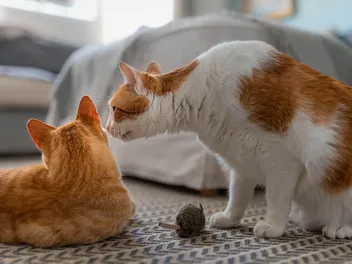
How to Introduce a Cat to a New Home: 6 Tips & Tricks



In this article
If you’re bringing a new cat into your home and you already have one or more other pets, it can take some time for them to adjust. Your new cat may be nervous about entering a new environment, and your current pets will need to adjust to having a new housemate and establishing a pecking order.
Here, we will provide helpful step-by-step tips to guide you on how to introduce a new cat to your home. But first, you must consider that bringing a new cat into your home can be risky for your existing pets. Before introducing it to your home, the new cat should be quarantined to make sure it is not suffering from any infectious diseases that could be transmitted to your other pets. Your pets’ vaccination schedules must be up to date, including booster shots. Before the quarantine, get the cat checked by a vet and have it rechecked and cleared up after the quarantine, which can reduce any potential health risks.
Fortunately, a little prevention, planning, and prep can make the introduction and transition as smooth as possible. Here’s how to introduce your cat to a new home and promote peaceful coexistence.

The 6 Tips & Tricks to Introduce a Cat to a New Home
1. Designate One Room for the New Cat
Your new cat will benefit from its own space to settle in and decompress. Ideally, you will have one room just for the new cat, which is free from other cats, a lot of foot traffic, or multiple entries for your other pets to get in. Leave your cat in this room with toys, a litter box, food and water, and cat furniture, and just visit from time to time. Once your cat adjusts, you can introduce it to the rest of the house. How long this takes will depend on the cat’s personality and its past experiences.
2. Offer Hiding Spaces
Cats will sometimes hide to get away from unpleasant or uncomfortable situations. This could be under a bed, inside of furniture, or in boxes or drawers. Provide hiding places that are cozy and comfortable for your cat, such as cat coves or cat beds with blankets. Make sure the hiding spot is in a quiet area, and try to leave your cat alone if it goes inside. The idea is that this is its own private domain, and if you bother it, you’re not creating an environment where it can feel safe and secure.

3. Cat-Proof Your Home
Your cat may be uncomfortable in your home at first, especially if it is semi-feral or came from a bad environment. If your cat doesn’t feel safe, its instinct may be to escape through a door or window. Make sure your windows and doors are all securely closed until your cat is confined to its room, and close any cat flaps or other escape routes. It’s important that every household member understands this rule and respects it. Over time, you will be able to relax as your cat becomes comfortable in its new space.
4. Introduce Your Cat to the Household
After a few days of your cat having time and space, you can try letting it out of its room to introduce it to the other people and pets in the household. Try to limit meetings to just a few minutes and one at a time. The last thing your cat needs is to be bombarded by boisterous children, rambunctious dogs, or a bunch of other cats vying for dominance. If possible, limit the number of visitors you have to your home until your cat has adjusted.

5. Build Positive Associations
After initial introductions, you can allow your cat to spend more time with the other household members. This can be stressful for everyone, including your current pets. Be sure to offer a lot of treats to your new cat and your current cats or dogs to build positive associations with each other. It’s best to offer a treat they don’t get otherwise, so the association will only be when the other animals are present. If you’re not sure how everyone will behave, separate your new cat from the rest of your pets with a baby gate—they can still see each other and enjoy treats, but they’re not free to play together yet.
6. Supervise Time Together
If you feel that your cat and other pets are comfortable with each other, it’s time for direct interaction. You can allow them supervised time together without a gate, rewarding positive interactions. If you experience any negative interactions, such as chasing, pouncing, hissing, or growling, distract your pets with a toy. End each supervised visit on a positive note, then gradually increase the time your pets are allowed to interact.
It may take days or weeks before your pets all interact positively. Once they have mostly positive or neutral interactions—free from any negative behaviors—you can allow them to be together unsupervised.

What Are Signs of Stress in a Cat?
If you see indicators that your new cat or your current cats or dogs are stressed out by the interactions, it doesn’t mean all hope is lost. It just means that it may take longer for everyone to adjust.
Some of the signs of stress may include:
If you notice these behaviors, redirect your pets and try to end the session on the next positive note. Then, try again another day.
If your pet is showing these signs, we suggest you speak to a vet.

Conclusion
Bringing a new cat home is an exciting experience, but it may be stressful for your new cat or other pets. It’s best to prepare and take things slow—the more time you put into the adjustment and introduction periods, the smoother things will go for everyone involved.
See also:
Sources
Featured Image Credit: New Africa, Shutterstock

Expert cat care, straight to your inbox
Vet-reviewed advice, behavior tips, and the best of Catster. Free, and you can unsubscribe anytime.
By signing up, you agree to our Terms & Conditions and Privacy & Cookies Policy.
Christian started writing for a local newspaper as a teenager, and he's been involved in the publishing industry for most of his adult life. Combining his love of writing with a passion for animals, he is currently the Director of Editorial at Pangolia and the Editor-in-Chief at Catster.
Christian lives in the Philippines with his wife, son, and four rescue cats: Trixie, Chloe, Sparky, and Chopper.
Join the conversation
Ask a question, share your story, or send private feedback.