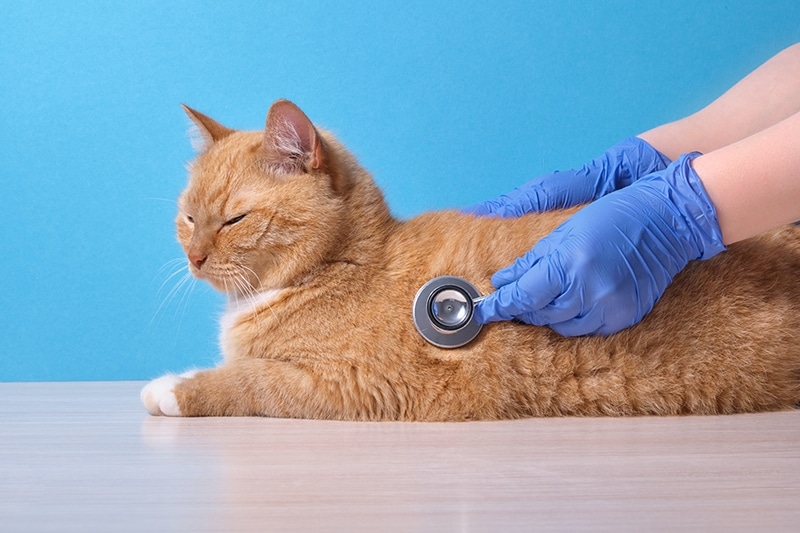
Heart Disease in Cats: Our Vet Explains the Signs, Causes & Treatment

In this article
Heart disease in cats does not define a single illness, but rather multiple conditions with different levels of severity. Some heart diseases are slower in progression and do not cause problems or require treatment for some time, but others can worsen and lead to heart failure.
Cardiac disease is when a cat's heart is no longer working properly. The heart is essentially a pump made of muscles that push the blood through the vessels throughout the body. When this pump no longer works properly, breathing and other problems occur. Unfortunately, cats usually do not show any signs of heart disease until the illness is already quite advanced or has actually led to heart failure.
Cardiovascular disease can be a primary or secondary condition to other diseases. It occurs most often in adult cats but can also be found in kittens (as early as 3 months of age). Heart disease can endanger a cat’s life when it leads to fluid retention in the lungs and body cavities, or it causes a blood clot.

What Is Heart Disease?
The heart is a muscle that works like a pump. With each heartbeat, there are two phases of the heart function: the contraction or systole, and the relaxation or diastole. The heart pumps blood into the body through large blood vessels set at a different pace, depending on the species of animal. In cats, the heart beats 160–220 times per minute.
A cat’s heart has an ovoid shape and is the size of a walnut, weighing around 20 grams. It’s located in the chest cavity between the two lungs and has four chambers (two atria and two ventricles) and four valves: atrioventricular valves (mitral and tricuspid) and semilunar valves (aortic and pulmonary valve) that regulate blood flow. The heart is made up of three concentric layers: the endocardium, the myocardium, and the epicardium. Externally it is covered by a sack called the pericardium that contains a very small amount of liquid , which has different roles.
When this organ no longer functions properly due to advanced heart disease, various respiratory and other life-threatening health issues occur. Heart conditions are divided into two categories: congenital (present from birth) or acquired (occur during life). Both congenital and acquired pathologies can be hereditary.
1. Congenital Heart Disease
Congenital heart disease is present from birth. These are defects in the structures and functions of the cardiovascular system that cause malformations of the heart during embryonic development. It can affect one or more kittens, and it may affect other tissues and organ systems. Some of these kittens may be stillborn or die soon after being born.
Although certain clinical signs can be identified from an early age, there are situations in which these diseases can remain undetected for years if the defects are very minor and well tolerated. Luckily, congenital heart defects in cats are rare and occur only in 1-2% of kittens.
The most common congenital heart diseases in cats are:
- Ventricular septal defect — A hole in the ventricular septum (tissue that separates the left and right ventricle). Cats can develop congestive heart failure when the hole in the ventricular septum is large enough.
- Patent ductus arteriosus (PDA) — The ductus arteriosus is a blood vessel that connects the fetal aorta to the pulmonary artery. In normal kittens, this blood vessel closes 1–2 days after birth. In kittens suffering from PDA, this vessel remains open and can lead to heart failure if it is not surgically corrected a few months after birth.
- Mitral valve dysplasia — Normally, the mitral valve keeps blood flowing in one direction (from the left atrium to the left ventricle). In cats suffering from this condition, the mitral valve enables blood to flow back into the left atrium when the left ventricle contracts. This disorder can affect the mitral or tricuspid valve. A heart murmur can usually be heard, and as the disease progresses, it can lead to heart failure.
- Stenosis (aortic or pulmonary) — This is the narrowing of the aortic or pulmonic valve.
2. Acquired Heart Disease
Acquired heart diseases occur most frequently in adult and middle-aged cats and are due to changes in the structure of the heart, leading to its abnormal function.
Some cases may be due to hereditary factors that progress with age. The most well-known and frequent condition is cardiomyopathy, a disease that affects the heart muscle. The cause is not known, but genetic and hereditary aspects seem to play a crucial role. In some cases, it can occur as a secondary condition; for example, it can occur secondary to thyroid disease, anemia, or a high blood pressure.
The most common hereditary heart diseases in cats are:
- Hypertrophic cardiomyopathy (HCM) — This is a thickening of the muscle associated with the left ventricle.
- Restrictive cardiomyopathy (HCM) — This condition can be caused by excessive scar tissue on the inner lining and muscle of the ventricle. This restricts and impacts adequate movement of the heart with each heartbeat and often affects geriatric cats.
- Dilated cardiomyopathy (DCM) — The heart muscle, especially the left ventricle, weakens and does not contract normally, making the heart bigger and the walls thin and flaccid. DCM can occur in cats that do not receive enough taurine in their diet. It is a rare condition because most cats get taurine (amino acid) from food.
Several cat breeds are prone to hypertrophic cardiomyopathy, including:
- Persian
- Sphynx
- Burmese
- Himalayan
- Devon Rex
- Maine Coon
- Ragdolls
- American Shorthair
- British Shorthair
What Are the Signs of Heart Disease?
The clinical signs of heart disease in cats differ depending on the type. Most cats do not show any clinical signs of heart disease until it progresses. A common clinical sign of heart disease is coughing, but in cats, this is rarely seen (unlike in dogs or humans).
Cats can also have a low exercise tolerance, but this sign is hard to notice because most cats live indoors and don't get the chance to exercise extensively. As the disease progresses, a low tolerance for daily activities can be noticed: Your cat will become lazier, sleep more, and hide in various places, especially under the furniture. In the majority of cases, most owners may not even notice any changes in their cat’s health, habits, and behavior, as felines are experts at masking signs of illness, and heart disease is usually diagnosed when it’s already quite advanced and causing severe and life threatening signs.
However, the most common clinical signs of heart problems in cats are as follows:
- Lethargy
- Weight loss
- Low appetite
- Slowed growth rate (in kittens)
- Difficulty breathing (dyspnea)
- Increased respiratory rate
- Open mouth breathing
- Collapse
- Sudden paralysis of the hind legs, accompanied by excruciating pain due to thromboembolism

What Are the Causes of Heart Disease?
Up to 15% of apparently healthy cats may actually be suffering from heart disease, with HCM being most commonly diagnosed. Heart disease is a precursor to congestive heart failure. This is likely to occur even despite treatment in many cases and unfortunately is usually when the diagnosis is first established, as cats often show very subtle or no signs at all of heart disease.
Heart conditions in cats can be congenital or acquired during life:
Heart disease can be further characterized by performing blood tests, x-rays, and ultrasound of the heart, and based on these parameters, your veterinarian or a vet cardiologist can determine how severe your cat's condition is.
Unfortunately, there is limited evidence that treatment makes a significant difference when treating cats with heart disease medically unless it’s a heart defect that can be resolved with surgery. Your vet will speak to you about certain treatment options and what their aim is in managing the signs of heart disease or heart failure.
How Do I Care for a Cat With Heart Disease?
The most important thing that you can do is properly administer the medications prescribed by the veterinarian and notify them if you encounter difficulties or if your cat's clinical signs worsen.
Here's what else you can do:
The evolution of your cat's illness depends on the severity of the condition, their response to treatment, your vet's recommendations, and your observations. The tests performed to monitor the progression will influence your vet's decision regarding your cat's therapy and prognosis.
Frequently Asked Questions (FAQ)
How Long Can Cats Live With Heart Disease?
Some cats may live with heart disease for years before showing any clinical signs or developing congestive heart failure, but it depends on how advanced and progressive the condition is. Sometimes, cats live for years with diagnosed heart disease, while those that are in congestive heart failure generally have a much shorter lifespan, anywhere from 3-18 months, depending on the extent of disease, other concurrent disease, and response to treatment.
Unfortunately, there are cats whose condition from the time of diagnosis can rapidly decline despite treatment over a few days or weeks, and they may not reach the 3-month mark.
Is My Cat in Pain With Heart Disease?
Heart disease on its own isn’t usually painful in cats, but it will have a major impact on the cat’s quality of life. However, if there are breathing difficulties, this will certainly cause stress and discomfort to your cat. In the case of a blood clot affecting their hind limb(s) and leading to weakness or paralysis of the limbs, there will also be excruciating pain. This condition requires the immediate intervention of the veterinarian.
Conclusion
Heart diseases in cats can be congenital (born with them) or acquired (occur in adult cats). Both types can have a strong hereditary basis. Cats can suffer from several types of heart disease, but the most common is the acquired hypertrophic cardiomyopathy. Some cat breeds, such as the Maine Coon, Persian, American Shorthair, or British Shorthair, are more prone to certain heart conditions than others. For this reason, cardiac monitoring of these breeds is recommended.
If you notice your cat exhibiting signs like breathing difficulties, fast heart rate, lethargy, reduced appetite, and similar, they need to see the vet immediately. In case of paralysis or weakness of the hind limbs with yowling in pain and open mouth or labored breathing, they will need to be taken to the vet as an emergency.
Sources
Featured Image Credit: TShaKopy, Shutterstock

Expert cat care, straight to your inbox
Vet-reviewed advice, behavior tips, and the best of Catster. Free, and you can unsubscribe anytime.
By signing up, you agree to our Terms & Conditions and Privacy & Cookies Policy.
Dr. Iulia Mihai, DVM MSc (Veterinarian)
Dr. Mihai is a vet with over 13 years of experience in laboratory, pet pathology, and cancer. She studied at the University of Agronomical Sciences and Veterinary Medicine of Bucharest, Romania (EAEVE member), where she worked in the laboratory of the faculty clinic after graduation. She has a master’s degree in equine and pet pathology and studied epithelial cancer for her Ph.D. Iulia has a passion for internal medicine and parasitology and started volunteering at the faculty’s clinic in her third year of college. She has worked in a couple of veterinary clinics over the years as an internal medicine specialist. She enjoys writing and teaching people about cat disease prevention, nutrition, behavior, and treatment.
Join the conversation
Ask a question, share your story, or send private feedback.