Frontline vs. Advantage for Use in Cats: Our Vet Explains the Differences

In this article
Fleas are a common issue when owning cats. Preventing and treating fleas is a routine part of cat ownership, but finding a suitable flea product can be challenging.
When choosing an appropriate flea treatment, it is important to consider your cat’s age, size, and whether they are breeding. You should always think about the other pets in your household too. Your cat may have health conditions affecting your choice of flea product, so always speak with your veterinarian for further guidance.
Fleas live around our homes as well as on our pets. They exist as adults—the ones we see hopping about—and as eggs or younger life stages that we don’t see. Flea products can kill adult fleas, some of the other life stages, or both.
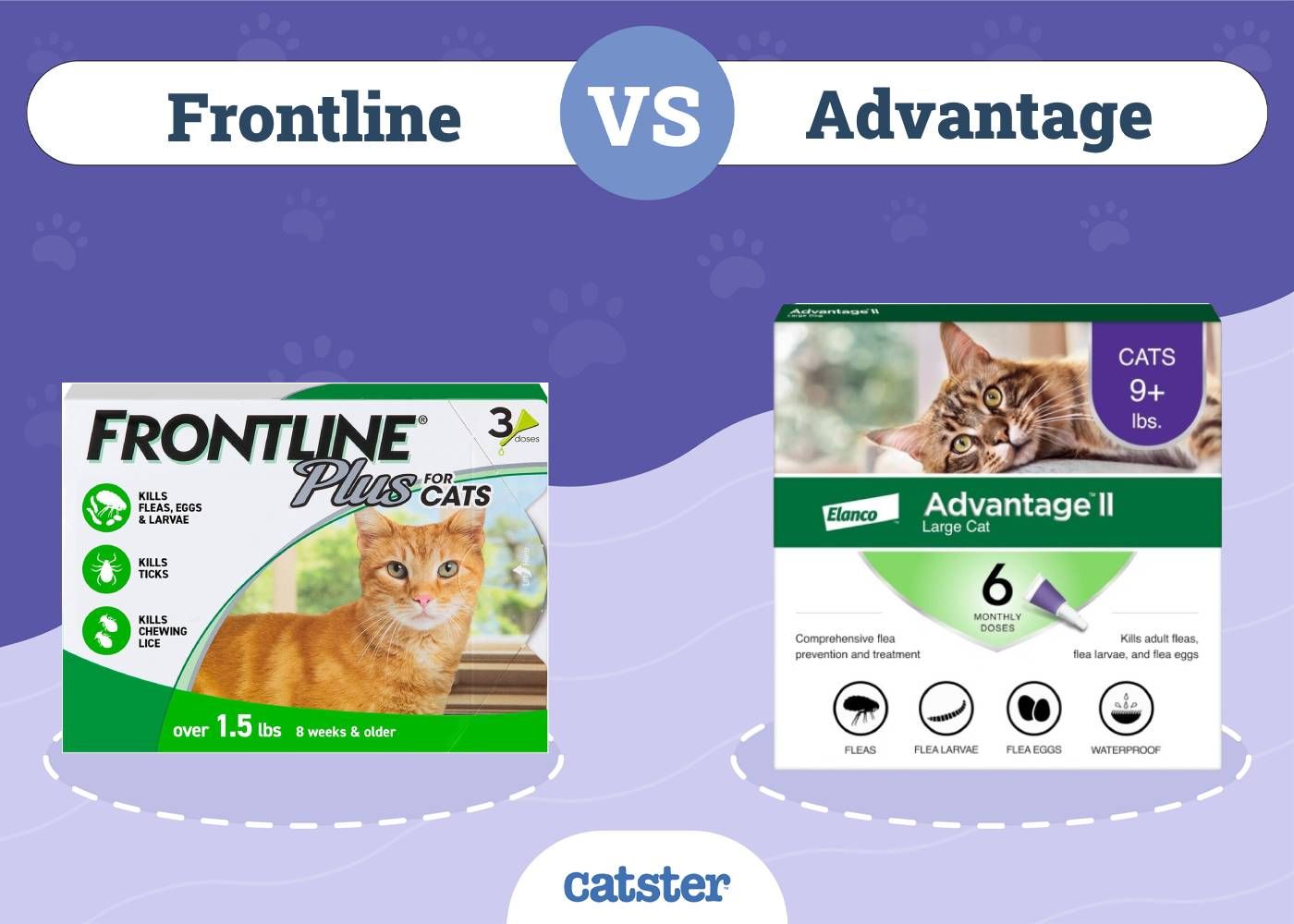
Both Frontline and Advantage are spot-on flea treatments. This means they come as pipettes containing liquid for you to apply directly to your cat’s skin. They are useful if your cat dislikes tablets. If you are choosing between Frontline and Advantage, which is best for you?

At a Glance

Frontline

What Is Frontline?
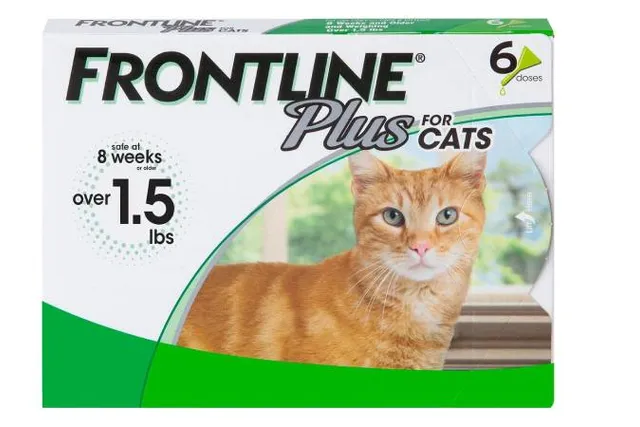
Frontline is a spot-on treatment and preventative for fleas and ticks, as well as a treatment for biting lice. A single pipette doses one cat from 2 pounds (1 kilogram) upwards. The active ingredient is Fipronil.
After applying Frontline, fleas are killed within 24 hours of landing on your cat and for up to 5 weeks following treatment. Ticks are killed and re-infestation is prevented for up to 1 month.
Do I Need a Prescription to Buy Frontline?
Frontline is available without a veterinary prescription. Other Frontline products, Frontline-Combo and Frontline-Plus, do require a prescription or to be sold by a Registered Qualified Person, because they contain different ingredients.
When Is Frontline a Suitable Flea Treatment for My Cat?
Frontline can be used in healthy adult cats that are older than 8 weeks of age and heavier than 1 kilogram or 2 pounds. Frontline is safe to use in female cats that are pregnant or nursing kittens.

How Often Can I Use Frontline on My Cat?
Frontline should be applied once every 4 weeks. In warm conditions, in summer, or in a centrally heated home, fleas reproduce very quickly and can over-populate your home. Frontline should not be used more often than every 4 weeks, so you might need an additional product to treat your carpets and bedding.
As is always the case when treating fleas, all flea-carrying pets in the household need to be treated at the same time with a product that is suitable for them. Frontline is not suitable for use on rabbits and can be dangerous to them. Dogs can have Frontline, but they should be given the dog version of the product.
If your cat has lice, all cats that come into contact with them need treatment—it’s best to get guidance from your veterinarian.
Can My Cat Get Wet After Using Frontline?
You shouldn’t bathe your cat for 2 days after applying Frontline. If your cat goes outdoors and the weather is wet, you might need to shut them indoors following treatment with Frontline.
When Can’t I Use Frontline to Treat My Cat?
As with many flea treatments, it is not sensible to use Frontline if your cat is unwell. Always speak with your veterinarian if you are in any doubt about your cat’s health. Frontline is not suitable for kittens under 8 weeks of age or weighing less than 1 kilogram or 2 pounds. Frontline can be harmful to rabbits so be cautious when treating your cat if you also have rabbits. If you are worried, seek advice from your veterinarian.
Summary of Frontline
Pros
- Useful in cats that don’t like tablets
- Kills fleas within 24 hours
- Continues to kill fleas landing on your cat for up to 5 weeks
- Kills ticks
- Prevents ticks reinfesting for up to 1 month
- Kills biting lice
- Is safe for use in pregnant females or females that are nursing their kittens
- Is supplied in packs of 1, 3, or 6 pipettes
Cons
- Cannot be used on kittens less than 8 weeks old
- Not safe in cats/kittens less than 2 pounds or 1 kilogram in weight
- Only treats adult fleas that land on your cat
- Cannot be used more frequently than every 4 weeks
- Dangerous for rabbits
- Cats must not be stroked until the treatment is fully dry
- Pets cannot be bathed for two days following treatment
- Dangerous if licked from the treatment site by the treated cat or another pet
- Can cause irritation when applied
Advantage

What Is Advantage?
Advantage is a spot-on treatment and preventative for fleas. The active ingredient is imidacloprid. It is supplied in packs of four pipettes and comes in two sizes, one for smaller cats and one for larger cats.
How Often Can I Use Advantage?
The general recommendation for treatment is to apply one pipette of the appropriate size to your cat every 4 weeks. However, fleas sometimes live around our homes as well as on our pets. If this is the case, your cat might become reinfected soon after treatment and more frequent treatments might be needed. You can use Advantage as frequently as once a week. It is wise to talk to your veterinarian if your cat is regularly reinfected by fleas.
Do I Need a Prescription to Buy Advantage?
Advantage does not require a veterinary prescription. It can be supplied to you by a Registered Qualified Person—someone who has undergone training in how to sell it responsibly.
When Is Advantage a Suitable Flea Treatment for My Cat?
Advantage kills adult fleas, so, like Frontline, it is best suited to preventing new fleas from causing an infestation in your home, rather than suppressing an infestation that is already there. However, Advantage can be used more often, which can help overpower a flea infestation. It is best to discuss this with your veterinarian. Advantage is a great choice of treatment if your female cat is nursing kittens, as it will prevent fleas on the kittens as well as the mum.
Can My Cat Get Wet After Using Advantage?
Advantage remains effective after your cat gets wet, but a repeat treatment may be required after a week, depending on the number of fleas around.
When Can’t I Use Advantage on My Cat?
Advantage is not suitable for use in cats under 8 weeks of age. It has not been fully tested for safety in pregnant females. If your cat has health problems or takes medication, it is worth discussing the use of Advantage with your veterinarian.
Can I Use Advantage to Treat Flea Allergy Dermatitis?
Flea allergy dermatitis (FAD) is a common condition in cats where the cat has an allergy to fleas and gets an exaggerated skin reaction to flea bites. Advantage is suitable as part of the treatment for FAD, but the condition should be treated under the guidance of your veterinarian.
Summary of Advantage
Pros
- Useful in cats that don’t like tablets
- Kills fleas within 24 hours
- Prevents flea infestation for 3-4 weeks after treatment
- Less liquid per treatment for smaller cats
- Is safe for adult cats 8 weeks and older
- Is safe for use in females that are nursing kittens
- When used in a female nursing young, it also controls fleas on the kittens
- Can be used to help manage flea allergy dermatitis
- Remains effective if the treated cat becomes wet
- Can be used as frequently as weekly if required
Cons
- Slightly larger volume of liquid for larger cats
- Does not treat or prevent ticks or biting lice
- Cannot be used in kittens less than 8 weeks old
- Treats adult fleas only
- Is not guaranteed suitable for use in pregnant females, although studies suggest it is safe
- Dangerous if licked from the treatment site by the treated cat or another pet
- Cats must not be stroked until treatment has fully dried, which is usually within an hour
- Can cause irritation when applied.
Frontline vs. Advantage: Which One Should You Use?
Both Frontline and Advantage are effective treatments for adult fleas. Their price per pipette is roughly comparable. Both kill fleas within 24 hours and have a lasting effect. Both Frontline and Advantage might need to be used alongside another treatment that kills younger life stages in the presence of a flea infestation. Always check with your veterinarian before combining treatments.
Can Spot-on Treatments Like Frontline & Advantage Cause Harm to My Cat or to Me?
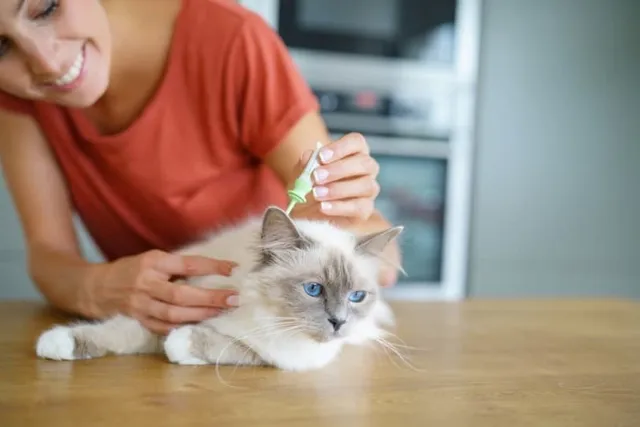
Frontline and Advantage are unlikely to cause any harm to you or your cat when used correctly. Full instructions for use can be found on the information sheet supplied in the box with the medicine. Care should be taken when using spot-on medicines. Keep them away from your skin and face in case of irritation or accidental swallowing. Apply them to an area of your cat that cannot be licked during grooming (the back of the neck is best), as they can be dangerous if swallowed. It is important to keep recently treated cats away from other pets as they can lick the product from the coat of the treated cat. Keep children away from recently treated cats as the cat should not be stroked until the product is fully dry.
Conclusion
Both Frontline and Advantage are available without a veterinary prescription as a way of controlling fleas on your cat. Both products are a useful alternative to giving a tablet. Both treatments can have side effects and should be applied carefully, following the information on the sheet provided with the treatment. If your home is infested, both products may need to be used alongside another treatment, to fully conquer the problem. As with any product, which is best for you depends on your individual circumstances. If you are in doubt, always discuss it with your veterinarian.
Next on your reading list:
Featured Image Credit: Icons vector created by terdpongvector - www.freepik.com
Expert cat care, straight to your inbox
News, insights, and useful advice, delivered to you.

No spam — unsubscribe anytime.
By signing up, you agree to our Terms & Conditions and Privacy & Cookies Policy.
How useful was this post?
Click a star to rate. You can leave written feedback afterwards. (We read all feedback.)
Dr. Joanna Woodnutt BVM BVS (Veterinarian)
Joanna is an experienced veterinarian working in the UK. She has written about pets and their health for many blogs, pet magazines and pet websites and loves to help readers understand their pets through her writing.
She has started her own freelance company so she can help more pet parents than just the one standing in front of her in a consultation room.
She enjoys teaching and educating clients, so a career in writing, public education and pet health is the perfect combination for her.