Is It True That All Cats Have White Whiskers? Vet-Verified Facts & FAQ


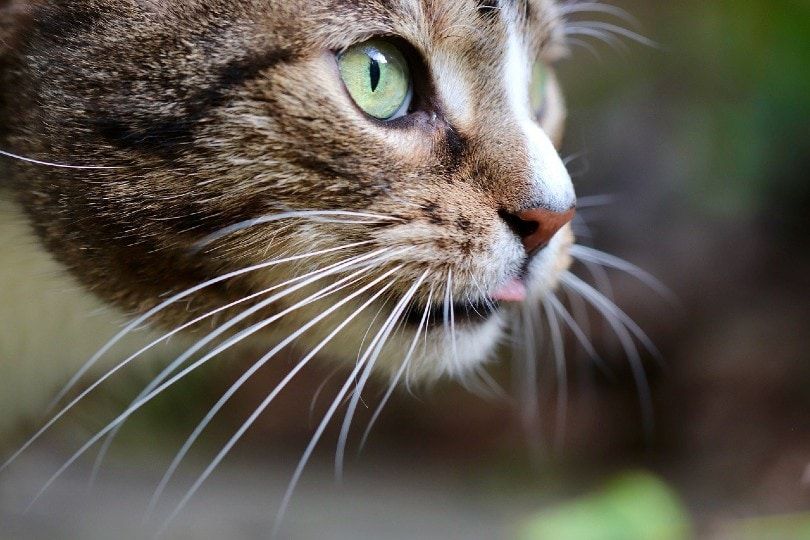
It appears that nearly all cats have white, almost transparent-looking whiskers, but there are some exceptions. Cats can come in a range of different colors and various patterns, but their whiskers are usually always white regardless of their fur coloration.
A cat’s whiskers are unique and serve important sensory functions; however, there is limited color variation when it comes to whiskers.

Why Are Cats’ Whiskers White?

Cats’ whiskers are white because the cells that form the whisker shaft typically lack active melanin production, which gives them an almost translucent white appearance. The whiskers of cats are approximately three times thicker than a cat’s normal fur and generally lack melanin. However, some cats’ whiskers can change color as they start to age.
Some whiskers may appear grey; however, they rarely have colors like black or orange. In some cats, genetics can play a role in the color of their whiskers, which can make them appear darker or pigmented. Some cats can have a mixture of different colored whiskers, and it can change as your cat goes through various life stages. Kittens are usually born with predominantly white whiskers that can darken to a grey color as they age.
Can a Cat’s Whiskers Be Black?
A cat can have black or dark grey-looking whiskers; however, the whisker itself will usually remain translucent in bright light because the whisker contains little to no melanin. Surface debris or keratin buildup can also cause a cat’s whisker to appear darker.
Certain breeds like the Bombay cat may have darker-pigmented whiskers, which can appear black if they are looked at from a distance. A cat’s whiskers can also turn a darker color if your cat is in their senior years. It is also common for a cat to have one whisker that looks darker than the others, and this may sometimes indicate that the whisker is going to fall off.
Some cats may not experience any changes in their whisker color even as they age. If your cat has a black coat, it does not necessarily mean that they will have black whiskers, as an orange or white cat may also have darker whiskers, and most black cats will have white or grey whiskers.
What Is the Difference Between Cat Fur & Whiskers?

A cat’s whisker starts as a single ring of skin cells and develops at the root to be much thicker and longer than your cat’s fur. Whiskers generally do not retain melanin that gives cats their fur coloration, which is why whiskers are white. A whisker may briefly contain pigment during early development, but this is typically lost as the whisker matures.
During the development of whiskers, the cells that form the hair shaft become keratinized, which contributes to their pale appearance.Cats’ whiskers grow close to nerves and have deep roots, which is why a cat’s whiskers are so sensitive to touch.
Whiskers are made from a protein called alpha-keratin, which is the same protein as a cat's fur; however, whisker follicle is structurally different. Whiskers are embedded deeper within the dermis and subcutaneous tissue, surrounded by a blood sinus and rich nerve supply, whereas fur hairs are more superficial. A cat’s coat color is dependent on the pigmentation in the skin cells, whereas the whiskers are not.
Final Thoughts
A cat’s whiskers are generally white in appearance, but they can change in color when your cat ages or as part of normal whisker growth and shedding cycles. It is possible for a cat to develop black whiskers depending on their genetics, and whiskers may darken when your cat ages. The main reason a cat’s whiskers are white is that they typically lack significant melanin, unlike your cat’s fur. It is not uncommon for cats’ whiskers to change color throughout their life, though many cats will have predominantly white whiskers.
See Also:
Featured Image Credit By: Annette Meyer, Pixabay
Expert cat care, straight to your inbox
News, insights, and useful advice, delivered to you.

No spam — unsubscribe anytime.
By signing up, you agree to our Terms & Conditions and Privacy & Cookies Policy.
How useful was this post?
Click a star to rate. You can leave written feedback afterwards. (We read all feedback.)
Sarah Psaradelis is an avid young writer with dual passions for literature and animals. She enjoys sharing knowledge of animal care and helping others. Sarah has over 8 years of writing experience and is currently studying veterinary science. She resides in South Africa where she takes care of fish, aquarium snails, dogs, and rodents. Sarah is a passionate vegan activist and animal rescuer pursuing her path to make the world a better place for humans and animals alike.