Are Cats Able to Feel Pain in Their Whiskers? Our Vet Explains

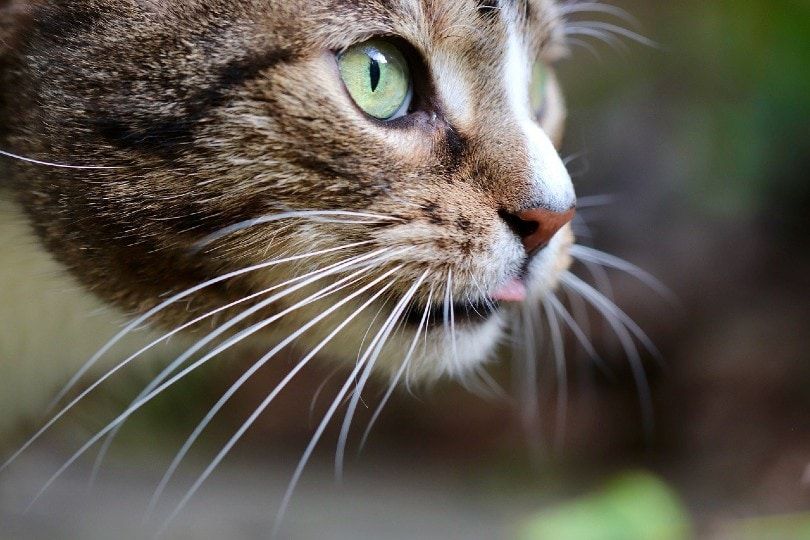
Your cat is cute as a button, with a friendly face made even more endearing by the presence of whiskers. But aside from their visual appeal, what purpose do whiskers serve in our feline friends? If trimmed or damaged, can cats feel pain in their whiskers?
Thankfully, while cat whiskers can transmit sensory information, they do NOT have feelings and will not be painful if cut or damaged. The following article will discuss whiskers in greater detail, to illuminate the importance of these specialized hairs in the day-to-day lives of our precocious pets.

What Are Whiskers?
Whiskers, also known as vibrissae, are sensory tactile hairs found in the majority of mammal species.1 Longer and thicker than the hair found throughout the rest of the body, feline whiskers are located on the upper lips, chin, above the eyes, and on the forearms. Whiskers originate in large specialized follicles, complete with a rich blood supply and plentiful nerve receptors—making them an incredibly unique and important part of a feline’s anatomy.
The Function of Feline Whiskers

Feline whiskers play an important role in the transmission of sensory information. When a cat’s whiskers contact a surface they bend; this movement is sensed by mechanoreceptors within the whisker follicle, which translate the movement into a neural signal.2 Nerves that originate in whisker follicles then transmit these signals to the brain, where the information is processed and used to provide felines with information about their environment.
Feline whiskers are so sensitive that, in addition to providing information as a result of touch, they can also detect subtle changes in airflow—thus, equipping cats with invaluable information about their surroundings, which allows them to both avoid danger and excel as a predator species. Additionally, the information obtained from whiskers may help accommodate the relatively poor short-distance vision of felines,3 and help protect their faces from scratches, scrapes, or other injuries.
Lastly, a cat’s whiskers serve as an important means of communication with other felines, as well as humans. A cat that is tense or alert may have its whiskers fanned out and pointing forwards,4 while a more relaxed cat will have whiskers that are less spread out, and oriented sideways from the face. A fearful feline may bunch its whiskers together, and keep them flattened against its face.

What Happens if You Cut a Cat’s Whiskers?
Feline whiskers are composed of keratin—the same protein that makes up the fur on the rest of their bodies. Keratin is also the same substance found in human hair, nails, and the outer layer of our skin. Because whiskers are made of keratin, they will not feel pain if cut or trimmed—similar to the lack of sensation humans experience when getting a haircut.
Even though trimming a cat’s whiskers will not cause any pain, whiskers should NOT be cut or trimmed, as this will diminish the sensory input felines receive from these specialized hairs. This sudden loss of sensory information may make it more difficult for a cat to navigate and understand its environment, potentially leading to stress and disorientation.
While whiskers themselves do not contain any nerve endings, the follicles in which they are anchored do—therefore, plucking or pulling a cat’s whiskers would be a painful experience and should be avoided.

Conclusion
In summary, while not unique to cats, whiskers are an incredibly important feature of our feline friends that provide them with the information necessary to thrive in their environment. While cats do not feel pain in their whiskers, they should still never be trimmed or cut (unless it is deemed medically necessary by a veterinarian), as doing so could put a cat’s confidence and safety at risk.
Featured Image Credit By: Annette Meyer, Pixabay
Expert cat care, straight to your inbox
News, insights, and useful advice, delivered to you.

No spam — unsubscribe anytime.
By signing up, you agree to our Terms & Conditions and Privacy & Cookies Policy.
How useful was this post?
Click a star to rate. You can leave written feedback afterwards. (We read all feedback.)
Dr. Leigh Wilder DVM (Veterinarian)
Leigh is a veterinarian with almost 10 years of experience in the US. She has loved animals since she was a child, and grew up caring for hamsters, guinea pigs, rats, fish, and dogs. Leigh received her Doctor of Veterinary Medicine degree from the University of Minnesota and has worked in both small animal clinical practice and shelter medicine since graduation. Leigh enjoys small animal preventative medicine and surgery and loves helping pet owners by sharing her knowledge. Outside of work Leigh enjoys spending time with her family, reading, and traveling.