Siberian Cat Grooming: 4 Vet-Approved Tips & Tricks



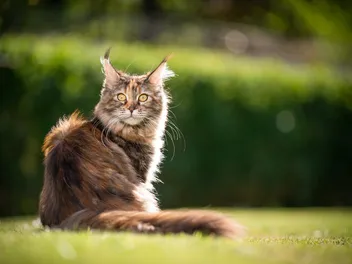
Siberian cats have long, thick coats, and it’s necessary to maintain their coat as part of keeping your cat healthy and happy. Coat problems, like tangles, mats, and oil buildup, can all lead to discomfort, pain, and infection, so it’s essential to your cat’s overall health and wellbeing for their coat to be maintained.
While this does require a commitment of time, effort, and planning on your part, it will pay off in the long run for your cat.

The 4 Tips for Siberian Cat Grooming
1. Get the Right Tools
The right brush can make all the difference in managing your cat’s coat. The wrong brush can leave behind loose fur, dead skin, or damage your cat’s coat. For long, thick coats, there are specific brushes that will be most effective. Your cat’s coat will benefit from a metal comb or a slicker brush. A de-shedding brush formulated for cats with long coats can also be beneficial, but these brushes should be used carefully because if used incorrectly or too frequently, they can irritate the skin and damage the coat.
Pros
- Multiple options available
- Different brushes can serve different purposes
- Helps maintain skin and coat health when used properly
Cons
- May be stressful or painful for your cat if used incorrectly
2. Start a Routine
The simplest way to maintain your Siberian cat’s coat is to get into a home grooming routine. Regularly brushing your cat’s coat will help keep their skin and coat healthy. Regular brushing distributes the oils on the skin, which helps moisturize the skin and coat, reducing shedding and flaky skin. Routine brushing will also prevent mats, which is important because mats can cause pain and skin irritation and infections. Siberian cats aren’t particularly prone to developing mats with proper care, and most of them can be maintained by once or twice weekly brushing.
Twice a year, most Siberian cats will molt, which is a form of heavy shedding. During this period, your cat may require more frequent brushing to remove the excess shed.
Pros
- Maintains skin and coat health
- Reduces shedding and skin flakiness
- Prevents mats and tangles
- Reduces excess cat hair in your home
Cons
- Requires a time commitment

3. Pick the Right Food
A high-quality cat food is one of the best ways you can maintain your cat’s overall health, which will positively impact their skin and coat health. High-quality cat foods are high in protein and are a good source of omega fatty acids, which support skin and coat health by improving moisturization, encouraging healthier hair growth, and reducing skin flakiness. Omega fatty acids can be added to food in the form of supplements, but high-quality cat food is still the best basis for supporting your cat’s skin and coat health. Food formulated with the skin and coat needs of longhaired cats in mind can be of major benefit to Siberian cats.
Pros
- Improves overall health
- Encourages healthier skin and coat
- May reduce shedding and skin flakiness
- Benefits can be achieved through supplementation
Cons
- High-quality food is often more expensive than low-quality food

4. Consult with a Groomer
Even the cleanest and most well-groomed cats may need extra help from a groomer sometimes. A consultation with a groomer can help you determine where your home grooming routine may be lacking, and it also provides you with information on how to handle certain problems, like mats. Many longhaired cats need a little bit of trimming around their back end to improve hygiene, and a groomer can do this for you. This type of trim is often called a sanitary or potty trim.
It isn’t recommended to shave your entire cat, but sometimes this is necessary, and a groomer can also provide this service for you as well. Consulting with a groomer before you need them will help you select a groomer who uses fear-free practices and doesn’t require sedation for cat grooming.
Pros
- Can help you identify where your grooming routine is lacking
- Improves your knowledge of your cat’s coat
- Can keep your cat healthier and more hygienic
- Can be used to shave your cat when necessary
Cons
- Requires planning ahead
- Can become costly
Conclusion
It may surprise you to know just how easy it can be to maintain the thick coat of Siberian cats. Their grooming needs are minimal, but they do require a grooming routine to keep their coat healthy and free of mats and tangles. During shedding or molting periods, Siberian cats may need more frequent coat care, but this will only occur twice per year. A groomer can be a great resource if you’re unsure if you’re providing appropriate care to your cat’s coat.
Sources
Featured Image Credit: Just-Mila, Shutterstock
Expert cat care, straight to your inbox
News, insights, and useful advice, delivered to you.

No spam — unsubscribe anytime.
By signing up, you agree to our Terms & Conditions and Privacy & Cookies Policy.
How useful was this post?
Click a star to rate. You can leave written feedback afterwards. (We read all feedback.)
Christian started writing for a local newspaper as a teenager, and he's been involved in the publishing industry for most of his adult life. Combining his love of writing with a passion for animals, he is currently the Director of Editorial at Pangolia and the Editor-in-Chief at Catster.
Christian lives in the Philippines with his wife, son, and four rescue cats: Trixie, Chloe, Sparky, and Chopper.