How to Train a Bengal Cat: 7 Vet-Approved Tips


In this article
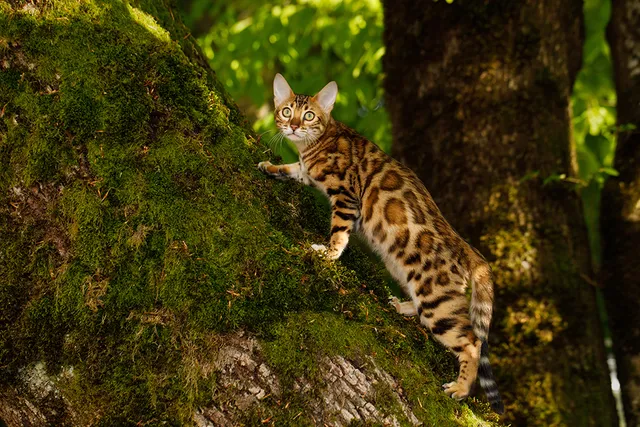
Bengals are one of the most intelligent cat breeds out there. They’re often compared to dogs because of their willingness to learn tricks and affinity for pleasing their humans. Bengals can learn various tricks and may learn faster than any other cat breed. They are also very energetic and mischievous, so training them is a great way to redirect potentially naughty behaviors.
If you’re curious about how to train your Bengal, you’ve come to the right place. Keep reading to find our seven tips and tricks for getting your Bengal interested in training.

The 7 Tips & Tricks to Train Your Bengal Cat
1. Get the Right Supplies
Before you can begin training your Bengal, you need to invest in the right supplies to kickstart your training regimen.
Cats can be very treat-motivated, so having the right treats can make or break your Bengal’s training session. You may find that your cat is more willing to do what they’re asked if they get a tasty snack afterward. Check out our guide on the best treats for picky cats for some inspiration.
A clicker is another great-to-have supply for kitty training. While it’s not entirely necessary, it can make the process a little easier. We like the Clik-R from PetsSafe, as it has a finger strap so you can hold the device in one hand, and it also comes with a training guide for more advice on getting started.
Target sticks are great tools to use alongside your clicker. A target stick is a long, usually telescoping stick with a small ball on the end. Trainers use target sticks to move their pets through space without having to physically touch them. It works as a visual target to get your Bengal moving from one place to another. You can use a target stick to guide your cat into their backpack or carrier and to aid with agility training. Check out this two-in-one target stick and clicker, as it's one of our favorites!

2. Never Punish
If there’s one surefire way to make your Bengal hate their training sessions, it is punishment. Just like humans, cats do better when rewarded for positive behavior than when punished for bad behavior.
Not only do punishments cause stress for your Bengal, but they can also wreak havoc on your relationship. You might even notice your kitty hiding from you, refusing to eat, or shedding more than usual.
Instead, give your Bengal words of praise and plenty of treats when they do a job well done. Be sure to reward them with their treat or praise immediately after they do an action or command correctly. The keyword here is immediately. If you wait too long between the action being complete and the reward being offered, your cat won’t be able to connect the two and won’t understand that good behavior is what resulted in the treat.
3. Get Their Attention
Bengals are generally very hyperactive, and getting their attention can be difficult. Cats are very motivated by their instincts and desires, so food is a great way to get your Bengal to pay attention to you. Call them by their name, and offer a treat to grab their attention.

4. Use the Right Food
It’s important to use the right treats as motivation for your Bengal’s training session. Giving them a low-quality treat that’s high in calories can cause nutrition problems due to unhealthy ingredients like artificial preservatives and flavorings.
Try to find a healthy high-protein treat that has none of those empty calories that won’t be of any use to your Bengal. Look for options that list protein as the first ingredient.
If you prefer “natural” options and don’t mind getting into the kitchen, plain boiled chicken breast shredded into tiny pieces is an easy and healthy treat. Just remember to keep it fresh. Bring only the portion that you will use to each session, and keep the rest in the fridge for no more than 4 days to ensure its safety.
Regardless of the kind of food that you use as a reinforcer, ensure that it does not exceed 10% of your Bengal’s daily calorie allowance. Use your reinforcement opportunities wisely.
5. Use Clicker Training
Clicker training acts as a fantastic foundation for your cat to understand what training is all about. Once your Bengal knows how a clicker works, training will be much easier.
When you first begin using a clicker, your goal should be to condition your cat to associate the clicker with a food reward. Start by sitting with your Bengal in a quiet space and clicking the clicker. After each sound, give your pet a treat. Repeat this around 10 times, and after a few sessions, your kitty will begin associating the clicker noise with a tasty treat.
Once your kitty understands that the sound means they will get a treat, you know that they are ready to move on to some basic training.
Timing is essential when you clicker train your pet. The instant your Bengal performs the behavior you’re trying to teach them, click and then offer a treat. The goal is to have your pet make the connection that certain behaviors performed by them but desired by you equals a treat!

6. Move Onto Target Stick Training
Once your Bengal has mastered clicker training, you can begin using your target stick.
Before your target stick sessions, put a piece of smelly food, such as tuna or your cat’s favorite wet food, on the ball at the end of the stick. Once your kitty gets a sniff of food on the stick, click your clicker. This noise will tell your Bengal that a treat is available. Repeat this several times. Make sure to wash the target stick well first.
The idea is to only do this in the first session or two, to help your Bengal understand the task and your expectations when you present the funny-looking tool. Once your cat reliably touches the target with their nose when it’s presented near their face, you can move to the next step.
Move your target stick farther away from your cat so they have to get up and walk over to touch it. Click the clicker and let them have their treat.
Once your kitty has learned that there’s a treat at the end of the stick, you won’t need to continue putting the treat there. Your Bengal will be able to associate following the stick with getting a treat. Every time you move the stick and your cat follows it, use your clicker and offer a treat.
To start testing your Bengal, maneuver the stick over furniture so they have to jump to get to it. At this point of their training, be sure to reward them with a click and treat when they touch the stick, to create a strong history of reinforcement with the target. Eventually, you can fade out the treats and only offer them randomly for following the target, but for now, you’re establishing the basis.
7. Have Patience
Cats, especially Bengals, do best with short training sessions. They have short attention spans, so be realistic when you plan the duration of every training session. Stop before they lose interest, and only teach them one thing at a time.

What Tricks Can I Teach My Bengal?
There is no limit to what tricks you’ll be able to train your Bengal to perform. Here are some of the basic commands you can begin with:
Once your kitty has these commands down, you can move to more complicated tricks such as:
Are Bengals Easy to Train?
If you have owned a Bengal for some time, you already know that this breed is exceptionally clever and intelligent. Most Bengal owners will find training their cats to be rather easy.
Of course, that’s not the case for every single Bengal. You may have adopted one that’s a bit more challenging. That doesn’t mean they’re not trainable, though. You may just need to find their motivations or the right time of day when they’re more willing to participate. You will also need to learn to have patience and celebrate the small wins.

Can I Train My Bengal to Walk on a Leash?
Absolutely! Teaching a cat to walk on a leash is not as difficult as you might think. You’ll first need to buy your Bengal a snugly fitting harness and a leash. We recommend a retractable option, as you can vary the length of the leash depending on where you’re walking or what your training goals are.
First, get your kitty desensitized to the presence of the harness. Simply put it in the room and use the target stick to get the cat near it. Ensure that you reinforce them for getting close and for eventually touching the harness. Take your time, and get the cat to pass by the harness, touching it with their head and the top and sides of their body. Eventually, place the harness over the cat, and reinforce them for having it there. You can use the target to guide the cat’s face and neck through the harness hoop.
Once that is achieved, the next steps consist of getting the cat accustomed to wearing the harness. Put it on them for a few minutes every day just to let them get a feel for it. After they are used to wearing the harness, you can attach the leash. As with harness training, start by desensitizing the cat to the leash's presence and feel. Only leave it attached for a few minutes at a time. Then, hold the leash, and let your kitty guide you or use the target stick to have them move around. You will need to repeat this process to get your cat used to walking while wearing the harness and having the leash attached.
Next, take them to a safe space, such as your enclosed backyard, to let them explore with the harness and leash on. Once they are comfortable walking around your yard, you can take your adventures further by heading to the street and going for a short walk.
Remember, never push your cat to do anything that they’re not willing to do on their own. Be patient, and let them lead the leash training sessions.
Taking your cat for a walk may sound challenging, but the right harness and leash can make all the difference! We recommend Hepper's Cat Harness & Leash Set because it combines important safety features with stylish and comfortable design elements.
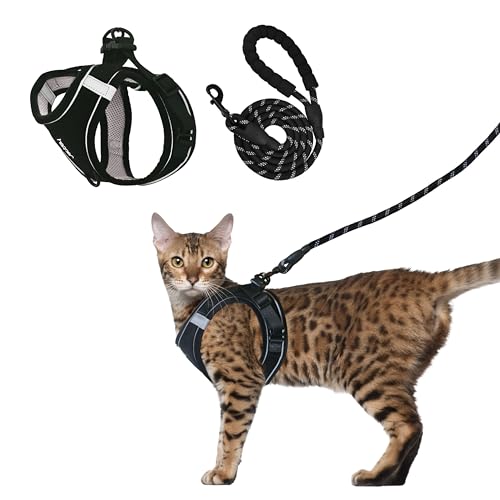
- Escape Proof - Cat leashes and harnesses for walking aren't all equally secure. Our double aluminium D-rings ensure strength when outside, as does the reinforced stitching on this step in vest.
- Superior Comfort - Our cat harnesses are lightweight, made with premium velvet fabric, breathable mesh, with soft edging and resilient cushioning. Also, it is machine washable. Looks and feels great!
- Free Extra Strength Leash - You don't need to worry about your cat escaping this harness. This cat leash is made of thick nylon climbing rope with rotating clamp to keep the strongest kitties at bay.
From the highly adjustable, machine-washable velvet harness to the sturdy nylon climbing rope leash, this set has everything you'll need to start adventuring.
>At Catster, we’ve admired Hepper for many years and decided to take a controlling ownership interest so that we could benefit from the outstanding designs of this cool cat company!
How Can I Train My Bengal to Stop a Bad Behavior?
Bengals have a lot of energy, and if they don’t have an outlet for all this pent-up energy, they can turn to naughty behaviors. Don’t let their small size confuse you. A bored Bengal can be just as destructive as a dog!
The best way to prevent any problematic behaviors is to set up your cat’s environment in a way that will not allow for mischievous misbehavior in the first place. Bengals need to play, scratch, hunt, climb, and exercise. Does your home have toys or structures like cat trees set up so your kitty can express the natural behaviors of their species and release some of their energy in a healthy way?
The best items to invest in when you have Bengals include:
Most Bengals also do well in multi-pet homes. If you're away a lot, you may want to consider adopting another cat or even a dog to keep them company. Having another playmate around can keep your naughty Bengal active and busy all day. However, you will need to introduce your two pets slowly to ensure that territory aggression is kept to a minimum.
Conclusion
Bengals are among the easiest cat breeds to train, so you’re already off to a good start if you have a Bengal at home. Patience is key to training any pet, so be sure you have realistic expectations as you begin down the path of training your cat. Plan well, use your reinforcers wisely, and keep the sessions short so your kitty stays interested in what you’re trying to teach them. Make sure you mix in play and cuddles. Give your Bengal the right space and tools to prevent unnecessary stress or boredom.
Featured Image Credit: Svetlana Rey, Shutterstock
Expert cat care, straight to your inbox
News, insights, and useful advice, delivered to you.

No spam — unsubscribe anytime.
By signing up, you agree to our Terms & Conditions and Privacy & Cookies Policy.
How useful was this post?
Click a star to rate. You can leave written feedback afterwards. (We read all feedback.)
For Chantelle, writing and animals are the two driving forces in her life. Growing up on the Canadian prairies surrounded by pets, she now shares her home with five cats, two guinea pigs, and a bearded dragon. Chantelle, her husband, and their child pride themselves on being dedicated pet parent, even spending a fortune on wall-mounted cat shelves to provide their cats with an indoor jungle gym. When she's not snuggling with her cats or photographing their humorous moments, Chantelle is exploring the Rocky Mountains, rewatching her favorite Netflix series, and reading up on various random subjects.