In this article
If you bring a cat into your home, you have to realize you’re bringing a predator right into your living room. While cats don’t go after big game like humans, that won’t stop them from stalking around your home looking for spiders, rodents, and other small animals to go after.
But how exactly do cats hunt? They have two primary methods they will use, and some of the finer details behind their actions might surprise you!

How Do Cats Hunt?
Cats are natural-born hunters, and they go about capturing their prey in one or a combination of two ways. They use the stalking method and the waiting method (or both), and we’ll go over how they hunt using each method for you here.

Stalking
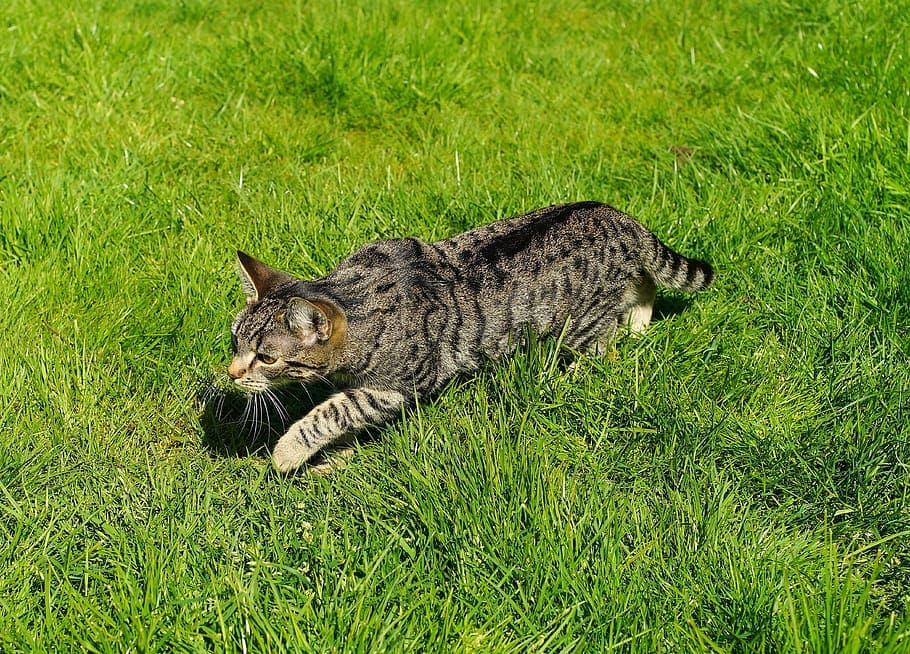
This is the most common way a cat hunts and it usually follows a pretty particular pattern. The cat starts by scanning the environment and finding their prey. From there, they “stalk” the prey and try to come up behind it.
Once they’re in position, they pounce and capture the prey. During this process, they might toy with the prey a bit to try and tire them out before they move in for the kill. After they complete the kill, they often “manipulate” the body before eating it.
Waiting
While the stalking method is the most common hunting method a cat—especially a domestic cat—will use, it’s not the only method they have. Cats will also deploy a “waiting” method while they’re hunting, especially if they have an area where they know prey likes to go.
In this method, they get into a prime position and watch a specific area. When the prey passes through, they’ll pounce, jumping straight to the capture and kill portion of the stalking hunting method.
Why Do Cats Toy with Their Prey?
If you’ve ever watched a cat hunting, you’ve likely noticed it doesn’t go in for the kill right away. Instead, you will watch as the cat bats the animal they’re hunting around a little bit. While this might seem counterintuitive to hunting, it makes perfect sense.
Your cat is trying to tire out the prey before going in for the kill simply as a form of enrichment. In addition, a theory suggests that a tired animal is less likely to hurt your cat in the process. However, this theory isn’t without its flaws, as playing means a cat will waste both time and additional energy before they eat. Nonetheless, they’re not playing with the prey to be mean; they’re doing it as a natural hunting instinct.
Mother cats often bring half-live prey to their kittens to encourage them to practice their hunting skills. At times, you might notice a feral cat moving an injured prey for this reason.
How Do Cats Kill Their Prey?
This largely depends on the type of cat (wild versus domestic) and the type of prey (rodents and mammals versus insects and other animals). Speaking to wild cats, they typically kill their prey by biting the neck, which severs the spinal cord—a fairly quickly and relatively painless death for the prey. However, domestic cats, as described above, generally don’t have the hunger-based prey drive of wild cats, but whenever they decide to kill rodents or small mammals, they use the same method: Go for the neck, snap the spinal cord, end of story.
Now, if you’ve ever seen your cat go after an insect or small lizard, it generally doesn’t work the same way. Cats will typically maim and dismember an insect or lizard, rendering it immobile, at which point, the cat loses interest and the creature in question dies a slow death.
Do Cats Hunt Because They’re Hungry?
In the wild, cats have a strong motivation to hunt. If they don’t capture prey, they don’t eat! But domestic cats don’t have this issue, and yet they’ll still hunt whenever they get the chance.
It doesn’t matter how much food you put out for them, your cat is still going to hunt if the opportunity comes up—it’s part of their natural instincts. Cats are opportunistic hunters and if they see an opportunity, they’re going to take it even if they’re not hungry at the moment.

Can You Stop Your Cats From Hunting?
While you can reduce the tendency for your cat to go looking for something to hunt, you’ll never eliminate that desire completely. The best thing you can do is to offer your cats plenty of opportunities to engage in play and exercise, as cats actually practice hunting when they engage in play.
From there, you need to keep prey away from them. This means keeping mice, spiders, and other small animals out of your home. If they’re well engaged with play and interactions with you and there’s nothing to hunt, there’s a good chance your cat won’t go around looking for prey as much. But if they spot something to hunt, they’re going to go after it!
If your cat is an outdoor cat, you can curb their hunting by offering them a safe catio to hang out in. Alternatively, cats can be leash-trained to enjoy the outdoors safely. Cats should not be allowed to roam unsupervised. This is dangerous for the animals in their vicinity, as cats are very destructive towards local fauna. In addition, your cat may also experience injury, end up lost, be harmed, or contract a disease or illness if they roam unsupervised. Depending on where you stay, some animals in your location might view your cat as prey.
Finally, though most pet cats do not have a dietary deficiency and rarely hunt out of hunger, it might be worth investigating your cat’s diet with your veterinarian to ensure that your cat isn’t looking for opportunities to hunt out of hunger.
Final Thoughts
Now that you know a little more about how a cat hunts you might be able to recognize the behavior the next time they’re on the prowl. They are magnificent hunters, so take a step back and watch them in action if you get the chance. Their speed and efficiency when they’re hunting might just surprise you!
See also:
- Why Do Cats Sneak Around? 10 Possible Reasons for This Behavior
- How to Satisfy Cat Hunting Instincts: 7 Expert Tips
Featured Image Credit: SJ Duran, Shutterstock