Get

In Your Inbox

Catster is reader-supported. When you buy via links on our site, we may earn an affiliate commission at no cost to you. Learn more.

Can Cats Eat Pine Needles? Vet-Approved Risks & Alternatives

Share

Can Cats Eat Pine Needles

If you want to celebrate Christmas with a beautiful pine tree in your house, but you also own a cat or two, you know how tricky this can be. Beyond the usual hazards of your cat vs. the Christmas tree, is it safe for your cat to snack on pine needles?

Are pine needles safe for cats? No, they are not! There are two concerns regarding pine needles and cats: pine needles have toxic elements, and there’s a puncture risk.

We know that you want to enjoy your Christmas tree, but not if it’s a risk for your cat. Here, we go over why pine needles are a risk for cats and what you can do to lessen the danger.

divider 2 cats

A Little About Pine Trees

Pine trees are conifers (which means they are a plant that bears cones — pinecones) that belong to the genus Pinus. There are at least 100 species of pine trees that range in size from about 3 feet to 100 feet tall!

Three pine trees are traditionally used for Christmas purposes:
  • White pine — The white pine is a light bluish-green color. It doesn’t do well with heavy ornaments because the branches aren’t as strong as some other trees. It also isn’t as strongly fragrant.
  • Scotch pine —This tree makes an excellent Christmas tree because of its dark-green color, medium fragrance, and strong branches.
  • Virginia pine — The Virginia pine has a medium fragrance and is a dense green tree with twisted needles.

Despite the beauty of all these different pine trees, there’s a good reason that cats and pine trees should be kept away from each other.

Cats and Pine Needles

There are numerous hazards for cats when it comes to Christmas trees, but those hazards are more extreme with pine trees in particular.

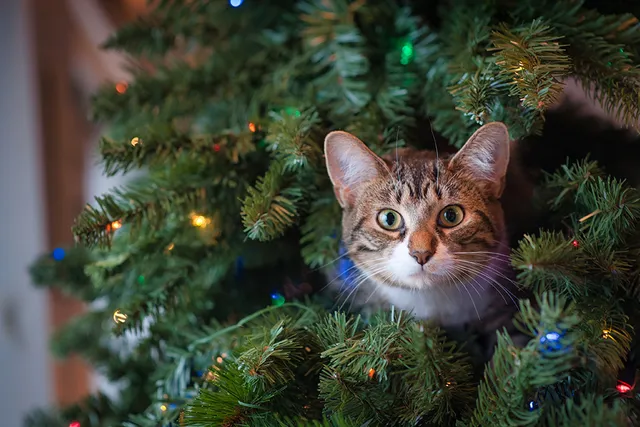
Christmas tree cat
Image By: Unsplash

Pine Sap and Oil

Cats and essential oils do not get along. Cats are highly susceptible to essential oil poisoning, either by ingesting it or it getting on their skin, where it can be absorbed. Cats are missing a specific enzyme in their livers called glucuronyl transferase that is needed to metabolize essential oils. Some essential oils are worse than others, but pine oil is included on the “toxic for cats” list.

The symptoms of a cat that has ingested pine oil can include:

If left untreated, any essential oil, like pine oil, that your cat ingested can eventually lead to death. Pine oil is also found in the sap of a pine tree. So, if your cat chews on pine needles or gets sap on their fur and licks it off, you need to contact your vet right away!

If you need to speak with a vet but can't get to one, head over to PangoVet. It's an online service where you can talk to a vet online and get the advice you need for your pet — all at an affordable price!

PangoVet_Mention-in-Content for PangoVet2 save money

Pine Needles Act as Needles

As anyone who has handled a pine tree can attest, those needles can be sharp! Swallowing a bunch of those little pine needles could cause internal damage.

The sharp points could potentially puncture the mouth, esophagus, stomach, and intestines, which can be painful and cause serious injury.

Additionally, any pine needles on your floors could puncture their paws. If you believe that your cat has swallowed any pine needles, speak to your vet about the next steps.

Pine tree needles sticking out
Image By: LUM3N, Pixabay

Tree Water

In some ways, the tree water can be the worst culprit for cats. There are many bad things in the water, including pine sap, bacteria, and mold.

Also, some trees are treated with chemicals to help preserve them and enhance their appearance. There could also be fertilizer, pesticide, and/or fire-retardant residue present on the tree, which can leach into the tree water.

You should prevent your cat from drinking any tree water, regardless of if it’s from a pine.

divider 2 cats

What Are the Options?

If you have your heart set on a real tree, you could investigate spruce or fir trees as alternatives to pine. You’ll need to stay on top of any dropped needles because you still don’t want your cat to be eating them, but these aren’t quite as bad for cats. You can also consider cat-proofing your tree:

  • Place your tree in a location that isn’t close to anything that your cat can use to jump onto it.
  • Secure the tree so it doesn’t easily topple over. Give it a sturdy base and attach it to the wall.
  • Consider laying down a tree skirt, which you can use to cover the dangerous tree water.
  • Use aluminum foil at the base of the tree. Many cats will avoid walking on it.
  • Adorn your tree with cat-safe decorations, and avoid decorating the tree around the bottom, which can entice most cats. Any ornaments should be shatterproof.
  • Be careful with the lights, as some cats enjoy chewing on wires. Wind the lights around the trunk and keep them away from the bottom. Try covering the wires with some kind of tubing.
  • Only decorate the tree when your cat is not in the room, as it will just increase their curiosity factor. Also, your cat will think that you’re encouraging playtime.
homemade gray tabby cat in a plaid tie with a Christmas tree
Image By: Nadtochiy, Shutterstock

The other option is to go with an artificial tree. These can be quite realistic and won’t have the same toxic risk. But be aware that you’ll still want to prevent your cat from eating any of the plastic needles, as they can potentially cause an intestinal obstruction.

divider 2 cats

Conclusion

It’s best to be safe and avoid having pine trees around your cat. The potential physical injury and the chance of poisoning just don’t make it worth the risk. Your best bet is an artificial tree, which can be used for years. Check online for other Christmas tree alternatives.

If you believe that your cat did eat pine needles, whether from your Christmas tree or from trees outside, you should speak to your vet as soon as possible. It’s best to err on the side of caution when it comes to your cat’s health and safety.

Want content like this delivered to you?

Sign Up For Our Newsletter

News, insights, expert advice, and everything cat

* By submitting, you agree to our Terms & Conditions and Privacy & Cookies Policy.


How useful was this post?

Click on a star to rate (you can leave written feedback after clicking submit)

Help us improve Catster for pet parents!

Your feedback really matters.

What did you like about this post? Also how can we improve it?

Join the conversation

Leave a Reply

You’re very welcome to leave a comment or question. Please know that all comments must meet our community guidelines, and your email address will NOT be published. Let’s have a positive and constructive conversation.


Talk With A Vet Online

Peace of mind,
anywhere, anytime

Affordable vet advice

Do Cats Cause Schizophrenia? Scientists Find a Link – Here’s What It Means

Being a fierce advocate (and occasional recipient of) mental health support and awareness, the term ‘crazy’ is not one I like to fling...

One in 100 Cats Gets Diabetes – Here’s How to Catch It Early

One in every 100 cats develops diabetes.1 That’s not a rare, unlucky condition reserved for cats with obvious health problems. It’s common enough...

Dramatic Rescue Turns Into Dramatic Reunion

What started as a routine call for the RSPCA became a heroic, five-hour rescue featuring one trapped and traumatized cat, an emotional family...

Ask Dr. Paola – Help! How Do I Know if it’s Ear Mites! (May 4, 2026)

Welcome to our “Ask Dr. Paola” series, where every Monday we bring expert advice straight from Dr. Paola Cuevas (MVZ) to help our...

More related

Do All Cats Have Retractable Claws? Vet-Reviewed Science & Info (With Infographic)

As cat owners, we love our little house panthers. But the one thing we aren’t fond of is the claws. Cats show their...

Persian Kittens For Sale in Nevada: Breeders List 2026

Excited Cats advocates for adopting before shopping, though we fully understand there are many reasons for seeking a breeder. So, we encourage it...

9 Best Whisker Relief Cat Bowls for Cats in 2026 – Reviews & Top Picks

Your cats’ whiskers help your cat balance and navigate their way through life. They are also attached to blood vessels and nerves, causing...

How to Litter Train a Stray Cat: 9 Vet-Reviewed Tips & Tricks

Although cats are very clean animals and respond well to litter training, you might need to show them the ropes if you bring...

Keep reading

How to Calm an Anxious Cat: 5 Vet-Approved & Effective Methods

While cats are often seen as independent and enigmatic creatures, they can also experience anxiety, and it can have a profound impact on their well-being. If your once playful and confident feline companion starts to show signs of being unwell—such...

Domestic cat lying on owner's lap

Why Do Cats Eat Grass? 5 Vet-Reviewed Reasons Behind the Behavior

Our beloved cats are quirky creatures with some habits that seem rather baffling to cat owners. One of these behaviors is cats chowing down on grass and then sometimes throwing it back up. Why? Why on earth do these intelligent...

close up of a cat eating grass

How Long Should Kittens Stay With Their Mother? Vet-Reviewed Facts & Development

There is no doubting the attraction of young kittens. They’re tiny and stumble around, and our instinct to protect them takes over. However, taking a kitten away from their mother too soon can be detrimental to the little furball. Not...

cat smelling kitten

UK Cat Chipping Law: What Is It & What You Need to Know (Vet-Verified)

It’s been on the cards ever since dog microchipping became compulsory in the UK, and as of June 2024, it is now a legal requirement that all pet cats in England are microchipped before they reach the age of 20...

Microchiping cat in vet clinic by veterinarians

How Do You Give a Cat Lactulose? (7 Vet Approved Methods)

Lactulose is a stool softener often prescribed to ease feline constipation. The product pulls moisture into your pet’s feces, encouraging regularity by making bowel movements less dense. It’s also often prescribed for cats suffering from liver failure to reduce the...

feeding cat using syringe

Why Do Cats Like Their Ears Rubbed? 5 Vet Reviewed Reasons

When you pet your cat, you’ve likely noticed that they want more of it. But why is it that cats like it when you rub their ears, how can they tell you they like it, and what are some other...

cat with a ear hematoma

Is Declawing Cats Illegal in the UK? Facts, Side Effects & Care Tips

Every cat lover is familiar with the chilling sound of little kitty nails being dragged across a piece of furniture. Sometimes, our cat’s attention is in the right place, like a scratching post, and other times, a beloved chair is...

cat nails with sharp claws in couch

Can Cats Eat Palm Leaves? Vet-Approved Facts & FAQ

Palms are common plants that are easy to care for and pleasing to the eye. They are distinguished by their large leaves, known as fronds, that give off a tropical vibe. Palm plants are used to decorate home and office...

Can Cats Eat Palm Leaves

Love Cats? So Do We! Join the Catster Community

Stay informed with expert pet care insights delivered straight to your inbox! Discover professional guidance on animal behavior, feeding tips, trusted product picks, and much more.


Sign up for the Catster Email Newsletter

Stay informed with expert pet care insights delivered straight to your inbox! Discover professional guidance on animal behavior, feeding tips, trusted product picks, and much more.