Get

In Your Inbox

Catster is reader-supported. When you buy via links on our site, we may earn an affiliate commission at no cost to you. Learn more.

How Do Cats Drink Water? Vet-Approved Facts

cat drinking from cat water fountain

Have you ever watched a cat drink water before? It’s not something many people think too much about, but it’s truly an amazing feat of physics that requires perfect timing and balancing inertia with gravity. Sounds unbelievable?

Keep reading to learn how cats drink and watch videos exhibiting their unique drinking style.

divider cat paws 2 oct 2024


How Do Cats Drink?

High-speed videos made by researchers recently found that the very top is the only part of a cat’s tongue that touches the surface of the liquid they’re drinking.

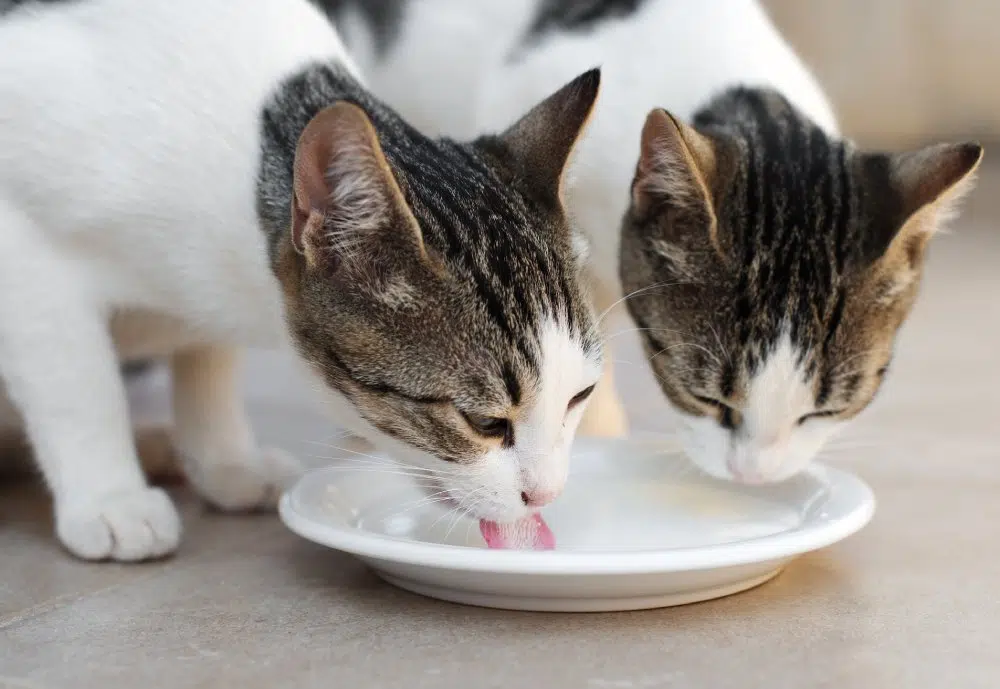
The lapping technique involves their tongues touching the liquid’s surface just barely before returning to the mouth. The tip of the tongue is the only part that touches the water’s surface, and it does so lightly that it doesn’t even break the surface tension. As the tongue returns, a column of liquid forms between it and the water’s surface. They catch this little jet of liquid in a flash and start all over.

This drinking method requires that they lap at the right speed to balance the inertial force, keeping the water moving upward with gravity, which pulls the water back. One of the most interesting parts of this discovery is that cats seem to instinctively know how rapidly they need to lap to balance the inertial force of the water with gravity.

cat drinking water from bowl in carpet
Image Credit: AnnaStills, Shutterstock

What About Wild Cats?

You might be surprised to learn that your domesticated cats’ wild counterparts (for example, lions and tigers) drink the same way, with one stark difference.

Researchers created a robotic tongue to mimic how a cat drinks. The “tongue” was a glass disk that could be controlled to move at different rates, allowing researchers to calculate how much water was ingested with every lap. Interestingly, the model allowed researchers to predict that the larger the cat is, the slower it would need to lap to strike that fine balance between inertia and gravity.

And researchers were right. The videos that they took of big cats drinking showed them lapping less than twice per second, compared to the four laps domestic cats could take in the same time frame.

How Do Dogs Drink?

Neither dogs nor cats drink like humans do. They can’t suck water into their mouths as we do. Like cats, dogs use their tongues to scoop water into their mouths. However, dogs thrust their entire tongue into their water dish much faster than cats, who gently dip their tongues into the water’s surface. It is this careless plunging of the tongue that makes dogs much messier at drinking than their feline counterparts.

Additionally, a cat’s drinking force is twice the strength of gravity, so they appear to drink much more elegantly than dogs, who generate a force eight times that of gravity when drinking.

divider 3 paws

Final Thoughts

Cats are much more refined drinkers than their canine counterparts, and hopefully, our blog has shown you the exact differences between how cats and dogs drink. Watch your cat closely next time he goes to take a drink so you can truly appreciate the physics at work.

Related Reads:


Featured Image Credit: Vershinin89, Shutterstock

Want content like this delivered to you?

Sign Up For Our Newsletter

News, insights, expert advice, and everything cat

* By submitting, you agree to our Terms & Conditions and Privacy & Cookies Policy.

How useful was this post?

Click on a star to rate (you can leave written feedback after clicking submit)

Help us improve Catster for pet parents!

Your feedback really matters.

What did you like about this post? Also how can we improve it?

Join the conversation

Leave a Reply

You’re very welcome to leave a comment or question. Please know that all comments must meet our community guidelines, and your email address will NOT be published. Let’s have a positive and constructive conversation.

Talk With A Vet Online

Peace of mind,
anywhere, anytime

Affordable vet advice

Can a Cat Climb Down a Tree? Vet-Reviewed Anatomy Facts & Rescue Tips

Saving a cat from a tree is one of those stereotypical tropes you see in many cartoons, but have you ever stopped to...

Will Cat Litter Keep Mice Away? Vet-Approved Facts & Info

Unless it’s a pet, the idea of a mouse running around in your house is troubling. Mice carry diseases and are considered a...

Can Cats Help With Anxiety? 9 Vet-Verified Reasons They Do

Cats give us so much, and we should count ourselves lucky that they choose to share their lives with us! We get their...

How to Get Your Cat Certified as a Therapy Cat: Vet Reviewed Training & Certification Steps

Science has proven that the presence of animals is extremely healthy for people, thanks to their ability to reduce stress, loneliness, and other...

More related

Will My Cat Come Back If I Let Them Outside or Do They Need Training? Our Vet Answers

Being a pet owner comes with a lot of difficult decisions. You must choose the right foods, toys, and veterinarians, among other things....

Why Are Cats More Popular Pets in Japan Than Dogs? (Japanese Cat Lore)

When it comes to pet ownership in America, 70% of households are pet owners, with 69 million homes owning dogs and 45.3 million...

6 Alternative Types of Natural Cat Litter: Vet Approved Options

If you’re searching for a new cat litter or natural alternative to the traditional clay litter, you are in the right place. Many...

Lilac Point Siamese Cat Breed: Info, Pictures, Temperament & Traits

The Lilac Point Siamese is one of the most well-known Siamese breeds, revered for their unique and striking lilac-grey color-point coat. They are...

Keep reading

How to Get Rid of Cat Dandruff: 6 Vet-Approved Tips and Tricks

Dandruff is common in cats and is generally a sign that your pet has dry skin. But the causes of dry skin can vary from a simple lack of sufficient humidity in the air to more serious conditions such as...

cat fur with dandruff

9 Best Cat Litters for Odor Control in the UK in 2025: Reviews & Top Picks

Ask any cat owner about cat litter and chances are you’re likely to hear a funny story. And why? Because cats can be a bit particular about their litter, litter boxes, and all of the ins and outs of their...

woman cleaning cat litter

Rescue Cat Behavior: Vet-Reviewed Problems & How to Help

Rescue cats often make wonderful pets, but while many quickly adapt to their new environment, some may exhibit certain behavioral challenges. Understanding and addressing these common problems can help improve the bond between you and your new pet. Here, we...

a sad cat inside a cage

Can Cats Eat Mums? Vet-Approved Risks & FAQ

Chrysanthemums are popular flowers that make dynamic and colorful additions in your garden or in a vase. Due to their long and challenging-to-spell name, they are also affectionately known as “mums.” If your cat seems to be interested in your...

Can Cats Eat Mums

Can Cats Eat Grass? Vet Approved Info & Facts

Cats are no strangers to odd behaviors, but as owners it is easy to worry because our feline friends do not always put their safety at the top of the list. It is quite common to see cats munching on...

Can Cats Eat Grass

Do Air Purifiers Help With Cat Allergies? Vet Reviewed Facts & FAQ

Though around 70% of U.S. households have a pet, many people suffer from animal allergies.1 A whopping 10 to 20% of the world’s population has allergies to cats and dogs. If you’re part of these statistics and want to live...

Close up of a Fluffy Cat Sitting Next to Air Purifier

Cat Vomit Color Chart: Vet Approved Meaning of Different Colors

Cats occasionally throw up. It’s simply a fact of life. Usually, you’d clean it up and move on with your day, but you should check what color your cat’s vomit is. The color can indicate if they have a health...

man petting a sick siberian cat

Why Is My Cat So Skittish? 5 Vet-Reviewed Reasons & Care Tips

Just like humans, cats have different personalities. If your cat is skittish, you may be wondering why. Some cats are simply shy and they are just as lovable! But others become skittish when they’re nervous or in pain. It’s important...

scared British blue-point cat hiding under the bed