Cats are creatures of mystery and mischief, so much so that even their anatomy is fascinating. But no part of a cat’s body is as mysterious as its claws. A cat’s claws are its weapons of choice; cats flex their talons on toys, scratchers, and sometimes even on their owners! But where do they go when a cat isn’t using them? How do they retract them? When cats want to extend their claws, they contract the flexor and extensor muscles in their foreleg to tighten up the digital flexor ligaments. read along while we delve into the ins and outs of how a cat’s claws work and how these naturally deadly tools are retracted.

How Do Cat Claws Work?
To understand how a cat’s claws work, we need to know what they’re made of. A cat’s claws, sharp as they are, are made of the same stuff as our nails: a hard substance called keratin.
Keratin is a protein that grows in layers using nutrients from the living tissue it’s anchored to, called the quick. Keratin is in animals’ nails, hair, horns, and hooves. Surprisingly, a cat’s nails are almost the same as our own, but they have a few differences in anatomy that make them both sharp and lethal.
The Anatomy of a Cat’s Claws
A cat’s claws are layers of keratin, grown around the mound-shaped quick that’s attached to the end of a cat’s digits. The claws grow around and over the blood vessel-rich quick, tapering to a sharp point. Human nails, for comparison, grow in flat layers on top of the quick.
This elongated growth is why cats can shed the outer layers of the claw without issue and why owners can sometimes find shed claws (“claw sheaths”) on the floor around their cat’s favorite scratcher! The outside layer of the claw sheds to keep the ends sharp, healthy, and ready for action. However, the really interesting part of a cat’s claws is the tendons, muscles, and ligaments that make them retractable.

Muscles, Ligaments, and Tendons: The Quick Guide
We don’t need to go through an entire anatomy lesson to learn how a cat’s claws work, but it’s essential to know how their muscles, tendons, and ligaments function to understand how they retract them.
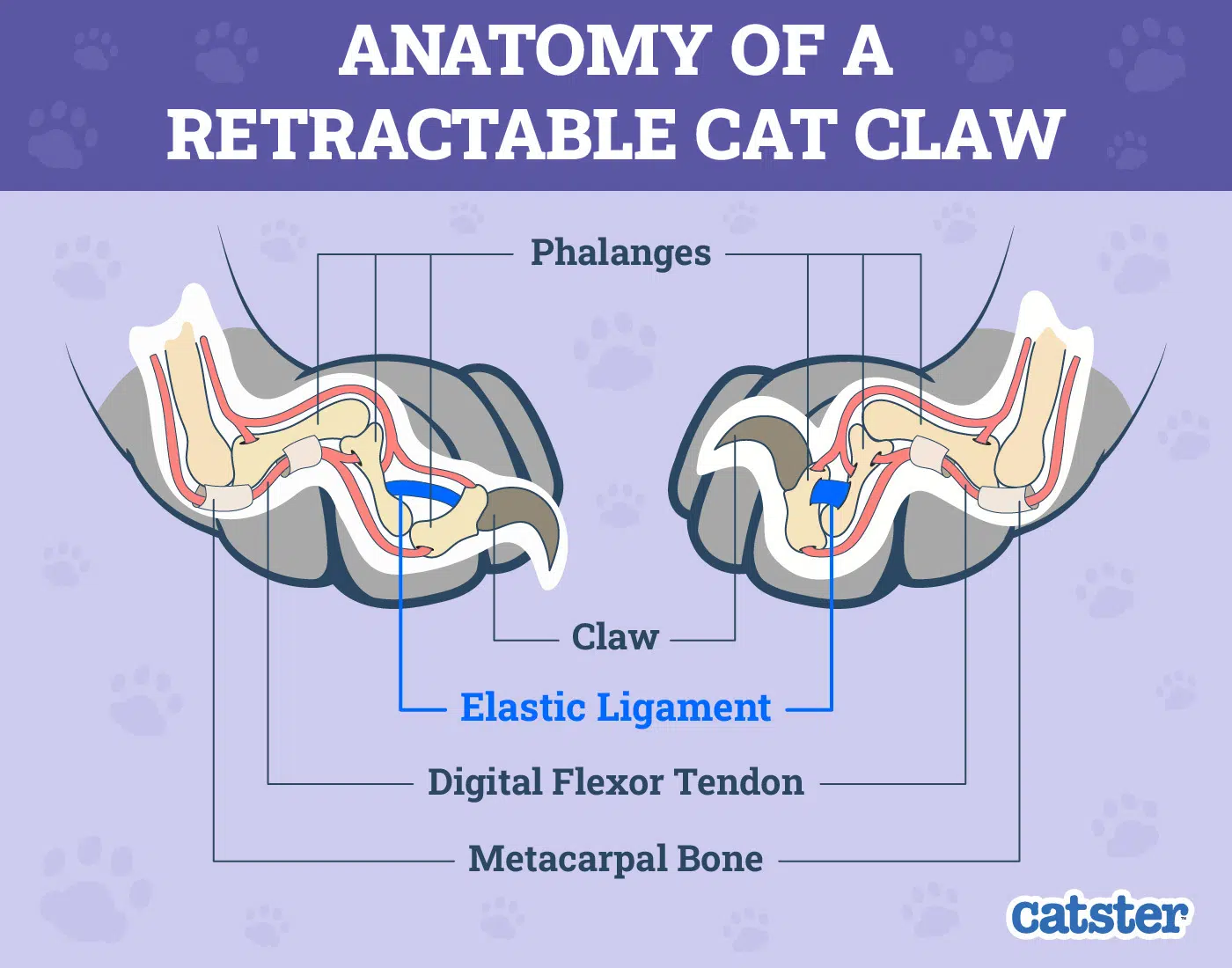
The claw sits in a cuticle on the last segment of a cat’s digit, called the distal phalanx. The nail is attached to the bone, which supports it and helps keep it stable. Two tendons run between the claw and the bones; the superficial and digital flexor tendons are the crucial parts of the claw-sheathing mechanism. Both tendons act to extend the claw or sheath it, depending on which is tightened and relaxed.
If we were looking at a cat’s paw from the side, the superficial tendon connects to the claw on the top and the digital on the bottom. There are two groups of muscles a cat needs to engage in extending its claws alongside these tendons: the foreleg flexor and extensor muscles. Lastly, an elastic ligament in the toes allows a cat to choose when its claws are retracted, giving them complete control even when bending the paw or walking.
How Do a Cat’s Claws Extend and Retract?
The digital flexor attaches to the bottom of the bone a cat’s claw is linked to, so if tightened, it pulls the bottom back, extending the claw out. If either of these muscles fails to work, the claw won’t be able to extend at all.
When the cat is done using their claws, these muscles relax with the tendons. Next, the digital flexor pivots the bottom of the toe bone back to its original position, allowing the claw to move back into its resting state. A cat’s claws are naturally in their relaxed position, so all they have to do is flex these muscles to extend them and relax them again to put their claws away.
Keeping your cat's paws healthy starts with keeping their nails trimmed. A great set of clippers like the Hepper Cat Nail Clipper Set can help you safely and easily do this at home. This set includes two sizes of clippers with stainless steel blades, built-in safety guards, and comfortable handles, along with a nail file and a storage pouch. Get ready for easy nail trimming!
Do Cats Extend Their Claws on Purpose?
The act of extending the claws is partially instinctive and partially meaningful for cats. Cats can actively use their muscles to bring their claws out, but sometimes this will be an instinctual action. For example, cats can instinctively extend their claws during times of stress or if they’re kneading, which signifies relaxation and contentment.
Bear in mind that not all cat’s claws can retract fully. If deformities in the phalanx (toe bones) mean ligaments don’t work as they should, the claw won’t retract. Also, if the nails are very long, they’ll still poke out of the front of your cat’s fluffy foot!

Where Do Cats Claws Go When They’re Retracted?
A cat’s claws don’t completely disappear when they’re retracted, nor do they slide back into the cat’s foot. So, they’re still technically “out,” but they’re very well hidden in a skin fold and tucked away. The ligaments that retract them pull them up off the ground, nestling them into the deep parts of the cats’ paw fur so they’re well protected.
Why Do Cats Have Claws? Do They Need To Retract?
The most obvious reason for cats having developed retractable claws is for hunting.
Hunting

Cats will track their prey in silence, creeping up behind them until the opportunity to pounce arises. Retractable claws are useful in sneaking and pouncing during hunting; when their claws retract, the cat can sneak silently on its soft, muffled paw pads. There’s no scraping or clicking of claws on the ground, reducing the chance of the cat being heard and alerting their prey.
When a cat wants to strike, its claws extend as the forelegs reach out. They are sharp enough to easily pierce the skin, causing injury and providing much-needed control. Big cats hunt big animals, so having claws while holding onto the back of a buffalo as it thrashes around trying to get them off can be the difference between life and death. House cats need a good hold on their prey because they’re small and often quick, like mice.
Climbing

Cats also use their claws to climb, as they love to get to high vantage points. Cats can see potential predators, prey, or rivals threatening their territory and keep an eye on their neighborhood when looking from a high vantage point. High places are a great stress reliever for them, and their claws provide great climbing gear to anchor them to the bark of trees.
A cat’s claws need to be retractable because of what they’re made from. Keratin is strong, but a cat’s claws aren’t thick and can break. A broken nail is painful (as you probably know); if a cat damages a claw or breaks it off near the quick, it can bleed. From a survival perspective, a cat uses its claws as its primary hunting weapon and as the first line of defense when fighting.
Damaged or broken claws could put a cat at a potentially fatal disadvantage if it comes to the final chance to feed or a fight over territory. Housecats also benefit hugely from retractable claws because if they couldn’t put them away, they’d get stuck on everything!
Advantages of Retractable Claws
Cats can protect retractable claws, keeping them safe and free from damage and stopping them from being worn down too much, cracked, or broken. Retracting the nails into a tucked-up position also reduces the risk of self-injury. For example, if a cat punctured its skin with a claw, it could put them at risk of potentially fatal infection.
They won’t get stuck in furniture, bedding, or other surfaces when walking around, nor when they’re out hunting. Having retractable claws also makes it easier for cats to grab onto and grapple with potential prey.

Disadvantages of Retractable Claws
Retractable claws are not suitable for digging. Animals such as Badgers, Moles, and Groundhogs have non-retractable claws used to dig burrows and escape predators at a moment’s notice. Retractable claws also decrease speed. For example, Cheetahs use their claws to provide constant contact with the ground, propelling them forward to catch their prey. Since they have non-retractable claws, they can reach greater speeds than other large cats.
Frequently Asked Questions (FAQs)
Which Cats Have Retractable Claws?
Nearly all cats have retractable claws, including the domestic cat, small wild cats like ocelots and fishing cats, and most big cats like lions, tigers, and leopards. The cheetah is the only cat that doesn’t have this ability as it’s highly specialized for speed, so much so that even though they’re still felines, they have their own separate genus: Acinonyx Jubatus.
Do Any Other Animals Have Retractable Claws?
Yes! But they are few and far between. Animals in the Virridae family, like binturongs and civets, have fully retractable claws. There’s also one species of frog, aptly dubbed the wolverine frog, that has a type of retractable claw. However, this frog’s claws are much more gruesome than a cat’s; the frog will force its bones out of its feet through thin skin that grows between its toes. These new protrusions then act as claws when threatened. Most animals have non-retractable claws if they have them at all.
What Exactly Is Declawing?
Declawing is the surgical removal of the last bone on a cat’s paws, the part connected to its claws. This mutilation is akin to cutting off all the fingertips on both your hands and the last part of your toes on your feet; it’s a cruel and unnecessary procedure that’s now banned in over 20 countries.
Declawing is painful during healing and potentially for the rest of the cat’s life, causing physical pain and discomfort, balance changes, and psychological damage since they can’t climb, scratch, or mark territory.

Conclusion
A cat’s claws have a fascinating mechanism, and frankly, it’s cool seeing them work. If you are gentle and your cat is willing, you can see this mechanism in action by lightly pressing on the top of your cat’s paw. Their claws will extend due to the movement of the ligaments attached to them, then gently slide back up into their paw fur. Cat’s claws can extend for all types of reasons, but the most common ones you’ll see are extending to have a good scratch or to claw at a toy. We hope you found this article on how a cat’s claws work as interesting as it was to write, and you now know exactly what’s going on when your cat stretches out to scratch at their favorite scratching post!
Featured Image Credit: RJ22, Shutterstock
 How Do Cat Claws Work?