Get

In Your Inbox

Catster is reader-supported. When you buy via links on our site, we may earn an affiliate commission at no cost to you. Learn more.

Do All Cats Have Retractable Claws? Vet-Reviewed Science & Info (With Infographic)

Share

cat claws when kneading

As cat owners, we love our little house panthers. But the one thing we aren’t fond of is the claws. Cats show their claws as they play and scratch our furniture when they think we’re not looking. When cats are done using their claws, they retract them. All domestic cats have retractable claws, but they don’t need to use them like in the wild.

Most wild cats have retractable claws, too. The only exception is the cheetah, which we’ll discuss later. Cats use retractable claws for good reasons that stem from instinct. Keep reading if you’re still interested in learning about retractable claws.

divider 3 paws

How Retractable Claws Work

To understand how retractable claws work, you have to understand the anatomy of a cat’s paw. Like a human, a paw has muscles, ligaments, tendons, and phalanges that work together to make it possible for the paw to retract claws at a moment’s notice.

Each claw sits in a cuticle (its bed) on the very last segment of a cat’s digits (the equivalent of human fingers). Each claw is also attached to a bone, and tendons are found between each claw and the adjacent bones. The superficial and deep digital flexor tendons are especially important.

When cats want to unsheathe their claws, they contract the muscles in their forelegs to flex the digital flexor tendons. When this happens, the tendons pull backward along their attachment to the other bones in your cat’s forelegs, allowing the claw (which only attaches to the last segment of a digit) to extend forward. If the cat relaxes the muscles in their forelegs, the tendons fall forward, sheathing the claws once again. Under normal circumstances, a cat’s claws are retracted because they aren’t flexing their foreleg muscles (cats walk on their tip toes).

Therefore, cats have to flex their foreleg muscles when they wish to unsheathe their claws. You can see this mechanism by gently squeezing the large paw pad on your cat’s foot: their claws should unsheathe when done properly.

The shape of a claw and the toe bones (phalanges) also help make it mechanically possible for a cat to retract the claw into the paw.
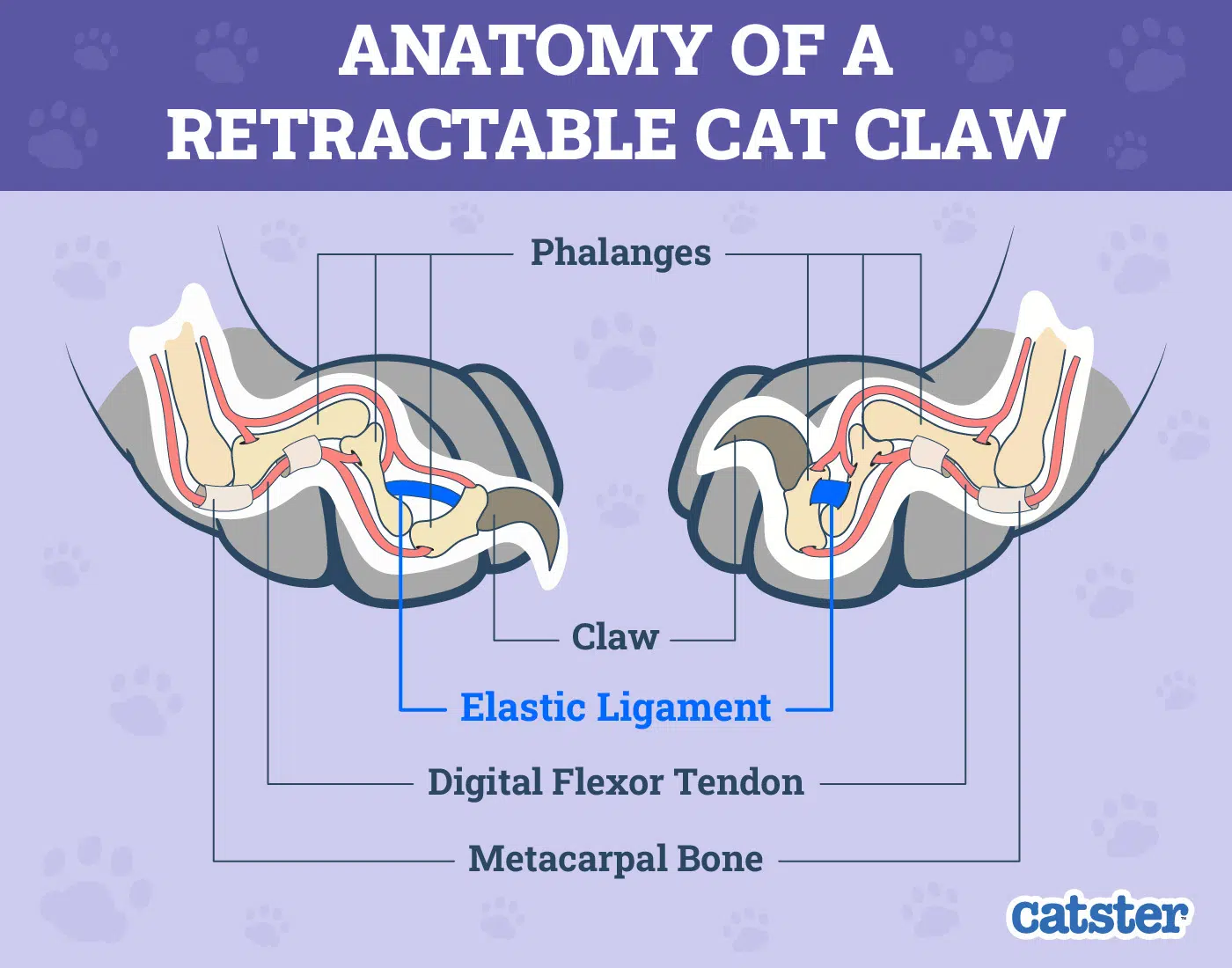

You are free to use this image but we do require you to link back to Catster.com for credit

divider 1 paws

Why Cats Have Retractable Claws

Cats have retractable claws for a few reasons. It might seem like destroying your couch or hurting your hands during a play session is the main reason, but don’t worry. That’s not the case. The purpose of retractable claws is to fulfill a cat’s role as a hunter. Most domestic house cats won’t need to use their claws for these reasons. Still, they’re a part of a cat’s anatomy, and they serve a few crucial roles.

Hunting

Since cats are natural-born hunters, they need claws to capture prey. Cats stalk their prey, and then, when the time is right, they use their sharp claws to grab, hold, and kill their prey. It’s not a fairy tale story, but it’s how cats are hotwired. They need meat to survive, and their claws play a significant role.

Domestic cats may not hunt for food, but they remain true to their instincts. Throw a stuffed mouse their way, or hide a string around a corner, and your kitty pounces with its claws out! Having retractable claws also gives cats stealth, allowing them to stalk their prey silently. When sheathed, the claws are also protected, which is crucial to a cat’s survival in the wild, as they rely on them to find food.

black and white cat hunting a prey on a tree
Image Credit by: Kapa65, Pixabay

Climbing

Domestic cats are both hunters and prey. In addition to being excellent hunters, cats are top-tier climbers. Climbing is part of their hunting ability. It’s a great way to stalk their prey with a view. But climbing also protects them from predators. They need to protect themselves from larger animals that pose a threat.

Claws grip onto tree bark and other materials very well. Mix this with a cat’s flexibility, and climbing a tree becomes a no-brainer. Cats love a good view at the end of the day. Your house cat still wants to climb on things like kitchen counters and shelves. Providing a cat tree and cat shelves is a great way to fulfill this instinct.

Self-Defense

If a kitty has ever scratched you, you know how much it hurts. Animals like dogs, coyotes, and other cats may attack a cat given a chance. Since cats are also prey, they need to defend themselves, and their claws are perfect.

cats fighting
Image Credit by: Samarskiy, Shutterstock
Important

Because functional paws and claws are essential for cats to live a normal life, the practice of permanently removing your cat’s claws, also known as declawing, is strongly discouraged. The procedure is extremely painful, completely unnecessary, and lowers a cat’s quality of life. A cat’s claws can be trimmed, and most cats will readily use a scratch post to keep their claws manageable.

divider 3 paws

Why Cheetahs Don’t Have Retractable Claws

It may come as a shock that cheetahs are the exception to the rule of all the cat species. However, cheetahs are almost always the exception. These cats have differences that give them their genus, Acinonyx jubatus.

Cheetahs lack the climbing abilities that other domestic and wild cats have. They make up for this with their jaw-dropping running speed of reaching 75 mph. When it’s time to run, Cheetahs can accelerate from 0 to 68 mph in three seconds.

Cheetahs are built differently to accommodate this speed. They have deep chests and enlarged hearts, plus large nostrils so they can breathe well during their sprint.

Because these fantastic creatures have to be ready to sprint at a moment’s notice, their claws don’t fully retract. This allows for better traction when they run and helps them stop should they need to come to a complete stop at high speeds.

divider 2 cats

Final Thoughts

Cats are amazing creatures, both wild and domestic. Hopefully, this post has given you some insight into the wonderful abilities of a cat and why your cat likes to scratch your sofa. It is not because your cat likes to get a rise out of you. At least, that’s not the only reason.


Featured Image Credit: RJ22, Shutterstock

Want content like this delivered to you?

Sign Up For Our Newsletter

News, insights, expert advice, and everything cat

* By submitting, you agree to our Terms & Conditions and Privacy & Cookies Policy.


How useful was this post?

Click on a star to rate (you can leave written feedback after clicking submit)

Help us improve Catster for pet parents!

Your feedback really matters.

What did you like about this post? Also how can we improve it?

Join the conversation

Leave a Reply

You’re very welcome to leave a comment or question. Please know that all comments must meet our community guidelines, and your email address will NOT be published. Let’s have a positive and constructive conversation.


Talk With A Vet Online

Peace of mind,
anywhere, anytime

Affordable vet advice

Welcome to Coastal Cats & Critters

As much as we all love cats, we also know that in many parts of the country (and the world), the problem of...

Ask Dr. Paola – Help! My Cat Suddenly Has Dandruff! (March 30, 2026)

Welcome to our “Ask Dr. Paola” series, where every Monday we bring expert advice straight from Dr. Paola Cuevas (MVZ) to help our...

Your Cat Keeps Vomiting After Eating: Here’s What’s Going On

Cats vomit. It’s one of the less glamorous facts of life with a feline, and most cat owners have cleaned up more than...

Ask Dr. Paola – Help! My Cat Gets Diarrhea from Wet Food! (March 23, 2026)

Welcome to our “Ask Dr. Paola” series, where every Monday we bring expert advice straight from Dr. Paola Cuevas (MVZ) to help our...

More related

How To Read a Cat’s Body Language: 5 Vet-Reviewed Moods & Signals

While cats can’t use words to tell us how they’re feeling, most are expert communicators who rely on different types of vocalization, body...

Has Your Cat Food Gone Bad? 8 Vet Reviewed Signs to Look For

Cat food manufacturers follow strict guidelines to produce safe products, but after they leave the factory, they can become damaged or improperly handled...

Can Cats Eat Radishes? Vet-Reviewed Facts & FAQ

We all know that cats are carnivores. However, we also know that some cats enjoy human foods, whether animal-derived or plant-based. Many cats...

220+ Halloween Cat Names: Ideas for Enchanted Kitty

Halloween is a popular holiday and a favorite one for many of us! One of its most iconic symbols is a black cat....

Keep reading

How Do You Determine a Cat’s Sex? A Vet-Approved Guide

Determining the sex of your cat can be confusing, especially if they are a kitten or are still young, as it is not always obvious. Given that male cats do not have visible testicles until they are approximately 6–10 weeks...

Thai Siamese point cat, with blue eyes, lying on the couch

6 Best Dry Cat Foods in Australia in 2026 – Reviews & Top Picks

Choosing the right food for your cat is one of the best ways to ensure your kitty’s health and longevity. It can be confusing to pick a cat food with so many brands, and many of them use marketing ploys...

grey cat eating food

Can Cats Eat Dog Pill Pockets? Vet-Reviewed Facts & FAQ

Unfortunately, almost all cat owners experience times when their cats are prescribed medication for a health condition. Cats don’t generally enjoy eating things that don’t taste like their favorite things, like fish, chicken, and beef. If you think about trying...

Can Cats Eat Dog Pill Pockets

Are Tulips Toxic to Cats? Vet-Reviewed Safety Information

Tulips are beautiful flowers, so there is no question why they are so popular. They are common inside and outside. Many cut flower bouquets include tulips, for instance. However, tulips are toxic to cats and many other pets. Because flowers...

Catster_Are Tulips Toxic to Cats

Cat Spraying vs Peeing: Vet-Verified Differences

Dealing with your cat peeing inappropriately in your home can be exceedingly frustrating. Many cat owners don’t realize there’s a difference between your cat peeing and spraying. While it may not seem like it, the distinction is important because several...

Can Cats Eat Collard Greens? Vet-Approved Nutrition Advice

Plain collard greens are perfectly fine for cats to eat. They provide a good source of fiber, along with nutrients and minerals. Cats cannot digest these greens quite as well as humans or dogs can, though, so they mostly act...

Can Cats Eat Collard Greens

Why Does My Cat Like Icy Hot and Bengay? Possible Reasons & Vet-Reviewed Safety Facts

Cats are naturally curious about various smells, but the smell of the topical pain relief products for muscle pain known as Icy Hot and Bengay seems to be a favorite with some cats. If you have ever applied these ointments,...

cat smells, lick feet and toes in bed

How to Tell If Your Cat Is Having a Seizure: 3 Vet Reviewed Signs to Look For

If you’ve seen your cat drooling, thrashing around, or having difficulty controlling its movements, you might wonder if your feline friend has been having seizures. Watching anyone you love, human or feline, experience a medical emergency where they shake and...

russian blue lying down

Love Cats? So Do We! Join the Catster Community

Stay informed with expert pet care insights delivered straight to your inbox! Discover professional guidance on animal behavior, feeding tips, trusted product picks, and much more.


Sign up for the Catster Email Newsletter

Stay informed with expert pet care insights delivered straight to your inbox! Discover professional guidance on animal behavior, feeding tips, trusted product picks, and much more.