Cat Hierarchies & Social Structures: Based on Science


If you live in a multi-cat household, you might have noticed that some of your cats get along better with each other than with others. Do domestic cats have a social structure, and if so, how are these organized? Are hierarchies established? If these questions have been bugging you, keep reading as we tell you everything you need to know.

Most Wild Cat Species Are Solitary Predators

Almost all wild cat species, apart from lions, are classed as solitary predators. Researchers have found that male cheetahs can sometimes be found living in small groups of two or three called coalitions. The solitary lifestyle in members of the cat family involves finding a territory within a large area of habitat where they can find enough prey to survive.
They may meet other cats when having a dispute over their boundary or for mating, but most of the time, they will be happy with their own company. Domestic cats are the only members of the Felidae family that can adapt to living in groups if the density of cats and the availability of food sources allow so. They are also the only species that will form social relationships with humans.
Luckily, cats are highly adaptable animals capable of forming social structures, and, most of the time, they learn to live alongside each other just fine.
Feral Cat Colonies

Researchers thought that feral cats, those that live with no human interaction, were brought together by a food source for a long time and simply tolerated living near each other. It was thought that the pull of having regular food was stronger than the urge to have their territory.
It’s now known that feral colonies sometimes follow a matrilineal structure with cooperating female cats looking after a group of kittens. Females breed so often that their kittens are sometimes raised in a joint litter. The mother cats will cooperate to drive away threats, including tomcats looking to mate.
Researchers have also found that the sex, body size, and age of feral cats that form feeding groups can affect the order in which they feed. Adult male cats tend to eat first, followed by females. Within these groups, the larger and older cats eat first, with age being the primary factor for males and body size the primary factor for females.
Kittens ate more frequently than adults and were prioritized over male and female adult cats.
Domestic Cat Social Structures & Colony Behavior
Domestic cats have had to learn to adapt their social structures ever since they started spending time near human settlements around 12,000 years ago. The abundance of prey led to multiple cats living within the same area, and cats learned to adapt to groups living in a similar way to feral cat colonies.
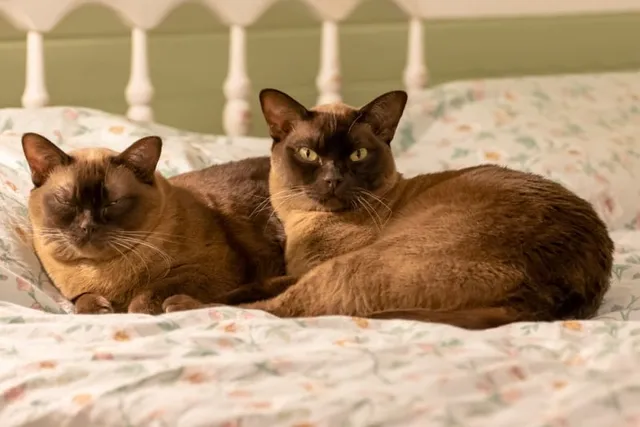
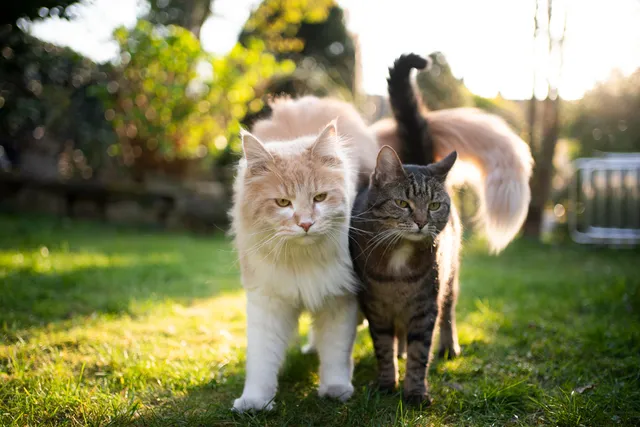
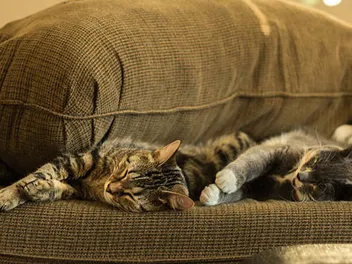
Cats in a multi-cat household will often adapt to live together in a relatively small area and can sometimes form strong affiliative relationships among some of them. This is usually easier to achieve if the cats are all neutered or spayed. Some cats prefer the company of a particular cat and will display social behavior with them that you may not see when interacting with another cat.
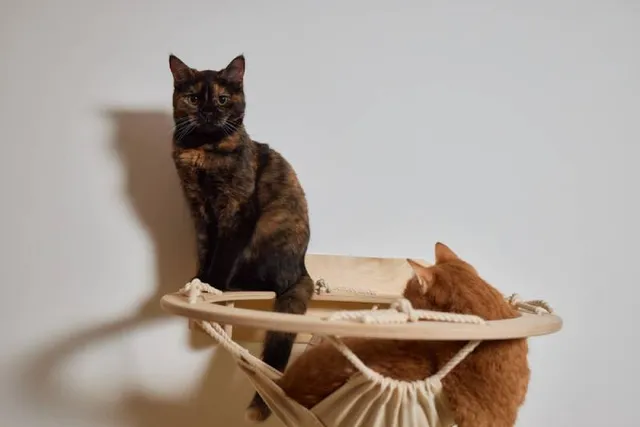
Even within homes, cats will establish small patches as “their” territory. They don’t tend to share this unless they’re a bonded pair. One cat may have claimed the top of the couch, while another prefers a chair in the hallway. Each cat will mark their territory, and once this is established, the other cats will respect this zone as belonging to the other cat.
Some cats may appear more dominant, even if you don’t see your cats fighting to establish this. It’s more likely that each cat understands their position within their household's social structure through subtle body language and pheromone markers.
When a new cat joins the house or a younger cat reaches maturity, there is often the potential for upheaval.
Hierarchy in Cats

Cats don’t tend to follow a linear hierarchy. Their relationships are complex, and some will form strong bonds and some won’t, but there is no clear ranking where each animal has a fixed position of dominance or submission. That being said, when cats that live together reach sexual maturity at around 6 months of age, they can push the boundaries with other cats to see who the more dominant personality is. You may have introduced a kitten into your household and found that they get along great with your older cat, only to run into issues once the kitten reaches maturity.
Cats may display territorial behavior within the community they live in using a range of techniques, including:
Take Note of Rubbing Behavior

Cats use scent from their facial glands, urine, feces, and anal glands to mark their territory. In multi-cat households, they usually create a communal scent by combining their pheromones so they can be comfortable with all the group members. If you notice your cat rubbing their face against you frequently, it’s a way of strengthening the bond with you.
Potential for Conflict
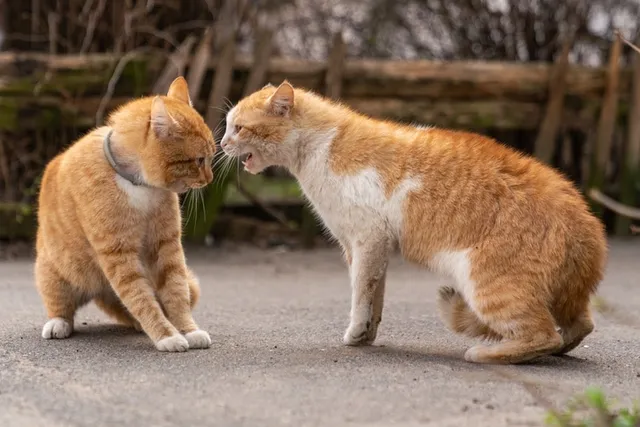
Domestic cats can live happily together as long as their owners are aware of how to reduce conflicts. Cats adapt to living in a social group as long as they don’t need to compete for resources. It’s important to make sure there are always enough resources to go around. This includes food bowls, water bowls, litter boxes, cat beds, hiding spots, scratching posts, and other items, like toys.
A good rule to follow is that there should always be one more resource than there are cats. So, if your household includes three cats, ensure there are always four food bowls, four litter trays, and so on. That way, your cats never have to compete for these resources because there will always be one available when they need it. Make sure the resources are spread throughout the house rather than grouping them in a small area. A less-dominant cat will feel uncomfortable approaching this setup if a more-dominant cat is there.
Some cats may claim certain items, like scratching posts and perches, as their own. If you notice that one cat in your household doesn’t use something, like the scratching post, consider investing in more. Scratching is a natural behavior that cats need to carry out, but if a more dominant cat has claimed a scratching post as part of their territory, a cat further down the social structure may feel uncomfortable using it.
Observing the behavior of cats in a multi-cat household can help you understand their social structure and solve issues if cats start to fight over resources or territory. It’s a good idea to reward positive behavior, so give your cats a treat or play with them when you see them positively interacting with each other. Make sure to give each cat individual attention as well!
Our domestic cats might look cute and fluffy to us, but their wild instincts run deep! Cats still need to protect their small slices of territory within your home, and while some cats may form strong pair bonds, others will prefer their own company. By paying close attention to their body language and behavior, you can do your part to ensure your cats can live together harmoniously as well.
Last thoughts
Our domestic cats might look cute and fluffy to us, but their wild instincts run deep! Cats still need to protect their small slices of territory within your home, and while some cats may form strong pair bonds, others will prefer their own company. By paying close attention to their body language and behavior, you can do your part to ensure your cats can live together harmoniously.
See also: Does the Full Moon Affect Cats?
Featured Image Credit: Murat An, Shutterstock

Expert cat care, straight to your inbox
Vet-reviewed advice, behavior tips, and the best of Catster. Free, and you can unsubscribe anytime.
By signing up, you agree to our Terms & Conditions and Privacy & Cookies Policy.
Emma is a freelance writer, specializing in writing about pets, outdoor pursuits, and the environment. Originally from the UK, she has lived in Costa Rica and New Zealand before moving to a smallholding in Spain with her husband, their 4-year-old daughter, and their dogs, cats, horses, and poultry. When she's not writing, Emma can be found taking her dogs for walks in the rolling fields around their home...and usually, at least some of the cats come along, too! Emma is passionate about rescuing animals and providing them with a new life after being abandoned or abused. As well as their own four rescue dogs, she also fosters dogs for re-homing, providing them with love and training while searching for their forever homes.
Join the conversation
Ask a question, share your story, or send private feedback.