What Do Cats and Dogs Have in Common? 14 Vet-Reviewed Similarities


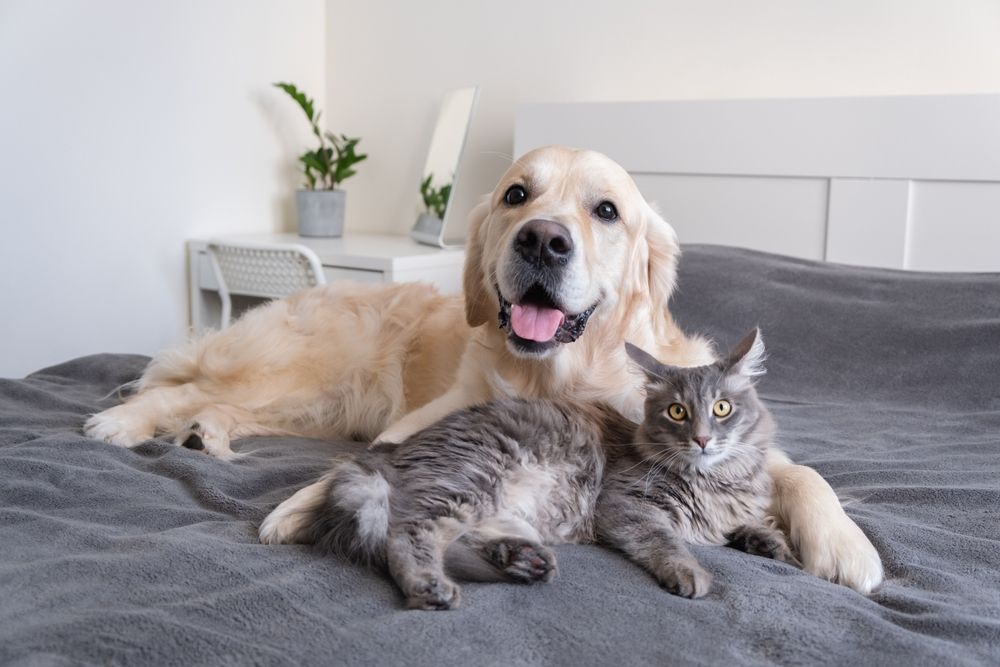
If you share your home with cats and dogs, you know how different the two animals can be. From personality traits to exercise needs to dietary requirements, there’s no denying that they have very different needs. However, if you look hard enough, you’ll find a lot of similarities between the two species. Read on to find 14 of the most interesting commonalities between cats and dogs.

The 14 Vet-Reviewed Similarities Between Cats & Dogs
1. They Rely on Body Language for Communication
Cats and dogs communicate through body language, though their signals are very different. For example, a dog with a wagging tail and open mouth is likely happy. A cat with a wagging tail and open mouth, however, would normally be communicating anger.

2. They Have a Heightened Sense of Smell
Cats and dogs excel in scent detection. For a long time, it was believed that dogs have a better sense of smell than their feline counterparts due to the fact that they have 50% more scent receptors than cats.
Recent research suggests, however, that cats have the upper hand when it comes to distinguishing between similar scents. There are three types of scent receptors, and the one responsible for the ability to distinguish between smells is known as V1R. Humans have just two V1R receptors, dogs have nine, and cats have an impressive thirty V1R receptors!
3. They Hear Better Than Humans
Cats and dogs both have a better sense of hearing than humans. However, this doesn’t apply to puppies, as all dogs are born deaf and remain so until they’re around three weeks old.
Dogs and cats both use their ears to express emotions and have fantastic hearing. They also share the ability to move their ears into different positions, thanks to a large number of muscles that control ear movement.

4. They Can Be Trained
While dogs often take the spotlight when it comes to performing tricks and training, cats can absolutely be trained and learn a variety of commands. The caveat is that cats are harder to train as they’re not as food motivated as their canine counterparts. The key to teaching cats commands and tricks is then finding the right motivation. Clicker training is a great way to introduce training to cats and dogs and is worth learning more about if you’ll be training either animal.
5. They Have Territorial Instincts
Cats and dogs can both be territorial at times, an instinctive behavior that aims to make sure they get their share of space, food, and mates.. However, how they respond to these instincts is quite different.
Cats mark their territory by urine spraying and chin rubbing to leave their scent on things that are “theirs.” Dogs are generally more social than cats and will often form packs for hunting and companionship. They don’t display rubbing behaviors to mark what is theirs but will guard their territory and hoard resources. They will also use urine to scent mark their territory, but are also more active about patrolling their land.

6. They Have Social Structure
Though cats are often thought of as aloof and independent, this isn’t always the case. Cats can be socially flexible, living happily and harmoniously with humans and even other animals. Even feral cats live together in colonies by choice and don’t isolate themselves from their peers.
Dogs are highly social animals, especially when they’ve been properly socialized. Dogs generally crave human connection, and science may finally have the answer. Several gene variations make dogs much more friendly than the wolves they were domesticated from.
Having a recognized and established social structure is important for both cats and dogs that share territory and resources, as it helps reduce conflict
7. They Can Take Care of Themselves
Your pampered pet knows when to expect their next meal and what their meal will be. But what would happen if your cat or dog were to sneak outside and become lost?
Cats are fantastic hunters and will learn quickly what they need to fend for themselves in the wild, including finding out where their next meal will come from and making it happen.
While many dogs are great at hunting, almost all dogs are excellent scavengers. You’ve likely witnessed this when your dog scoops up a piece of meat you drop at the dining room table the moment it hits the ground.
Cats and dogs both have strong survival instincts that would serve them well if they ever found themselves in the wild without kibble or a can opener, and even those that have only ever lived the life of human-provided luxury, would still be able to search for and recognize good food options..

8. They Eat Meat
Cats and dogs both eat meat.
Cats are obligate carnivores, meaning they need animal protein to survive. They need the nutrients found in animal flesh to thrive, such as taurine (an amino acid), arachidonic acid (a fatty acid), and vitamins like niacin, pyridoxine, and vitamin A. Their bodies are unable to digest plant material properly.
Though dogs have largely descended from carnivorous wolves, they have evolved into omnivores, meaning they eat both animal and plant material. They may best be described as “opportunivores,” meaning they’ll eat whatever is available to them, but still have specific nutritional requirements that need to be met.
9. They Have Similar Gestational Periods
The length of a pregnancy in both cats and dogs is between 61 to 65 days, with 63 being the average. In both species, the litter size usually ranges between 1 to 8 puppies or kittens, with the average falling somewhere in the middle. Both dogs and cats tend to wean their young at around 5-8 weeks old.

10. They Love Sleeping With Their Humans
We may invest a lot of time and money into finding the perfect bed for our cat or dog, but in many cases, their favorite bed is ours. The shared warmth and security of sleeping in the same bed as their humans is something enjoyed by many canine and feline companions, with recent surveys showing that 62% of small dogs and 62% of cats sleep with their human owners. The percentages fall a little when looking at medium- and large-sized dogs, though (41% and 32%, respectively).
11. They Have Similar Ancestry
Cats and dogs belong to the order Carnivora, which also includes bears, mongooses, skunks, walruses, and sea lions. This order is the fifth largest order of mammals, with almost 280 species. Animals belonging to this order share a number of features, though one interesting similarity is their teeth. They all have blade-like carnassial teeth (modified molars), which are adapted to allow for the shearing (rather than tearing) of flesh for more efficient meat consumption.

12. They Age Faster Than Humans
It’s a sad fact of life that most of us will outlive our canine and feline counterparts, and this is simply because they age faster than we do. Both cats and dogs age more quickly than us due to differences in their metabolism and genetic makeup.
The good news is that various studies show that our pets are living longer than ever now, thanks to their heightened status in the household and better access to quality veterinary care.
It’s a news story we love to read: when cats and dogs find their way home after being lost for days, weeks, months, or even years. But how do they do it?
A study from the Czech Republic suggests that dogs may use magnetic alignment to enhance their homing efficiency. This same magnetoreception used for spatial orientation and navigation is also noted in other species, such as migratory birds and sea turtles.
Cats also have a homing instinct that helps them return home, too. Though we’re not exactly sure how it all works yet, evidence suggests that they use the planet’s geomagnetic fields combined with scent cues to find home. Their superior sense of smell likely plays a role in finding their way back when they are closer to home.

14. They Spend a Great Deal of Their Day Sleeping
Most cats sleep anywhere between 12 and 18 hours a day, though some will sleep even more than that. Hunting and exploring are very energy-consuming activities, and even if your kitty isn’t out hunting for their next meal, they’re always on high alert.
Dogs, on the other hand, sleep somewhere between 10 and 14 hours daily. However, exactly how much sleep your dog needs will depend on their age, activity level, size, and health needs. Puppies, older dogs, and larger breeds need closer to 18 hours of sleep a day, while small breeds and working dogs may catch fewer ZZ’s.
Final Thoughts
As you can see, cats and dogs do have a lot of similar traits when it really comes down to it. They may love their creature comforts, but their ancestral hunting instincts mean they can fend for themselves in a pinch, and even find their way home from a significant distance. But all that really matters is that both species make fantastic companions that add much joy, friendship, and unconditional love to the lives they touch.
Sources
Featured Image Credit: Kashaeva Irina, Shutterstock
Expert cat care, straight to your inbox
News, insights, and useful advice, delivered to you.

No spam — unsubscribe anytime.
By signing up, you agree to our Terms & Conditions and Privacy & Cookies Policy.
How useful was this post?
Click a star to rate. You can leave written feedback afterwards. (We read all feedback.)
For Chantelle, writing and animals are the two driving forces in her life. Growing up on the Canadian prairies surrounded by pets, she now shares her home with five cats, two guinea pigs, and a bearded dragon. Chantelle, her husband, and their child pride themselves on being dedicated pet parent, even spending a fortune on wall-mounted cat shelves to provide their cats with an indoor jungle gym. When she's not snuggling with her cats or photographing their humorous moments, Chantelle is exploring the Rocky Mountains, rewatching her favorite Netflix series, and reading up on various random subjects.