Catster is reader-supported. When you buy via links on our site, we may earn an affiliate commission at no cost to you. Learn more.

Cat Behavior

Right or Left? Do Cats Have a Dominant Paw? Vet-Reviewed Science & Info

By Kathryn Copeland · Reviewed & fact-checked by Dr. Luqman JavedVet Approved
Dr. Luqman Javed
Reviewed & Fact-Checked byDr. Luqman JavedDVM (Veterinarian)
Dr. Luqman (also known as Dr. Lucky) grew up with an immense passion for animals of all kinds. By becoming a veterinarian, he turned his childhood dream into reality. Now, his goals are focused on providing help to cats all around the world by helping to cat owners understand their feline friends better to ensure the best quality of life for them. His passions are wildlife, exotic pets, pet owner education, and animal welfare. He graduated with his DVM from the Universiti Putra Malaysia in 2020. He has worked with a variety of animal species and has decades of personal experience with keeping many different types of exotic pets, such as turtles, hamsters, freshwater fish, chickens, songbirds, and parrots (and he has extensive skills in training parrots, too).View authorThe information is current and up-to-date in accordance with the latest veterinarian research. Read about our vets
Share
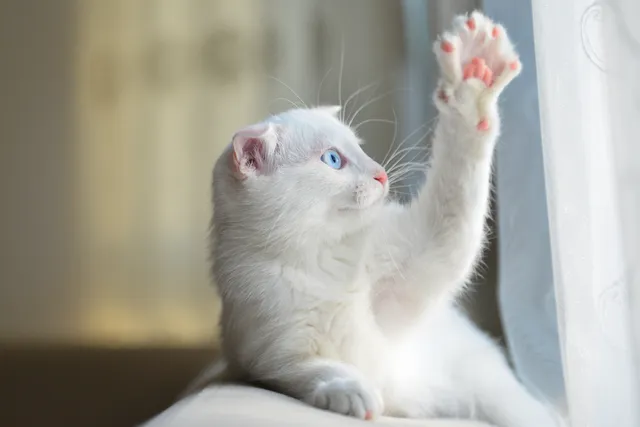
cat reaching its paw out

We humans can get hung up on the strangest things! For example, only about 60 years ago, left-handed people were considered “sinister” (a term derived from a Latin word meaning “on the left side,” which was equated with evil).

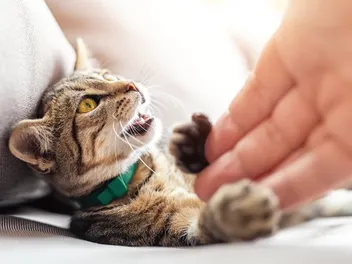
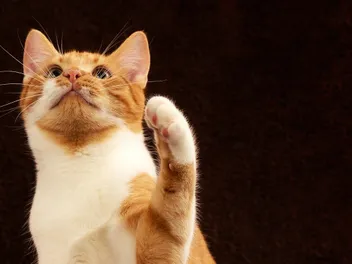
Lefties (also called southpaws) are in the minority, but have you ever wondered if cats, like humans, favor a left or right paw? While cats aren’t specifically right or left-handed the way that humans are, there is a tendency for them to favor one of their front paws.

Read on for more details about this physical trait, along with extra tidbits about cats and their paws!

divider cat paws oct 2024

Are Cats Left or Right Pawed?

The Study

Researchers from the Animal Behaviour Centre at Queen's University in Belfast conducted a study in 2018 that explored the laterality of 44 cats, 24 of which were male and 20 female.1 Laterality is when an animal prefers to use one paw over the other.

The cats were all fixed, ranged in age from 1 to 17, and were various breeds. The researchers studied cats in their homes rather than in a lab setting with the help of the cat owners, who monitored their cats throughout the course of their daily routines. This was to prevent stress for the cats, which would definitely have occurred if the entire study had been conducted in a “forced” or lab setting.

Emphasis was placed on which paw the cats used first when walking downstairs or stepping into the litter box and whether the cats preferred sleeping on one side or the other.

The cats were additionally tested briefly in a lab setting to retrieve treats from a food maze and a tower with holes.

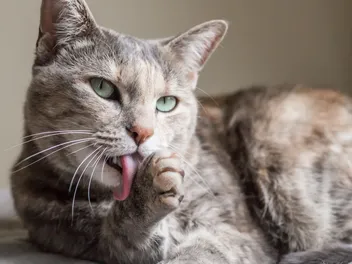
cat licking paws
Image Credit: TeamK, Pixabay

The Results

The results showed that 73% of the cats had a clear preference as to which paw they used most when reaching for food. Around 70% of the cats tended to use the same paw when going downstairs, and 66% used the same paw when stepping into their litter boxes.

Interestingly, the female cats seemed to favor the right paw and the males the left paw. But the side that the cats slept on didn’t show any specific preference.

In another study, more cats were shown to be “left pawed” rather than “right pawed”2. However, this study didn’t factor in the sex of the cat in the observations.

What Does This Tell Us?

Dr. Deborah Wells, one of the researchers in the first study, feels that animals with a left-paw preference and those that don’t have a preference tend to be more “flighty” and more susceptible to stressful situations than animals that are right pawed.

The reasoning behind this is that the left side of the body is controlled by the right side of the brain and the right side by the left side of the brain. The left side of the brain processes positive emotions like excitement and happiness and focuses on familiar and non-stressful behavior. The right side of the brain responds to unfamiliar and emergency situations with an urge to escape. It additionally processes what are considered negative emotions like fear and sadness.

So, if a cat is right-pawed, they may tend to be more playful and self-assured, and left-pawed cats might be more aggressive or fearful.

Most of these results aligned with another, similar study conducted on dogs by the same team in 2017.

You Can Try It at Home

You can try the same kinds of experiments that the researchers conducted on your own cat. Watch your cat when they go into the litter box: Which paw do they use to enter?

Look at which paw they extend before going downstairs. You can even try using the treats trick. Put a few treats in a container, and watch which paw they use to retrieve them. Of course, you would need to repeat all these experiments multiple times so you will know beyond a shadow of a doubt if your cat is a righty or a lefty!

divider cat paws oct 2024

Final Thoughts

The study gave us more insight into our cats, but of course, more studies are needed. Also, this whole right vs. left preference is actually relevant with several other species! From apes and horses to even whales, all have shown a preference for one limb over the other.

There’s still a long way to go if we want to understand our cats better, which will involve a great deal of cat-watching. But that’s not such a bad thing!


Featured Image Credit: Pixabay

The Catster Newsletter

Expert cat care, straight to your inbox

News, insights, and useful advice, delivered to you.

No spam — unsubscribe anytime.

By signing up, you agree to our Terms & Conditions and Privacy & Cookies Policy.

Click a star to rate. You can leave written feedback afterwards. (We read all feedback.)

Kathryn Copeland
Authored by

Kathryn Copeland

Leave a Reply

You're very welcome to leave a comment or question. Please know that all comments must meet our community guidelines, and your email address will NOT be published. Let's have a positive and constructive conversation.

15 Vet-Verified Facts About Cat Paws: Anatomy, Purpose & Benefits

15 Vet-Verified Facts About Cat Paws: Anatomy, Purpose & Benefits

Cat paws are equally adorable and interesting features of our favorite felines. A cat's paws play a role in several important functions, such as temperature re…

Sarah Psaradelis
By Sarah Psaradelis ·
How Do Cats Walk? Our Vet Explains

How Do Cats Walk? Our Vet Explains

Any cat owner whose ankles have fallen victim to a sneak attack from a playful kitty knows that sometimes you can’t hear them coming! But have you ever wondere…

Dr. Luqman Javed
By Dr. Luqman Javed ·
What Are Cat Paws Made Of? 5 Vet-Reviewed Facts & FAQ

What Are Cat Paws Made Of? 5 Vet-Reviewed Facts & FAQ

Cats’ paws are incredible and are used for a host of different things. Paws help with balance and carrying the load of the cat, and they also provide protectio…

Christian Adams
By Christian Adams ·
My Cat Is Holding Their Paw Up When Sitting: Vet Reviewed Facts & FAQ

My Cat Is Holding Their Paw Up When Sitting: Vet Reviewed Facts & FAQ

Our kitties are constantly warming our hearts with their hilarious antics. It seems they are always making a strange noise or learning new skills that make you…

Ashley Bates
By Ashley Bates ·

Why Don't Cats Like Their Paws Touched? 8 Vet Reviewed Reasons

Any cat owner knows that a cat's paws are among their cutest features, but most are off-limits to touching. Why is this? Why do some cats hate having their paw…

Christian Adams
By Christian Adams ·
Why Don't Cats Like Their Paws Touched? 8 Vet Reviewed Reasons

10 Weird Cat Litter Box Habits (Vet-Approved Explanation)

Cat litter isn’t everybody’s favorite topic, but it’s an important one, nonetheless. You’ve gotten used to your cat’s usual comings and goings and probably eve…

Codee Chessher
By Codee Chessher ·
10 Weird Cat Litter Box Habits (Vet-Approved Explanation)

Why Does My Cat Reach His Paw Out to Me? 9 Vet-Verified Reasons

There are several reasons that your cat may reach out to you, whether they are lying down or lightly tapping you with their paw while standing up. As you might…

Christian Adams
By Christian Adams ·
Why Does My Cat Reach His Paw Out to Me? 9 Vet-Verified Reasons

Why Does My Cat Cross Their Front Paws? Does This Mean They Feel Relaxed?

Cats are curious creatures. Their behavior can be hard to decipher, but some actions are clearer than others. For example, if your cat stretches one of their p…

Christian Adams
By Christian Adams ·
Why Does My Cat Cross Their Front Paws? Does This Mean They Feel Relaxed?

Why Do Cats Sleep at the Foot of the Bed? 8 Possible Reasons for This Behavior (Vet Reviewed)

Of all the strange things cats do, why do they choose to sleep at your feet instead of snuggling at your chest at night? On average, felines sleep for 16 hours…

Christian Adams
By Christian Adams ·
Why Do Cats Sleep at the Foot of the Bed? 8 Possible Reasons for This Behavior (Vet Reviewed)

Why Is My Cat Running Sideways? 7 Vet-Reviewed Reasons

Cats are fascinating pets and behind their every action, there is a myriad of reasons and impulses driving them. Cat’s sideways movement, often called “crab wa…

Christian Adams
By Christian Adams ·
Why Is My Cat Running Sideways? 7 Vet-Reviewed Reasons

Why Do Cats Lick Their Paws After Eating? Vet-Verified Feline Behavior Explanation

Cats take grooming seriously—so seriously that some cats spend up to 50% of their waking time grooming themselves, with their tools of trade being their tongue…

Christian Adams
By Christian Adams ·
Why Do Cats Lick Their Paws After Eating? Vet-Verified Feline Behavior Explanation

Why Do Cats Walk in Circles Before Lying Down? Vet-Verified Facts & FAQ

Cats are known for their weird yet fascinating behavior, which can sometimes leave owners shaking their heads. One of the most peculiar behaviors that many cat…

Christian Adams
By Christian Adams ·
Why Do Cats Walk in Circles Before Lying Down? Vet-Verified Facts & FAQ

Love Cats? So Do We! Join the Catster Community

Stay informed with expert cat care insights delivered straight to your inbox! Discover professional guidance on feline behavior, feeding tips, trusted product picks, and much more.

You may opt-out at any time. View our Privacy Policy for more information.

The Catster site on a phone