Bringing your fluffy new kitten home is an incredibly exciting time. However, you must ensure that the kitten doesn’t come with any unexpected visitors, like a load of fleas, for example! Choosing an effective and fast-acting flea treatment is essential to caring for your new kitten.
If you already know how much they weigh, you can select one of the flea treatments on this list. Our reviews are designed to help you pinpoint which flea treatment will suit your kitten best. So, whether you’re looking for a spot-on treatment to use as soon as you bring your kitten home at around 12 weeks or a long-lasting solution for older kittens, we have you covered.
In this article
 A Quick Comparison of Our Favorites in 2026
| Image | Product | Details | ||
|---|---|---|---|---|
Best Overall

|

|
Frontline Plus Cat & Kitten Flea and Tick Treatment |
|
CHECK PRICE |
Best Value

|

|
PetArmor Flea & Tick Squeeze-On Treatment |
|
CHECK PRICE |
Premium Choice

|

|
Zoetis Revolution Topical Flea Treatment |
|
CHECK PRICE |

|
Onguard Flea & Tick Treatment |
|
CHECK PRICE | |

|
Bayer Advantage II Flea Treatment |
|
CHECK PRICE |
The 9 Best Flea Treatments for Kittens
1. Frontline Plus Cat/Kitten Flea Treatment — Best Overall

If you’re looking for the best overall flea treatment for kittens today, you can’t beat the Frontline Plus Cat & Kitten Flea and Tick Treatment. This long-lasting formula remains active for 30 days after application and works immediately to kill fleas, eggs, and larvae.
It’s also waterproof, so if your cat needs a bath, you don’t need to worry about it losing efficacy. It’s suitable for cats and kittens over 8 weeks of age or weighing over 1.5 pounds. Frontline Plus kills fleas, lice, and ticks that can be vectors for Lyme disease.
- Lasts for 30 days
- Waterproof
- Kills fleas, lice, and ticks
- 6 months’ worth of treatments
- Expensive
2. PetArmor Flea & Tick Squeeze-On Treatment — Best Value

Our pick for the best flea treatment for the money is the PetArmor Flea & Tick Squeeze-On Treatment. It’s suitable for kittens over 8 weeks of age and 1.5 pounds in weight, and it’s easy to use and gets to work killing those fleas immediately. Although it’s a great flea treatment, it missed out on our top spot because it only kills adult fleas, not the eggs or larvae.
PeArmor also kills ticks and lice within 72 hours of application. It’s waterproof, so it’s a good choice for cats with allergies that need a bath. This pack comes with three pipettes, equaling a 3-month supply.
- Great value for money
- Easy to apply
- Lasts 4-6 weeks
- Only kills adult fleas
3. Revolution Topical Flea Treatment for Kittens — Premium Choice
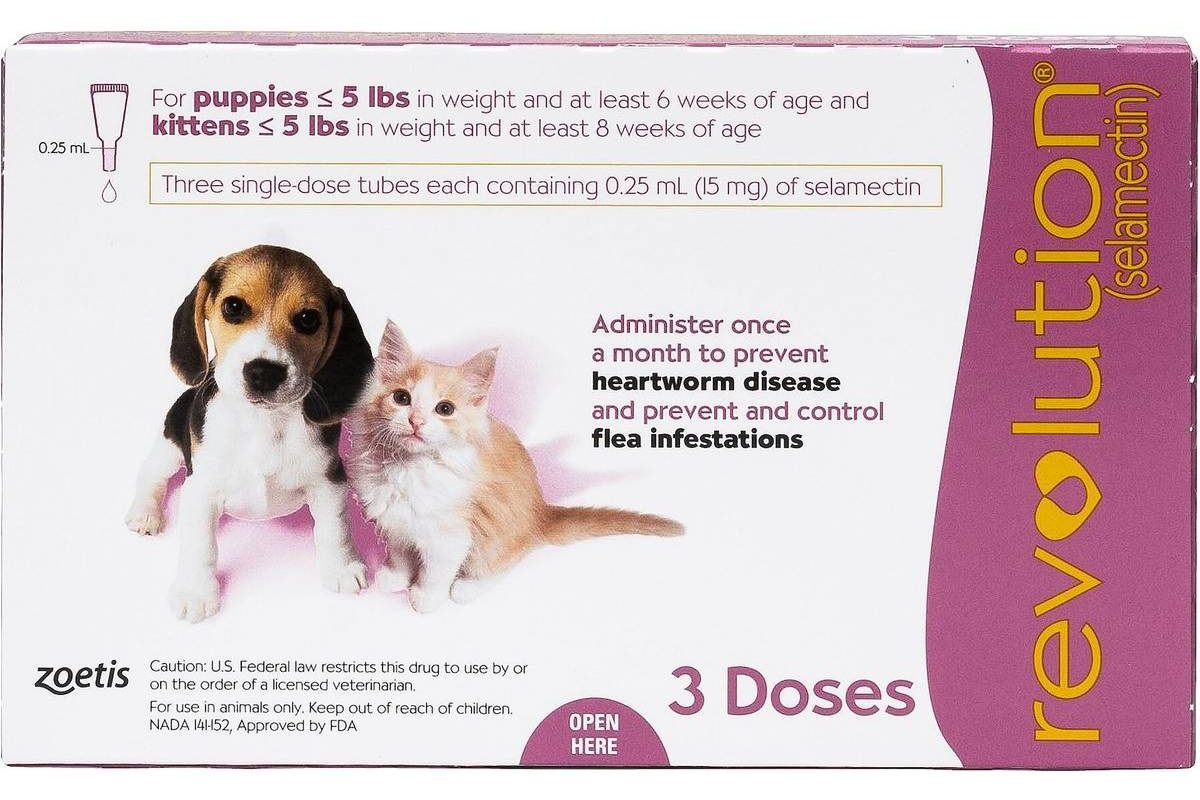
If you’re looking for a premium choice for your kitten, the Zoetis Revolution Topical Solution Flea Treatment is our recommendation. It kills adult fleas and prevents eggs from hatching, but it doesn’t affect the flea larvae, so you may need a few treatment cycles before you notice that all the fleas have gone.
Because Revolution Topical treats heartworms and fleas, you’ll need a prescription from your veterinarian. It’s a simple process, and all you need to do is add the contact details for your vet so the order can be verified with them.
- Suitable for kittens from 8 weeks of age
- Non-greasy formula
- Also protects against heartworms, roundworms, hookworms, and ear mites
- Requires veterinary prescription
- Doesn’t act on flea larvae
4. Onguard Flea & Tick Treatment

Onguard Flea & Tick Treatment kills fleas, flea eggs, larvae, and chewing lice. This spot-on treatment can be used on kittens over 8 weeks of age as long as they weigh more than 1.5 pounds. It contains two active ingredients to stop the flea infestation while preventing future infestations.
Onguard remains active for 30 days and is waterproof in case your cat gets caught in the rain or needs a bath! You can choose from two pack sizes: three or six treatments. The easy-to-use applicator has been redesigned and helps make sure that every drop of this treatment comes into contact with your cat’s skin.
- Available in packs of three or six treatments
- Kills fleas and ticks
- Made in the U.S.A.
- Expensive
- Some cats can have a reaction
5. Bayer Advantage II Flea Treatment

The Bayer Advantage II Flea Treatment has been specifically designed for kittens weighing between 2 and 5 pounds. It contains two active ingredients designed to work together to kill all life stages of fleas. The pack includes two pipettes, each of which protects for up to 30 days.
This treatment is waterproof after 24 hours, so your kitten can have a bath without washing it off. Be sure to weigh your kitten carefully since Advantage II is only designed for use in kittens who weigh over 2 pounds.
- Veterinarian recommended
- Kills all life stages of fleas on contact
- Contains two active ingredients
- Not as effective as some other flea treatments
- Not suitable for kittens under 2 pounds
6. Sentry PurrScriptions Plus Flea & Tick Squeeze On Treatment

The Sentry PurrScriptions Plus Flea & Tick Squeeze-On Treatment provides five-way protection from fleas, eggs, larvae, deer ticks, and mosquitoes. If you live in an area with West Nile Virus, Sentry is a great option since it’s effective on mosquitoes carrying West Nile.
Unlike most treatments, it shouldn’t be used on kittens under 3 months of age. Although Sentry is an effective option, you’ll have to wait a little longer before using it on your tiny fur baby.
- Quick-drying formula
- Effective for 1 month
- Only suitable for kittens over 5 pounds
- Not for kittens under 12 weeks of age
7. Catego Flea & Tick Treatment

The Catego Flea and Tick treatment can be used on kittens over 1.5 pounds and at least 8 weeks of age. The topical, spot-on formula quickly gets to work and kills fleas in just 6 hours. It’s also effective against flea eggs, larvae, ticks, and lice. The patented applicator is designed to penetrate under your cat’s coat and can be applied directly to your cat’s skin.
Catego is relatively affordable, and you can also buy it in a pack of one single treatment, which brings the cost down. This spot-on solution is quick-drying and non-greasy, but we can’t find information from the manufacturer stating it’s waterproof after it’s been allowed to dry.
- Choose from one, three, or six treatments per box
- Suitable for kittens over 1.5 pounds
- Not as long-lasting as some treatments
- Some cats can have irritation at the application site
8. Capstar Flea Tablets

If your cat has sensitive skin and reacts to spot-on topical flea treatments, these Capstar Flea Tablets might be the answer. Of course, giving tablets to some cats can be a challenge! The Capstar tablets start working in just 30 minutes and are proven to be 90% effective at eliminating adult fleas in a matter of hours.
They’re suitable for kittens weighing 2 pounds and upward, so make sure you weigh your kitten beforehand to ensure they’re above that weight limit. These flea treatments for kittens tablets can be given once a day if your cat has a serious infestation. As they only kill adult fleas, you may need to treat your cat repeatedly until all the fleas have reached the adult stage of their life cycle.
- Effective alternative to spot-on treatments
- Begins working within 30 minutes
- Expensive
- Only effective against adult fleas
- Some cats don’t like tablets
9. Bravecto Topical Solution

If you’re looking for a long-lasting option for older kittens, the Bravecto Topical Solution is an excellent choice. It works for 12 weeks against fleas, which is more convenient than the monthly treatments. However, it doesn’t seem to be effective for 12 weeks when applied to kittens under 6 months of age, and we recommend waiting until your kitten is at least that age.
Bravecto is effective, but there have been reports of cats developing neurologic abnormalities after use. As you need authorization from your vet to order this product, we highly recommend speaking to them about whether this is a good option for your kitten.
- Suitable for kittens from 2.6 to 6.2 pounds
- Lasts for up to 12 weeks
- Most effective on kittens over 6 months old
- Requires prescription authorization from your vet
- Expensive
- Reports of cats developing neurologic abnormalities

Buyer’s Guide: Finding the Best Flea Treatment for Kittens
Flea treatments have come a long way in terms of effectiveness, but how do you know which treatment will suit your kitten best? Fleas can cause all sorts of problems for cats, including allergy dermatitis and bacterial infections, but they’re particularly nasty for kittens. Due to their small size, kittens are sensitive to anemia.
So, if they lose too much blood from flea bites, their tiny bodies can’t cope as well as those of adult cats. Kittens also don’t have a fully developed immune system, so they can be more susceptible to bacterial infections.
Before you choose any flea treatment, we recommend discussing your preferred option with your veterinarian to ensure it’s a good match for your kitten.
- Application method. The most common flea treatments are topical spot-on solutions, tablets, and powders. Topical spot-on solutions lead the way in effectiveness, but they can be accidentally ingested, and some leave an oily residue. Tablets are also a good option if your kitten has sensitive skin, but they must be given more often. Powders are a good short-term option but need frequent reapplication.
- Application frequency. Make sure to find out how long the treatment lasts, and make a note to re-apply it before the coverage ends. Many spot-on treatments are effective for around 30 days, but some aren’t waterproof, so if your cat comes into contact with water, you’ll need to re-apply it.
- Section of flea life-cycle targeted. Some flea treatments only treat adult fleas, and when the eggs and larvae start to develop, your cat will still have fleas on their body, and you’ll need to re-apply the treatment again. Other flea treatments target all life stages and are more effective at quickly dealing with an infestation.
- Using a flea treatment designed for adult cats on a kitten can lead to a dangerous buildup of the product. Always select a flea treatment designed for kittens, and check that your kitten’s age and weight match the recommended details on the packaging. Some flea treatments are suitable for 8-week-old kittens, but they’re usually still with their mother cats. Others are only suitable for kittens over 12 weeks old. Signs of an overdose of flea treatment include excessive salivation, diarrhea, vomiting, muscle tremors, twitching, in-coordination, and depression. If your kitten has an adverse reaction after their flea treatment, speak to your veterinarian immediately.
If you’re unsure about the right method or medication for treating your cat, you should consult your vet, especially if your pet has an underlying health condition.
If you need to speak with a vet but can't get to one, head over to PangoVet. It's an online service where you can talk to a vet online and get the advice you need for your pet — all at an affordable price!


Our Flea Treatments for Kittens Selection Process
Catster’s dedicated team of writers and editors collaborate with expert veterinarians, considering a wide range of factors when selecting the best for cats. These parameters include customer reviews, brand reputation, veterinary experience, and in some cases, hands-on testing. Of course, our cats have a say in the process, too! We strive to select and review the highest-quality products available, to help you choose the best possible product and make the most informed decision for your and your cat’s needs.
Why Trust Catster?
Catster has been a trusted online brand since 2001, so we know a thing or two about flea treatments for kittens. We’re a team of cat-loving writers, editors, and veterinarians dedicated to helping you make the most informed decision for your feline. We deeply believe in providing the best information for cat owners to help their cats live their best life possible. We look at reviews from the most trusted sources available, and this, combined with our veterinary team’s experience and expertise, helps us gather the best options on the market. Our team is invested in the welfare and health of cats around the world, and believe that expert knowledge is one of the best ways to achieve this.

Conclusion
Taking the spot for the best overall flea treatment for kittens is the Frontline Plus Cat & Kitten Flea and Tick Treatment. It’s safe for kittens over 8 weeks of age, and this long-lasting and effective flea treatment is easy to apply.
In terms of the best value, the PetArmor Flea & Tick Squeeze-On Treatment can’t be beaten. It can last up to 6 weeks, but bear in mind that it only acts on adult fleas, not their eggs or developing larvae.
Whichever flea treatment you choose for your kitten, getting into a regular cycle of treatment prevents the biting insects from attacking your cat and your family! This leaves more time for everyone to enjoy those adorable kitten cuddles.
Featured Image Credit: Anastasiya Tsiasemnikava, Shutterstock