

In this article
When mother cats want to move their kittens, they gently bite the skin on their necks to lift them. The kittens almost always react the same way: They go completely limp. There’s even a scientific name for this inert, lifeless state: the flexor reflex. However, this nerve-triggered response disappears after the first few weeks of a kitten’s life. So, why does an adult cat also become completely immobile when you grab their scruff?
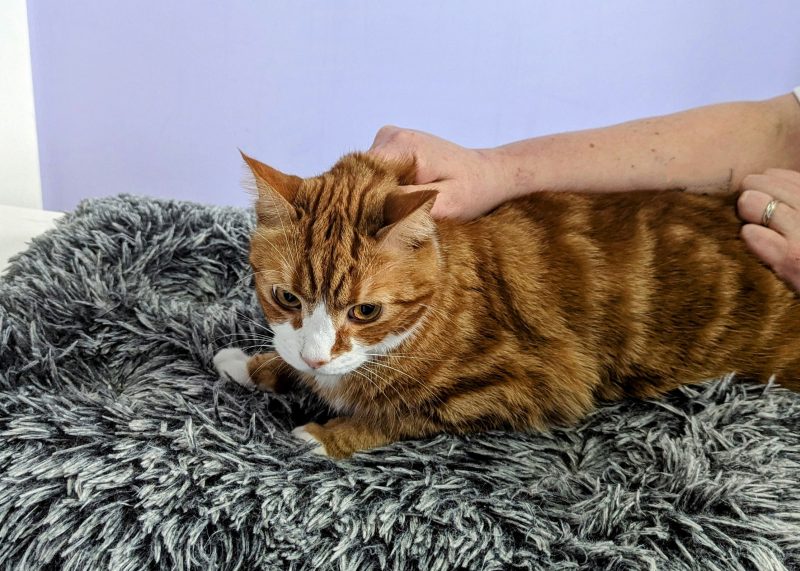
According to feline experts and veterinarians, a cat that “freezes” when you pick them up by the scruff of their neck is experiencing a learned helplessness response, which should not be confused with their being relaxed and content. In fact, it’s quite the opposite: The cat is likely feeling pain and fear.
Here’s why “scruffing” a cat is not considered to be an appropriate way to pick up or hold a cat.

What Does It Mean When an Adult Cat Goes Limp When You Scruff Them?
A cat that becomes still when you pick them up by the scruff of the neck is showing a submissive response. This state is called learned helplessness, which basically means the cat doesn’t try to move because “they don’t believe their actions matter.” This sentence may sound a little too anthropomorphic, but it’s a scientifically recognized phenomenon in both animals and humans.
- In psychology, learned helplessness refers to the “maladaptive passivity shown by animals and people following experiences with uncontrollable events.”
- In the book, “Modeling Neuropsychiatric Disorders in Laboratory Animals,” learned helplessness is described as “a phenomenon in which a subject (human or animal) that is exposed repeatedly to an inescapable stressor develops a behavioral syndrome in which it shows reduced capacity to escape the same stressor.”
- In a study on the behavior of cats in shelters, researchers noted that “learned helplessness is an interesting form of extreme stress, which can be seen during chronic stress or during the exhaustion phase. The animal typically has learned that its behavior has no impact on the situation around it. These animals are withdrawn and unmoving but will continue to remain vigilant for change.”
In other words, learned helplessness could be compared to a cat that “freezes” when faced with a stressful, inescapable situation: Their muscles become rigid and they go completely limp. They may seem calm and silent, but this “false” relaxed posture hides real distress and discomfort.

Is It Painful for an Adult Cat to Be Grabbed by Their Scruff?
Yes, it’s likely painful and scary, especially for an adult cat, as they are heavier than kittens. The sensation of their scruff being pulled can be unpleasant, and going limp may reduce the pain, though it doesn’t indicate relaxation.
Basically, scruffing a cat should be avoided because it can cause fear, stress, and loss of control in the animal. There are better and gentler ways to handle your feline friend.
Are There Situations Where It’s Okay to Grab a Cat’s Scruff?
Kittens are naturally grabbed by the scruff of their necks by their mother during their first few weeks, but this type of handling should not be repeated once they reach adulthood.
That said, the following situations may require this type of handling, but it’s preferable to limit them:
- If there is an immediate safety concern (such as when cats are fighting violently), scruffing them may be appropriate to prevent injury.
- During critical veterinary procedures or emergency/trauma evaluation, scruffing may be done if other methods of passive restraint have failed and it’s in the cat’s best interest and safety.
How to Tell When Your Cat Doesn’t Want to Be Picked Up

If your cat doesn’t want to be held, they may exhibit what veterinarians call “the four F’s of stress”:
- Fight — Dilated pupils, flattened ears, hissing, growling, scratching, or biting
- Flight — Trying to move away, hiding, or wiggling to get down when picked up
- Freeze — Rigid posture, unresponsiveness, and limpness when picked up (which is not a sign of relaxation, but rather a learned helplessness response!)
- Fidget — Signs like lip licking, yawning, sudden grooming, or doing a full-body shake after being placed down
If you notice any of these signs, veterinarians recommend giving your cat a bit of space and letting them approach you for interaction when they’re ready.
How to Pick Up Your Cat in a Proper and Painless Way
First, make sure your cat actually wants to be picked up. How can you know that? Observe their body language.
Signs a Cat Wants To Be Picked Up
A relaxed cat will display a few of the following signs:
- A calm posture
- A tail that’s moving in a slow and lazy movement
- Ears not folded on the head but facing forward
- Normal-sized, almond-shaped pupils
- A soft expression
- Blinking slowly
Important Note: Cats might also purr when relaxed, but know that purring doesn’t always indicate contentment. Indeed, when frightened or not feeling well, cats may purr to self-soothe.

Tips on How to Safely Pick Up Cats
- Approach your cat slowly, avoiding sudden movements.
- Crouch down next to them and initiate contact with a gentle stroke along the back.
- Gently slide your hand along the outer side of their body, under their chest, with your fingertips facing their face.
- Place your elbow toward their rear end, cradling them as if you were holding a football, and use your other hand to provide additional support to the front of their chest.
- Let your cat settle into a comfortable position. Some prefer their legs to hang, while others need more support for their back legs.
- Avoid the belly-up position, which can make cats feel vulnerable.
If your cat begins to show signs of discomfort or frustration, place them back on the floor. Always be patient and gentle with your feline friend and respect their boundaries. Just like humans, not all cats enjoy being touched and handled.
Holding your cat in this manner gives you two secondary options of restraint in case safety becomes a concern, and you cannot safely release them:
- The hand under their chest can hold onto the elbow closest to your body to give you a more secure hold.
- The second hand can apply a gentle scruff hold (not carry or lift) if it becomes absolutely necessary.
Final Thoughts
Ultimately, each cat has their own preferences for how they prefer to be lifted and held, and of course, there are some cats that do enjoy being cradled like a baby, or others, like the Ragdoll, that go into a very relaxed, floppy state when they are content in their person’s arms. However, you should always avoid grabbing your feline friend by the scruff of the neck. This can cause pain, significant fear, and stress and rob them of their sense of control. This is why it’s important to choose gentle methods to handle your cat and above all, to always respect their pace and boundaries!
Featured Image Credit: Dr. Karyn Kanowski, Catster.com







