
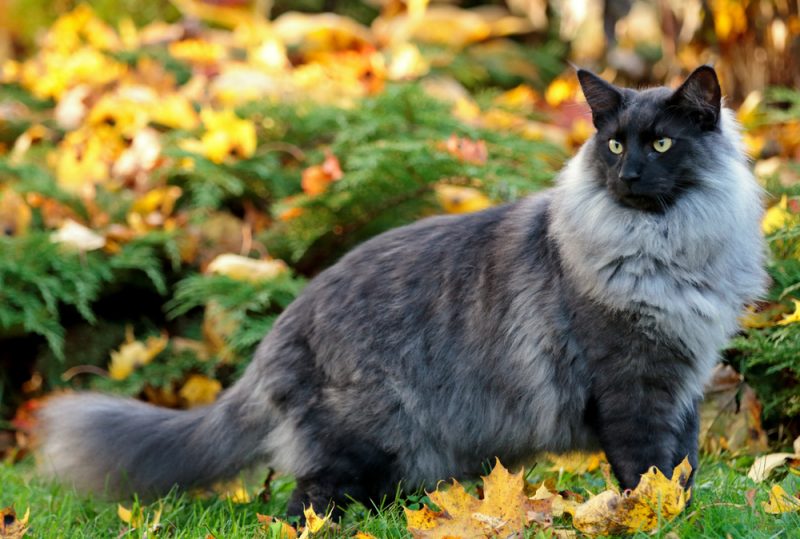
Cats generally weigh somewhere between 8 and 10 pounds, but some breeds are far heavier! Hybrids such as Bengal cats and Savannah cats are often larger than the average domestic feline. Large members of some breeds, such as Maine Coon Cats and Siberian Cats, regularly tip the scales at 20 pounds, with the former generally being considered the largest domestic cat breed. Keep reading to learn more about the 10 largest domestic cat breeds.

The 10 Largest Domestic Cat Breeds
1. Maine Coon Cats

| Weight: | 10–20 pounds |
| Lifespan: | 12–15 years |
Maine Coon cats usually come close to or at the top of most lists of the largest cat breeds, when talking about domestic cats of course. They’re native to the northern forests in the eastern part of the North American continent around the state of Maine, and they’re the state’s official cat. They have long, soft fur that comes in a range of colors that require regular grooming to prevent tangles.
Maine Coons are known as some of the sweetest, gentlest cats around and make wonderful family pets. Often described as “dog-like,” they typically love being right in the middle of whatever is going on at home. Many are polydactyl, meaning they have more than the standard number of toes. Maine Coons love playing in the water, and bath time generally isn’t a problem.
2. Chausie Cats

| Weight: | 15–25 pounds |
| Lifespan: | 15–20 years |
Technically considered hybrids, Chausie cats are ancient mixes of domestic cats and wild kitties living in ancient Egypt and parts of South Asia. They have short, thick coats that are often black or brown, but some feature tabby stripes. Chausies have tufts of fur on their ears, athletic bodies, and strong muscular legs that give them an elegant look that hints at their wild heritage.
They are active cats and require a fair amount of physical activity and mental engagement to stay happy and healthy. While the breed has existed for millennia, pedigree Chausies are relatively rare. Most are easy to train, and some enjoy exploring the outdoors with their favorite human on leashed walks. They’re often considered good choices for allergy sufferers, as they’re not typically big shedders, but they still produce the protein that triggers most allergy symptoms in people.
3. Norwegian Forest Cats

| Weight: | 12–22 pounds |
| Lifespan: | 15–20 years |
Norwegian Forest cats have thick, dense, medium-long water-resistant coats that come in many colors and combinations, but colorpoint shading isn’t found in the breed. They have large, muscular bodies, and some large males can weigh more than 19 pounds. They’re a natural breed and typically healthy; many even live long enough to celebrate their 20th birthdays. They’re native to Norway, where they’re the nation’s official cat.
Norwegian Forest cats are generally friendly and social, but most can be a bit independent. They’re known for becoming particularly attached to one person. Sturdy cat trees are a must for homes with Norwegians since they love climbing and hanging out in high places.
4. Ragdoll Cats

| Weight: | 15–20 pounds |
| Lifespan: | 10–15 years |
Ragdoll cats are sweet, loving companions and were the most popular pedigree breed in the United States in 2022, according to the Cat Fanciers’ Association. These large kitties have sparkling blue eyes and medium-to-long coats in several shades and patterns. Laid-back and adaptable, Ragdolls typically get along well with people and other pets.
They thrive on interacting with humans, but most don’t have incredibly high physical activity needs. Ragdolls bond deeply with people and usually dislike being left alone. They’re happiest when cuddled up close to their favorite person and can be trained to respond to their names and fetch toys. They don’t reach maturity until they’re around 4 years old!
5. Siberian Cats

| Weight: | 12–20 pounds |
| Lifespan: | 10–18 years |
Siberian cats are a natural breed native to the far northern reaches of Asia. They’re Russia’s national cat! They have thick, fluffy triple-thick coats and huge tails. They take a while to reach their full size, and most don’t reach their adult proportions until they’re around 5 years old. They’re usually solid cats that have a tendency to gain weight.
Siberian cats become attached to people, and they often do best in homes where they’re regularly included in activities and spend lots of time with their families. Most love to climb and hang out in high places, and some can become anxious when left alone for too long. As a natural breed, Siberians are healthy and can live up to 18 years.
6. Savannah Cat

| Weight: | 11–20 pounds |
| Lifespan: | 12–20 years |
Savannah cats are technically hybrids. They’re mixes of African servals and domestic kitties. They typically have long legs, slender bodies, and gorgeous spotted coats. Some large first-generation (F1) hybrids can reach 16 inches at the shoulders, making them 7 inches taller than the average cat! Earlier-generation hybrids are larger and more energetic than later-generation cats.
Third-generation (F3) Savannahs are often more moderately sized and less active than first and second-generation pets. But even then, most are incredibly active and full of energy. Savannahs are usually easy to train, and some enjoy leashed walks with their owners. They’re a relatively healthy breed; their average lifespan is 12 to 20 years.
7. American Bobtail Cat

| Weight: | 11–20 pounds |
| Lifespan: | 13–18 years |
American Bobtail cats have short tails that range from tiny stumps to 4-inch rumps. They have thick, double coats that naturally repel water and keep them warm in cold environments. They can have medium-length or long fur, and their coats come in several shades. Their front legs are shorter than their back ones, giving them a slightly pitched forward appearance.
American Bobtails are intelligent, and many can open doors and free themselves from locked rooms and cages. Some even wag their tails when particularly content! Most absolutely thrive on human interaction — they’re known for enthusiastically greeting their humans at the door. American Bobtail Cats are generally active, playful, curious and loving.
8. Ragamuffin Cat

| Weight: | 10–20 pounds |
| Lifespan: | 12–18 years |
Ragamuffin cats are stunning mixes of Ragdoll, Himalayan, and Persian Cats. They even have a bit of domestic longhair kitty mixed in as well. Ragamuffin Cats have been around since the 1990s, so they’re a relatively young breed. While they’re quite large, most Ragamuffin Cats are gentle and often don’t fare well in the rough and tumble outdoor world.
They’re more inclined to enjoy riding in a buggy to keep you company on a nice walk than to relish chasing birds. They look like Ragdoll Cats but come in a wider range of colors and can have eyes of various shades. They’re known for being some of the gentlest, friendliest kitties around! Most live relatively long lives, about 18 years is the average for Ragamuffin Cats.
9. Bengal Cats

| Weight: | 6–15 pounds |
| Lifespan: | 12–20 years |
As Asian Leopard Cat-domestic hybrids, Bengal Cats look like they just stepped out of the jungle thanks to their gorgeous spotted coats and athletic builds. They’re curious and extremely active, and most require a great deal of physical activity and mental stimulation. Bengals love water, and playing with the water dripping from faucets is a favorite activity.
They’re incredibly smart and can open doors and work their way into closed drawers. Bengals whose mental and physical needs aren’t met often become stressed and anxious, which can sometimes lead them to pee outside the litter box and become destructive. However, they can easily be trained to do tricks, and most enjoy walking on leashes. Some Bengals make growling noises when eating!
10. Persian Cats

| Weight: | 7–12 pounds |
| Lifespan: | 12–18 years |
Persian Cats have flat faces, compact bodies, and luxurious long fur that comes in several shades and colors. They’ve been popular for centuries and have existed since the 1600s. The breed’s famous flat faces result from a random genetic mutation. Most Persians are relaxed pets and generally do best in quiet environments where they receive lots of gentle attention.
They can be reluctant to engage with new people and prefer napping to running around. However, they enjoy lazy play sessions if their favorite human is involved. Most have little interest in launching attacks from the furniture but enjoy lounging around in the sun and napping.
Conclusion
Cats are generally considered small companion animals, with most tipping the scales at somewhere between 8 and 10 pounds, but there are a few breeds that fall outside of that range, including Maine Coon Cats and Ragdoll Cats. Maine Coon Cats are generally considered the biggest cat breed in the world; it’s not unheard of for these kitties to reach 25 pounds. And Ragdoll Cats are sweet, loving companions with incredibly gentle personalities that can weigh up to 20 pounds. We hope you enjoyed learning about the largest cat breeds in the world!
Related Reads:
- History of Domestic Cats: A Look Through the Ages
- Best Cat Trees for Large Cats – Reviews & Top Picks
Featured Image Credit: Elisa Putti, Shutterstock
 The 10 Largest Domestic Cat Breeds










6 Responses
I had found a link before that asked questions about his features and was given results of most likely what breeds are in him. I can't find it now
Do you mean this one?: https://www.catster.com/lifestyle/what-breed-is-my-cat/
😺
I'm searching for charter and looks to see what mixed breeds he has.
Gail Friend, you could also try a DNA ancestry kit test: https://www.catster.com/lifestyle/best-cat-dna-tests/
😸
Hi there…You forgot the Turkish Van! I've had two now and they are beautiful cats!
Hi Nancy,
Thank you so much for your message, and you're absolutely right—we can't forget about the beautiful Turkish Van. They are such unique and stunning cats with their striking coats and playful personalities. How lucky you’ve had the pleasure of raising two.
We always appreciate hearing about our readers' personal experiences with different cat breeds. If you have any favorite stories or insights about your Turkish Vans, we’d love to hear more! Thank you again for bringing this up
Wishing you and your Turkish Van lots of happy moments ahead!
Best regards