Does Laser Therapy for Cats Help With Pain? Vet-Reviewed Facts & FAQ


In this article
If your cat experiences persistent pain or discomfort from arthritis, muscular injuries, or other wounds, prescribed medicines are a natural solution. Unfortunately, some cats aren’t compliant when it comes to taking pills, but leaving them in pain is not an option.
In this case, veterinary laser therapy is a non-invasive treatment for your furry friend that can relieve pain, reduce inflammation, and speed up the healing process. It doesn’t involve any drugs, surgery, or distress, so you don’t need to worry about hurting your cat.
Still, it’s understandable to be skeptical about laser therapy for your dear pet, so we’re here to ease your mind. Keep reading to learn how veterinary laser therapy works and how it can relieve pain for your cat.

How Does Laser Therapy for Cats Work?
Veterinary laser therapy is a non-invasive and painless procedure that involves no drugs or surgeries to treat certain conditions in an animal. In most cases, veterinary laser therapy is performed alongside other treatment protocols for your pet.
When it comes to cats, vets utilize a deep-penetrating light to elicit photo bio-stimulation, which is a chain of chemical reactions. As a result, the release of endorphins will provide pain relief for your cat and stimulate their injured cells to speed up the healing process.

How Does It Affect Your Cat’s Tissues?
Laser therapy relies on a specific wavelength of light waves to trigger photobiomodulation, which alters the physiology of cells and tissues in the cat’s body. Its cellular components absorb this light, stimulate electrons, and activate the cells. This causes the promotion of growth, repair, migration, and proliferation.
The response of these deep tissues to laser therapy varies based on the delivered light wave’s wavelength. Veterinary laser therapy utilizes red or near-infrared light with a 600- to 1070-nanometer wavelength. Conversely, green, violet, and blue light have lower wavelengths but are more popular today. The superficial tissue, such as the skin, is more likely to absorb lower wavelengths, while higher wavelengths are able to penetrate into the bones and muscles.
Here are a few ways laser therapy helps tissue repair:
Can It Help With Pain?
Laser therapy can relieve your cat’s pain in three ways. First, it triggers vasodilation (widening blood vessels), reducing internal and external inflammation. Then, it activates your cat’s lymphatic drainage system, reducing swelling caused by inflammation or bruising.
Second, laser therapy stimulates the nerve cells responsible for preventing pain signals from reaching the brain. Lastly, these treatments trigger high levels of endorphin production, providing natural and instant pain relief for the cat.

How Is It Administered?
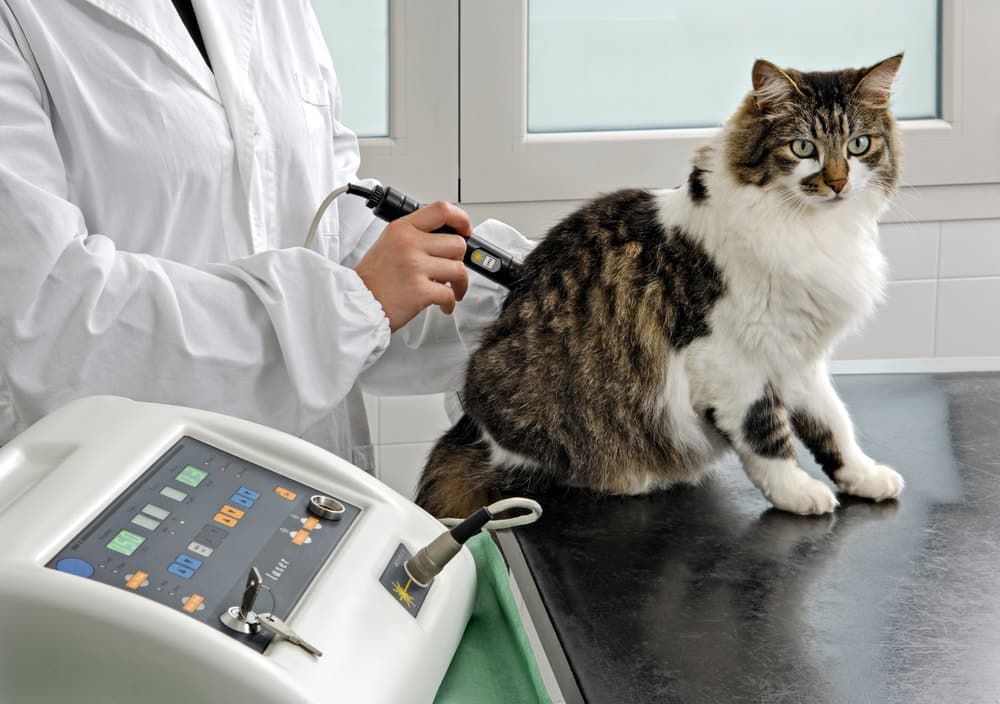
Laser therapy is administered simply and painlessly as the vet slowly moves the handheld laser wand back and forth on the damaged tissue.
The number of sessions required depends entirely on your cat’s condition. If the illness is chronic, you may need to bring them in for weekly sessions. But if you’re dealing with open wounds or surgical incisions, daily sessions may be necessary.
How Long Does It Take?
The duration and quantity of laser therapy sessions depend on your cat’s condition and the severity of the disease. A great example of using laser therapy is to relieve pain from surgical incisions, where vets use laser post-operatively to speed up the healing process.
Other than that, the vet may utilize a one-time laser treatment for wound care if your cat has an infection or ulceration. In these cases, the treatment is done over the course of one or two sessions.
Of course, if your cat is dealing with chronic or severe pain, the vet may need multiple sessions to complete the laser therapy treatment. The session duration may vary, but they typically last somewhere between 3 and 8 minutes. The vet will determine the session duration based on your cat’s improvement.
For example, chronic low back pain requires approximately six weekly laser therapy treatments, while arthritis may require longer sessions. You can expect the sessions to get shorter as the vet notices improvements in your cat’s condition, pain, and response.


Where Is It Used?
Veterinary laser therapy can be used to aid various conditions in your pet, such as:
In most cases, patients for veterinary laser therapy are older cats and dogs with musculoskeletal issues. If your cat is displaying any of the following signs alongside pain and discomfort, laser therapy may benefit your pet:

Advantages of Laser Therapy for Cats
Pain relief is one of the main benefits of laser therapy for your cat, but these treatments can also help your pet with the following conditions.
Increased Metabolic Activity
Laser therapy treatment triggers the release of specific enzymes alongside food for blood cells and better oxygen production. As a result, it improves your cat’s metabolism and boosts energy production and use inside the cells.
Improved Nerve Function
If your cat’s nerve function recovery in a damaged tissue is slow, they may suffer from numbness or even impaired limbs. With the help of laser therapy, the vet can accelerate the nerve cell reconnection and multiply the action potentials required to optimize your cat’s muscle action.
Stimulated Trigger Points & Acupuncture Points
Aside from improving your cat’s metabolism and nerve function, laser therapy treatments can also stimulate their trigger and acupuncture points. Since the entire procedure is non-invasive, your cat can experience musculoskeletal pain relief in a safe and drug-free way.
Reduced Fibrous Tissue Formation
Laser therapy can also prevent scar tissues from forming after your cat’s tissues are damaged due to burns, surgery, scratches, or cuts.

Faster Wound Healing
Collagen is made up of fibroblasts, which primarily aid the body in the wound-healing process. Since laser therapy promotes the development of fibroblasts in your cat’s damaged tissues, it can also accelerate the wound healing process. That’s why most vets utilize laser therapy on open wounds and burns.
Accelerated Tissue Repair & Cell Growth
High-wavelength laser therapy penetrates deeply into the damaged tissue to speed up cellular growth and reproduction. This way, it can also multiply the energy provided to the cell, enabling the cells to capture nutrients faster and discard waste products easily. As a result, the cells found in muscles, ligaments, and tendons repair more quickly due to laser therapy.
Anti-pain (Analgesic)
Laser therapy does a great job of activating the nerve cells responsible for preventing pain signals from reaching the brain. Not only does this decrease nerve sensitivity, but it also reduces pain, edema, and inflammation. Other than that, laser therapy triggers endorphin and enkephalin release for your cat’s adrenal gland and brain.
Improved Vascular Activity
Laser therapy can accelerate the production of new capillaries in your cat’s damaged tissue, leading to a faster healing process without scar tissue. It can also speed up angiogenesis, triggering a temporary vasodilatation response.

Disadvantages of Laser Therapy for Cats
Veterinary laser therapy has virtually no disadvantages. You may think it must be expensive and has many side effects, but that’s not the case.
Side Effects
Laser therapy does not have any adverse side effects or drug usage, so your cat won’t need to recover from the procedure. Depending on the condition, you may need to bring your cat in for multiple sessions to see long-term results. Soon enough, they’ll showcase reduced pain and discomfort alongside increased activity after the first few sessions.
Cost
Since almost all vets utilize laser therapy, these treatments aren’t too costly. In fact, you can expect to pay $25 to $50 per session, depending on the session’s duration. The number of sessions required depends on your cat’s condition and response to the laser light.
Frequently Asked Questions
How Does Laser Therapy Improve the Health and Well-Being of My Cat?
Laser therapy can improve your cat’s health and well-being in various ways. First, it promotes cell production and improves nerve function by providing more cell energy, which enables your cat to heal faster. Second and more importantly, laser therapy can reduce inflammation and chronic pain by reducing cell death.
Can Laser Therapy Cure My Cat?
Whether veterinary laser therapy can cure your cat depends on the disease that they're suffering from. In most cases, vets utilize laser therapy to reduce chronic pain and inflammation, not to treat severe conditions. If your cat’s unable to take pills, laser therapy can help them heal faster and re-establish normal functions.
To cure your cat’s condition, you’ll need to utilize laser therapy alongside other treatment protocols, such as veterinary orthopedic manipulation or medication.
How Many Laser Therapy Treatments Does My Cat Need?
The number of laser therapy sessions required depends on the condition the vet is treating. For example, acute injuries can heal within five to seven treatments, allowing the cat to cure faster and prevent scar tissue. The main aim here is to reduce their pain and promote faster wound healing.
Conversely, your cat may be on various medications and suffering from a chronic condition. In that case, the maximum number of treatments may be required, which is approximately 14 sessions. Here, the vet will aim to ensure your cat is comfortable and pain-free on minimal medications.
If your cat is a senior, you may need to bring them in for monthly laser therapy treatments, while younger cats with long-standing conditions will need to come every 3 to 4 months.

Is Laser Therapy Painful for Cats?
Luckily, laser therapy is a completely painless and even comforting procedure for your cat. The laser administers a warm and soothing sensation, allowing your cat to relax. In fact, most cats even fall asleep during their laser therapy sessions.
How Long Will It Take for My Cat to Experience Pain Relief From Laser Therapy?
After the required number of laser therapy sessions, your cat will begin experiencing pain relief and clinical sign improvement within the first few weeks. However, if your cat’s condition is severe and long-standing, it may take a bit longer for the pain relief to kick in.
In severe cases, the vet may need to utilize traditional methods to stabilize the cat alongside laser therapy treatment.
Is It Okay to Self-Diagnose My Cat’s Pain?
Cats are incredible at hiding their pain and discomfort, which is why it’s not wise to assume your cat’s pain is minimal by noticing their external signs. By the time you see severe signs, they may have been suffering for an extended period already. If you have any suspicions about their pain or discomfort, it’s best to take them to the vet for a complete physical examination.
Conclusion
Veterinary laser therapy is a painless and non-invasive procedure that may provide pain relief for your cat while speeding up their healing process. If your cat has trouble taking pills or is suffering from chronic pain, a laser therapy treatment may be the solution you’re looking for.
Featured Image Credit: Luigi De Zotti, Shutterstock
Expert cat care, straight to your inbox
News, insights, and useful advice, delivered to you.

No spam — unsubscribe anytime.
By signing up, you agree to our Terms & Conditions and Privacy & Cookies Policy.
How useful was this post?
Click a star to rate. You can leave written feedback afterwards. (We read all feedback.)
Jeff is a pet parent who loves writing. He is a data privacy tech professional with 20 years of experience leading teams at various Fortune 100 startups. Jeff's hobby is photography.