5 Vet-Reviewed Reasons Why Your Cat Uses You As A Scratching Post & How To Stop It


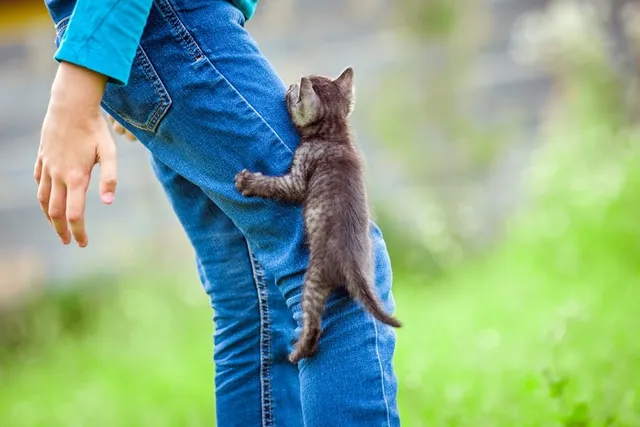
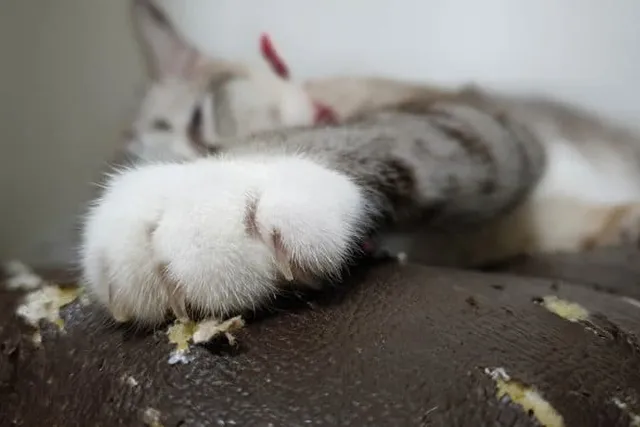
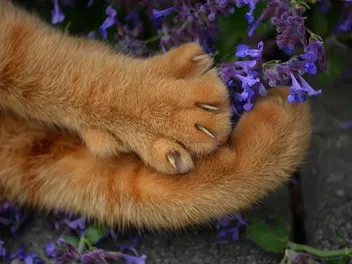
Your cat’s claws are used for survival as hunting weapons and tree-scaling devices in the wild. As domesticated pets, their claws are kept in tip-top shape with regular scratching, which also serves as a way to do a full body stretch. Of course, to save our furniture, we have designated cat scratchers that they quickly take to. So, it can be jarring when they stretch their paws up to our legs, only to drag their claws down our calves, or sit on our knees to claw at our lap.
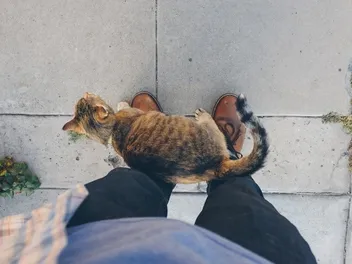
Why would cats use our legs as a scratching post? There are plenty of reasons for the contact between your cat’s claws and your legs, and none are sinister!

The 5 Possible Reasons Why Your Cat Uses You As a Scratching Post
1. They Want Attention
As quadrupeds (four-legged animals), cats are tactile with their front paws. They use them to investigate strange objects, reach for items, and play with them. If their meows aren’t enough to attract their owner’s attention, they may use their front paws to get attention.
Reaching up and placing their paws on your legs could signify they want you to talk to them, pet them, or play with them. Either way, they’re just looking for love and attention. Unfortunately, they don’t always have much control over their claws. This is true if they use your leg to stretch out on, as the stretching can cause the nails to pop out involuntarily.

How to Stop It
2. They’re Hungry
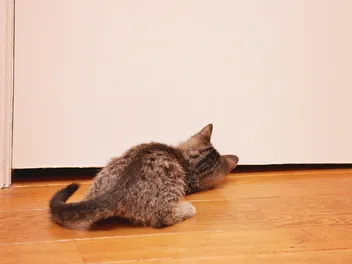
Your cat may be not looking for social attention but asking you for something in particular. For example, when your cat wants you to open a door for them to go through, they often stretch up and scratch at the door to communicate this, while meowing and following you around intently.
If you are near their feeding area or their bowl and they scratch at your leg, they may be asking for you to feed them.
How to Stop It
3. To Get Comfy
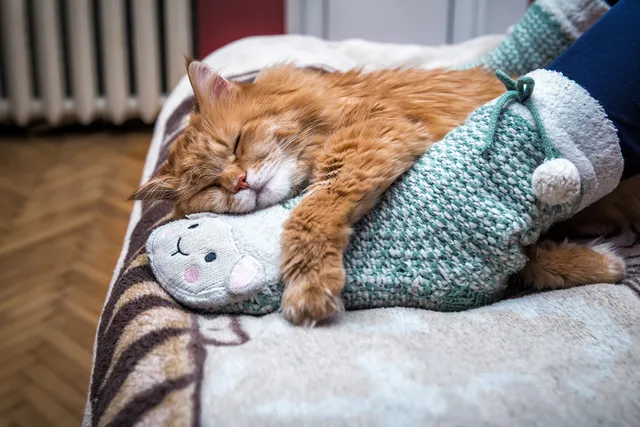
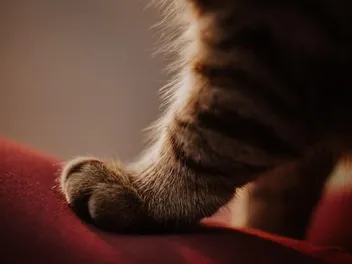
A behavior you may be familiar with in dogs is also typical in cats: using their paws to prepare a spot to sleep in. Pawing and kneading at surfaces can be a way for cats to soften a surface before they lay down. If your cat likes to sit on your lap, your legs may get battered by their claws as they prepare to snuggle in!
This behavior comes from wild denning behaviors where cats prepare a spot to rest in for protection from the elements. This may also be a form of nesting for pregnant or nursing cats, as they look for a safe and warm space to keep their kittens.

How to Stop It
4. They Love You!
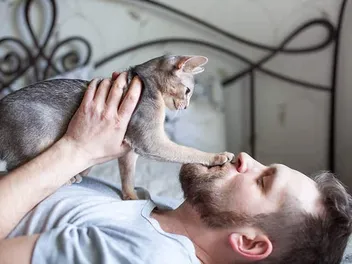
Besides using their claws and paws to get comfortable, kneading their feet on your lap can signify your cat adores you. What better way to say “I love you” than by digging their claws into your lap?
Kneading behavior stems back to when your cat was a kitten. During nursing, kittens use it to stimulate the mammary glands for milk production. Of course, your cat knows that no milk will come from your legs, but it is a retained behavior.
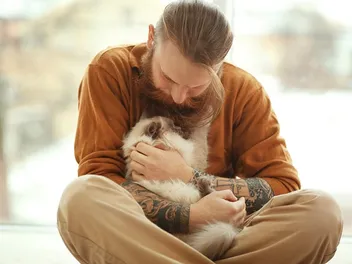
Your cat may be trying to tell you that they know you are their “human mom,” and they love you very much. You’ll know it is the reason behind the clawing if they are also snuggling up to you, purring, or even drooling pleasure.
How to Stop It

- Complete Set - These cat nail clippers include both a large and small pair, meaning it works well as a kitten claw trimmer when they're a small kitty, and then before you know it, as a cat nail cutter
- Razor Sharp Stainless Steel - The most comfortable cat nail clippers for indoor cats provide a fast and clean cut. And for rough residuals remaining, the free cat nail file included can smooth it all.
- Safety First - With a safety nail guard and locking spring, you can make sure every grooming cut is stress free for you, and pain free for your purry pal
Trimming your cat's nails at home can be hard, but having a professional do it can be expensive. With the help of great tools like Hepper's Cat Nail Clipper Set, you can easily and quickly trim your cat's nails at home. This set includes two pairs of stainless steel clippers with safety guards and locking mechanisms, plus a built-in nail file and a convenient pouch.
At Catster, we’ve admired Hepper for many years and decided to take a controlling ownership interest so that we could benefit from the outstanding designs of this cool cat company!
5. To Mark Their Territory
Part of a cat's scratching comes from instincts. They use the scent glands located on their paws (interdigital glands) to mark their territory. Scratching can leave behind visual and chemical messages to other cats in the area.
Your cat may mark their territory on your legs to leave their scent behind. This familiar scent can provide comfort and security to your cat.
How to Stop It
Final Thoughts
If your cat treats your leg like a scratching post, they aren’t trying to cause you harm. You will know if they are genuinely being aggressive if the scratching is coupled with biting and hissing.
Your leg may be subject to your cat’s claws for various other feline means of communication. However, you can use our guide to help you decipher what your cat is trying to tell you!
Featured Image Credit: RomeoEbaloo, Pixabay
Expert cat care, straight to your inbox
News, insights, and useful advice, delivered to you.

No spam — unsubscribe anytime.
By signing up, you agree to our Terms & Conditions and Privacy & Cookies Policy.
How useful was this post?
Click a star to rate. You can leave written feedback afterwards. (We read all feedback.)
With an early start in the veterinary industry and as a conservation educator at Disney’s Animal Kingdom in Florida, Sophie has since been a successful Zookeeper and Conservationist, specializing in native New Zealand species. When she’s not bird watching in native forests or crawling through the underbrush at midnight searching for rare frog species, she can be found with her farmer husband on their sheep and beef station, far from civilization. Alongside them, they have 2 cats, 9 chickens, and 11 dogs (most notably, her sidekick, a black Labrador aptly named Jellybean). Sophie enjoys her writing career as it provides opportunities to help and support pet owners of all kinds to give animals the best welfare possible. The only downside is the long list of strange searches in her internet history!