Get

In Your Inbox

Catster is reader-supported. When you buy via links on our site, we may earn an affiliate commission at no cost to you. Learn more.

Are Cats Self-Aware? Do They Understand Mirrors & Their Self-Reflection? (Vet-Reviewed)

Share

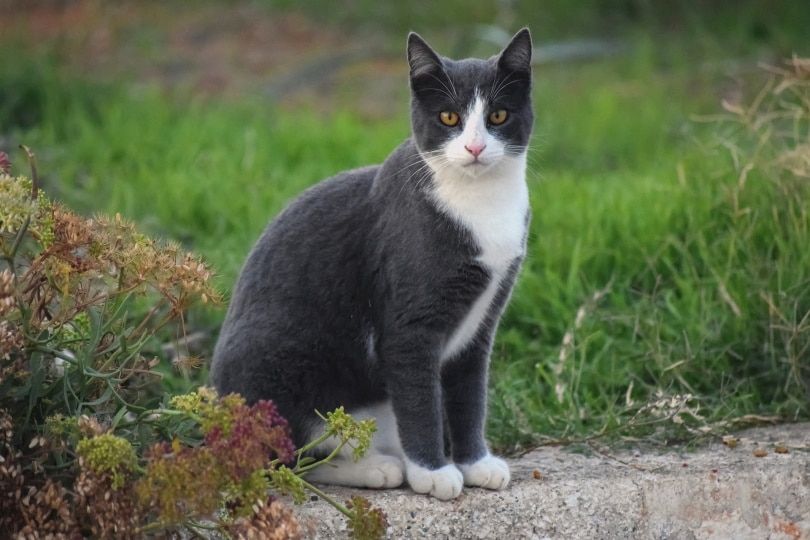
cat burp_Dimitris Vetsikas_Pixabay

Self-awareness in animals is often seen as a sign of intelligence, and it is something that scientists have looked at for decades, not only in cats but also in virtually every species of animal. Despite what it might look like when your cat does see themselves in a mirror, scientists claim that they do not recognize their own reflection and are instead either defending against what they deem to be an aggressor or acting aloof in the hope that the “other cat” will leave. Cats that ignore their reflection aren’t thought to be self aware but instead are thought to be desensitized to the mirror and their reflection.

divider 3 paws

What Is Self-Awareness?

Recognizing oneself in a mirror requires a great deal of complex thought and incredible self-awareness. Humans aren’t the only species that can recognize a reflection to be themselves, but they are the most advanced. Other species that can recognize their own reflection include whales and dolphins, orangutans, chimpanzees, and elephants1. Magpies and trained pigeons have also passed what is known as the red dot test. Species that have actively failed the test include monkeys, which are often seen as being highly advanced, and giant pandas.

cats reflection_Taya Ovod_Shutterstock
Image By: Taya Ovod, Shutterstock

The Red Spot Test

The red dot test is the scientific test most often used to determine whether an individual or a species does indeed recognize their own reflection. The test is also referred to as the mirror self-recognition test or the mark test.

Developed in 1970 by scientist Gordon Gallup Jr., the test requires that an animal is anesthetized, and a red dot is placed somewhere on the animal that they would not normally be able to see. When they wake up, they are given access to a mirror. If that animal touches the red dot or attempts to investigate the dot on themselves, it means that they recognize their own reflection and the fact that there is an unusual or unexpected mark on them. It shows that they do not see the reflection as another animal.

Cats and the Mirror Test

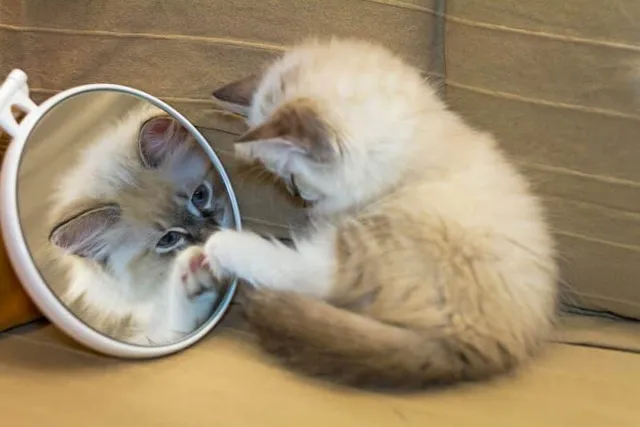
Cats have been subjected to the mirror test in controlled conditions, as well as simply placed in front of a mirror in their home. When put in front of a mirror, cats may act aloof and ignore the reflection, they may look behind the mirror to find the animal that they see, or they may strike a defensive pose in a bid to get rid of the threat of another cat in the same vicinity. This is considered to be a failure of the test, so cats are not considered to be self-aware in this way.

cat and mirror_Smile19_Shutterstock
Image By: Smile19, Shutterstock

Cats and Intelligence

If you believe cats to be quite intelligent, it is worth noting that the feline is still an incredible animal and they show intelligence in many other ways.

For example, in controlled experiments, they have shown that they understand the concept of object permanence. They recognize that an object continues to exist even when it is out of sight, which is why if you put one of their favorite toys in the cupboard, they understand that it is still there, potentially even weeks later.

They are also known to have long and in-depth dreams, similar to those of humans. However, they do not understand cause and effect as humans do.

Cats do have memories that can last as long as 10 years. Some experiments show that cats follow the law of effect, which means that they can accidentally perform an action that has a desirable effect and then continue to perform that action with greater consistency because they want the desired effect.

cats reflection II_ OlenaPalaguta_Shutterstock
Image By: OlenaPalaguta, Shutterstock

divider 3 paws

Are Cats Self-Aware?

We tend to think of cats as being highly intelligent animals. This is largely because they communicate with us by meowing and using other verbal and non-verbal cues. We respond to them, and this gives us an inflated opinion of their intelligence. They are intelligent enough to learn habits and determine when it is food time, have good memories, and understand object permanence.

However, the red spot test suggests that they are not visually self-aware—they do not recognize their own reflection as themselves and are more likely to consider it to be another cat.

But as any cat owner will attest, cats don’t need to be self-aware, as long as their humans are aware enough to do their bidding.

See also:


Featured Image Credit: Dimitris Vetsikas, Pixabay

Want content like this delivered to you?

Sign Up For Our Newsletter

News, insights, expert advice, and everything cat

* By submitting, you agree to our Terms & Conditions and Privacy & Cookies Policy.


How useful was this post?

Click on a star to rate (you can leave written feedback after clicking submit)

Help us improve Catster for pet parents!

Your feedback really matters.

What did you like about this post? Also how can we improve it?

Join the conversation

2 Responses

  1. Cats aren't all that sensitive to color. It might be difficult to see a "red dot" on their body. I suppose the mirror test does show cats can't really identify themselves in a mirror though.

    1. Thanks for your comment, Marques! You're right, cats don't really see red or pink the way we do. Those colors probably look more like gray or dark brown to them. The red dot test is from the 1970s, which is around the same time vision scientists did more careful studies, and the idea of cats being "red-blind" really stuck. If you have a cat and a mirror, you can see for yourself, you don't really need a red dot!

Leave a Reply

You’re very welcome to leave a comment or question. Please know that all comments must meet our community guidelines, and your email address will NOT be published. Let’s have a positive and constructive conversation.


Catster's Digital Magazine is Back!

Vet-approved health & behavior advice

Real cat stories & community features

Chatting With Dr. Matt McGlasson About Special Needs Kitties, Social Media Fame, and Rating Cat Toe Beans | Chatty Cattys, Episode 32

In this episode of Catster’s Chatty Cattys podcast, Dr. Karyn and Nicole sit down with a very special guest: veterinarian and social media...

Does Your Cat Need A Friend? How to Tell If Your Cat Is Lonely

Cats have a reputation for being perfectly happy on their own – independent, self-sufficient, and solitary. But, like many stereotypes, this one does...

Proof That Moving Cats Indoors Is Easier Than You Think

We know that indoor cats live longer and have significantly lower rates of illness and injury than those that spend part or all...

Why Cats Love To Get High

If you’re trying to find a cat in any home, the search almost always ends by looking up. They’ll be on top of...

More related

How to Hide Your Cat’s Litter Box: 12 Smart Solutions

There are many wonderful things about owning a cat, but keeping up with their litterbox is not one of them! While most people...

How to Put On a Cat Collar in 4 Easy Steps

Getting your cat into a collar doesn’t have to be traumatic for you or your pet, and outfitting your cat with the proper...

Why Do Cats Show You Their Butt? 6 Vet-Reviewed Reasons

Although cats have lived with humans for millennia, they still do many things that leave us feeling puzzled or confused. One behavior that...

8 Best Disposable Litter Boxes in 2026 – Reviews & Top Picks

Have you ever cleaned your litter box only to find that it still smells? In traditional plastic litter boxes, the smell of ammonia...

Keep reading

Can Cats Eat Cheese Puffs or Balls? Vet Reviewed Risks & Health Facts

As a responsible and caring cat owner, you may sometimes find it hard to resist those pleading eyes when you’re enjoying a delicious snack. With their crispy texture and savory flavor, cheese puffs or cheese balls are a popular favorite...

Can Cats Eat Cheese Puffs or Balls

Do Cats Pee Blood When Stressed? Vet-Reviewed Causes For Blood In Urine

Any health problem that affects your four-legged friend is cause for concern, especially if it seems like your cat is peeing blood. The presence of blood in the urine is called hematuria, and it can be caused by various underlying...

Why Do Cats Eat Grass? 5 Vet-Reviewed Reasons Behind the Behavior

Our beloved cats are quirky creatures with some habits that seem rather baffling to cat owners. One of these behaviors is cats chowing down on grass and then sometimes throwing it back up. Why? Why on earth do these intelligent...

close up of a cat eating grass

Is It Safe To Dye Your Cat’s Fur? Vet Approved Advice

If you’ve been online and pictures of cats with dyed coats have crossed your path, you may be wondering how the process works, what it involves, and whether it may be something to consider doing with your companion. In theory...

woman preparing dye for hair coloring on pink background

How Do Cats Cool Down? Vet-Reviewed Methods & Signs of Overheating

Like most mammals, when the weather gets hot, cats use different methods to stay cool. That’s especially true for cats with thick coats of fur, but any cat can overheat and need to cool down if the situation gets too...

tabby cat licking her paw

Can Cats Eat Wheatgrass? Vet-Reviewed Benefits & Facts

If you have a dog, chances are you’re used to asking them what they have in their mouths. On the other hand, cats can be a little fussier about what they eat, but some nibble the edges of plant leaves...

Can Cats Eat Wheatgrass

4 Everyday Noises That May Be Scaring Your Cat

While thunder and fireworks can surely terrify Fido, can these noises scar your cat? There are many everyday sounds that felines find disturbing and are the cat equivalent of fingernails being drawn across a chalkboard. But what noises could be...

scared kitten hiding

10 Best Dry Cat Foods in the UK in 2026: Reviews & Top Picks

Whether you feed your cat a combination of wet and dry food or just dry food, getting the right kibble is important. It should meet your cat’s nutritional requirements according to their age, health conditions, and, of course, their preferences....

grey cat eating food

Love Cats? So Do We! Join the Catster Community

Stay informed with expert pet care insights delivered straight to your inbox! Discover professional guidance on animal behavior, feeding tips, trusted product picks, and much more.


Sign up for the Catster Email Newsletter

Stay informed with expert pet care insights delivered straight to your inbox! Discover professional guidance on animal behavior, feeding tips, trusted product picks, and much more.