What Is a Cat’s IQ? Vet-Verified Facts & How to Test Feline Intelligence


In this article
Just like people, cats seem to come from all ends of the intelligence spectrum. Some cats show amazing problem-solving and learning skills, while others spend a lot of time trying to figure out how to catch the ceiling fan. Is there a way to determine a cat’s IQ level, though? Wouldn’t it make things easier for you if you knew what level of intelligence you’re working with when trying to train your cat? What is the IQ of a cat?
There isn't a way to test a cat's IQ level, but there are other methods to test their intelligence.

What Is a Cat’s IQ?
If you’ve ever seen a human IQ test, then you know that it includes aspects that a cat can’t complete, like visual-spatial recognition and problem-solving. Because of the necessity for things like human language, a human IQ test wouldn’t be able to be used for a cat.
However, there is no cat equivalent of the human IQ test. In fact, IQ, or intelligence quotient, is based on the average intelligence level of the general population, with outliers falling above or below the average. Trying to rank a cat’s intelligence based on human intelligence averages simply doesn’t make any sense.

How to Test Your Cat’s Intelligence
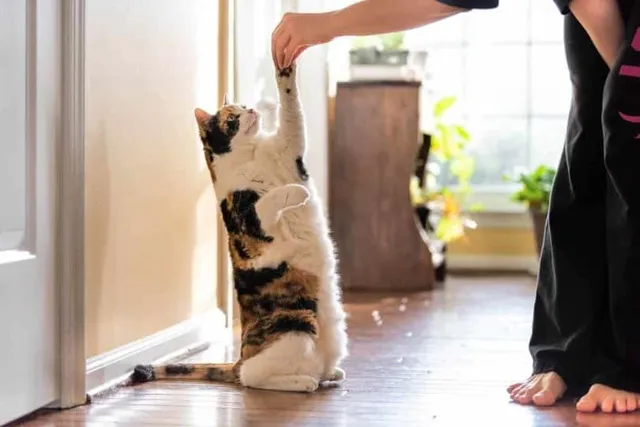
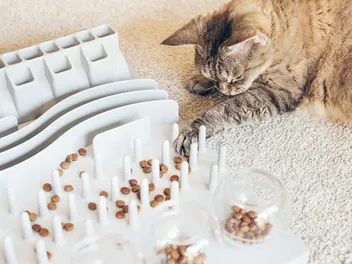
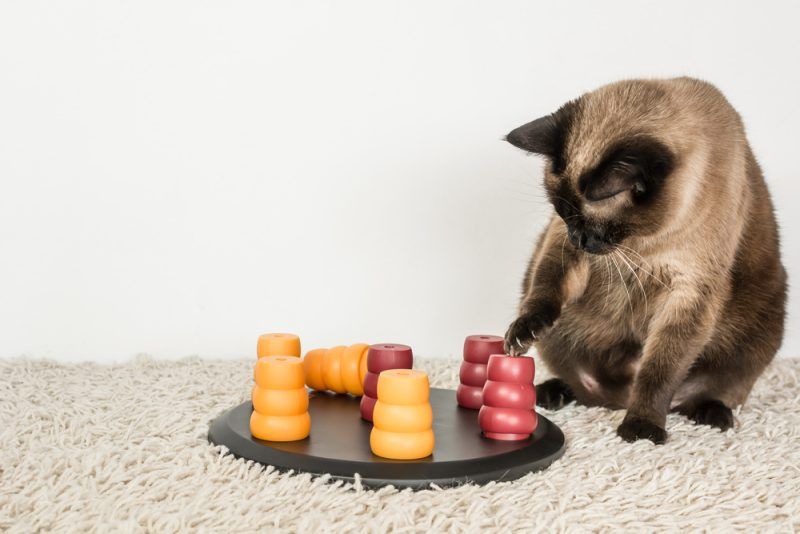
Although you won’t be able to test your cat’s IQ level, you can still provide them with challenges to help determine their general intelligence and problem-solving skills. The most intelligent cats are thought to have an intelligence level around that of a human toddler.
To test your cat’s intelligence, grab their favorite toy and a cardboard box. This test is best performed in a quiet room that is free of distractions. Allow your cat to see the toy, then simply place it behind or inside of the box. Cats that go looking for the toy have a basic understanding of object permanence, like a 1–2-year-old child. Some cats may not understand where the toy has gone after it disappeared, so they won’t go looking for it. Other cats may completely forget about the object as soon as it’s out of sight.
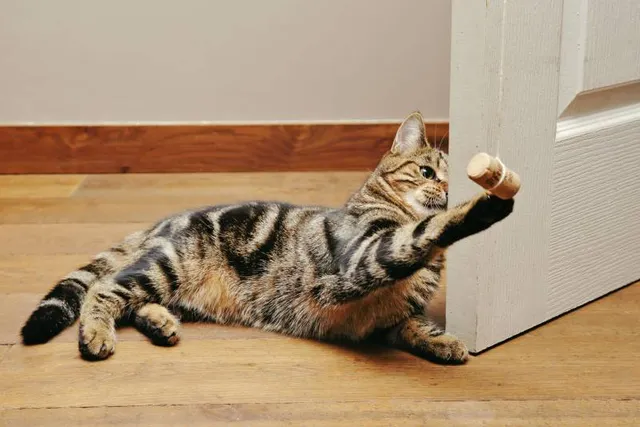
There are also some actions that your cat may perform that indicate a higher level of intelligence. For example, cats that scratch at doors or windows but have never been let outside show an understanding that these objects open to an area that the cat wants to explore. Many cats will meow or paw at you when it’s time for their meals, showing that they have a basic grasp of time in relation to the routine of feeding.
Cats that attempt to or succeed in opening cabinets or doors where their food or treats are kept also show problem-solving skills and object permanence.

Conclusion
There isn’t a way to compare a cat’s intelligence to a human’s, so cat IQ tests don’t exist as they wouldn't work. Cats can be quite intelligent, although usually only as much as a human toddler. Anyone who has spent time around cats will know they are independent thinkers and understand that they are often not that cooperative in studies, making their intelligence levels hard to accurately assess!
They are capable of complex thinking which will lead to attempts at solving problems or exploring their curiosity about objects or places. They have also been shown to have good long and short-term memories.
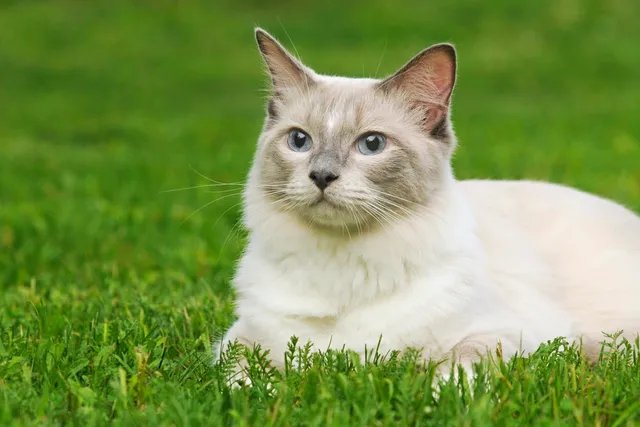
Featured Image Credit: Agata Kowalczyk, Shutterstock
Expert cat care, straight to your inbox
News, insights, and useful advice, delivered to you.

No spam — unsubscribe anytime.
By signing up, you agree to our Terms & Conditions and Privacy & Cookies Policy.
How useful was this post?
Click a star to rate. You can leave written feedback afterwards. (We read all feedback.)
Brooke Billingsley, a former veterinary assistant for nine years, became a nurse in 2013. She lives in Arkansas with her boyfriend of five years, surrounded by her beloved pets: three dogs, two cats, five fish, and two snails. Brooke has a soft spot for special needs animals, caring for a three-legged senior dog and a widely known cat with acromegaly and cerebellar hypoplasia. She has developed a keen interest in fish keeping and is always learning how to provide the best environment for her aquatic pets. In addition to her passion for animals, Brooke enjoys gardening and maintains a vegetable garden during the summer. She stays active with yoga and received her 200-hour yoga teacher certification in 2020. Brooke also hosts a podcast that delves into folklore and myth, dedicating her spare time to research and writing. She embraces the philosophy that every day is an opportunity for learning and growth, continually working to acquire new skills and knowledge.