21 Fun & Vet-Reviewed Facts About Cats For Kids


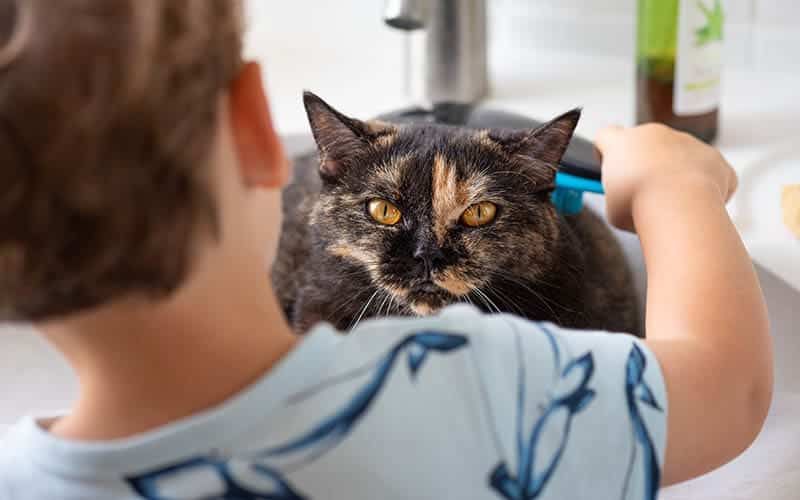
Getting a new cat can be a lot of fun for the entire family, but it can be hard to know how you should behave around them if you're not familiar with them. Involving the kids in learning about cats can help, and a fun way to do that is by going over interesting facts that might surprise you. Keep reading while we list several fun facts about cats for kids.

The 21 Fun & Vet-Reviewed Facts About Cats For Kids
1. Cats Have Superhero-Like Hearing
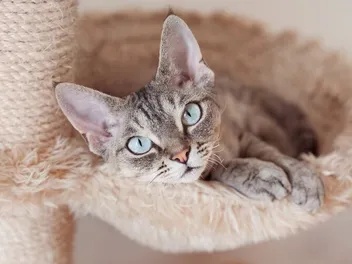
Cats have incredibly sharp hearing and can hear sounds much higher and lower than we can. They can hear both high-frequency noises and low-frequency noises, giving cats one of the broadest hearing ranges among mammals.
This superhero-like ability comes in handy for their wild relatives where hearing the faint rustle of a leaf can mean catching their next meal, and many mice and other rodents make high-pitched noises that the cat can hear. The cone shape of the cat’s outer ear acts as an amplifier of sound, helping a cat to hear quieter sounds more clearly, as well as helping to locate the sound accurately.
Cats can also rotate their ears like radar dishes, pinpointing the exact location of the sounds they hear. This superpower helps them stay alert to their surroundings, whether they’re lounging at home or prowling in the garden.

2. Their Whiskers Are Like High-Tech Sensors
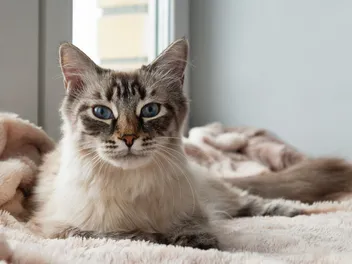
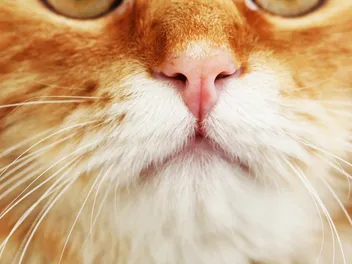
A cat’s whiskers are highly sensitive touch receptors that can detect even the slightest changes in the environment, like a change in air current that might indicate a predator moving in the distance. They also use their whiskers to measure openings to determine if they can fit through them, and they help them detect what’s right under their noses, as cats have poor up-close vision.
3. Cats Have A Secret Language With Their Tails
Cats communicate a lot with their tails, and their position and movement can tell you a lot about how they’re feeling. For example, a straight-up tail usually means they’re happy and confident, while a puffed-up tail might indicate fear or feeling threatened.
A slowly wagging tail might mean they’re concentrating on something, and a quickly twitching tail can show irritation.
4. Cats Nap A Lot, But They’re Not Lazy
Many cats sleep most of the day, but that doesn’t mean they’re lazy! Their bodies are capable of intense bursts of energy, after which they need rest. This sleep pattern is a trait of their wild ancestors who needed to conserve energy for hunting. Cats in the wild might only eat once every few days, so resting a lot makes sense to conserve energy.
5. They Walk Like Supermodels
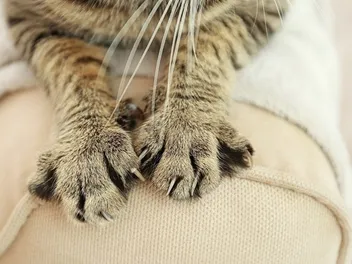
Cats have a unique way of walking called ‘direct registering’, which means their back paw steps into almost the exact spot as the front paw did beforehand. They do this to reduce visible tracks and noise in order to be stealthier. They share the trait with larger wild cats, like the lion and tiger.

6. Cats Can Make 21 Vocalizations
Cats are vocal animals and can make loads of different sounds, from meows and purrs, to hisses and growls. Each sound communicates something different. Interestingly, adult cats don’t tend to meow at other cats, only at humans, because they communicate to other cats through different means, such as scent, facial expression and body language. Cats having a quarrel tend to hiss at each other.
The wide range of sounds that cats can produce allows them to express their needs and feelings very clearly to us, and learning what different cat sounds mean can help you understand and connect with your pet on a deeper level.
7. Their Purrs Have Healing Powers
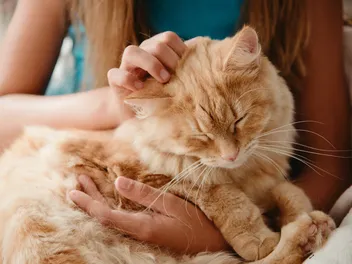
The frequency of a cat’s purr is between 25 and 150 Hertz, and scientists believe that the frequency of the purr may be medically therapeutic and capable of healing bones and tissues. They think that purring may help cats recover faster from injuries as well as a way of communicating. Cats purr when they are happy, but they also purr when they are stressed, for example, at a visit to the veterinarian, so we know there is a lot more to purring than just a happy cat noise.
8. People Used to Worship Cats
In ancient Egypt, cats were revered and even worshiped. Egyptians saw cats as protectors of their homes, crops and as symbols of grace. Killing a cat was considered a serious crime in ancient Egypt, and some were even mummified and buried with their owners. You can still see them in museums today.
9. They Have A Special Kitten Language
Kittens have a special language they use to communicate with their mothers. They make a unique chirping or mewing sound to call her when they are hungry or in distress. They can also recognize their mother’s voice and distinguish it from other cats. As kittens grow into cats, they stop meowing at other cats, and reserve this form of communication for their humans only.

10. Cats Dream Just Like Us
Cats are thought to experience Rapid Eye Movement (REM) sleep, which means they are also highly likely to dream, just like we do. If you’ve seen your cat twitching, moving their paws, or making soft noises while sleeping, they’re likely dreaming. Scientists believe that, like humans, cats probably dream about their daily experiences or an exciting time that they had.
11. Each Cat’s Nose Is As Unique As A Human Fingerprint
The pattern of bumps and ridges on your cat’s nose is one-of-a-kind, and scientists can use it to identify them, just like a fingerprint.
12. Cats Have Good Low-Light Vision
Cats can see well in low-light conditions. Their eyes have a high number of rods, a type of cell that’s sensitive to low light. They also have a reflective layer of tissue at the back of the eye that helps to bounce light back through the retina, to increase the amount of light available. It is this reflective layer that causes cat’s eyes to glow at night.
Their excellent low-light vision allows them to spot the tiniest movements at dawn and dusk, when many rodents come out to forage.
13. Cats Can’t Taste Sweet Things
Unlike humans, cats lack the taste receptors for sweetness, which is unusual for mammals. Typically, cats have no interest in candy, soda, or other sweet treats. So, if you’re eating a cookie and your cat seems curious, they’re likely more interested in why you’re eating it than looking to try it themselves.
14. They’re Olympic-Level Jumpers
Cats are amazing athletes, especially when it comes to jumping. They can leap up to six times their body length in one jump to escape predators, catch prey, and explore their environment. They can jump upwards just as impressively, with an adult cat able to jump 4-5 feet in the air!

15. Cats Have A Built-In GPS
Cats have an incredible sense of direction and an innate ability to find their way home from several miles away. This is known as a homing instinct. This skill likely involves a combination of their sharp memory, keen sense of smell, and possibly even an ability to sense the Earth’s magnetic fields.
16. They Love Boxes
If you’ve had a cat before, you likely know that they love boxes. Boxes provide a safe, enclosed space where they can observe their surroundings without being seen. This behavior probably comes from their wild ancestors, who used small spaces to hide from predators and ambush prey.
17. Cats Can Live Into Their 20s, Sometimes Even Longer
With proper care, cats can live into their 20s and sometimes even longer. The oldest recorded cat lived to be 38 years old. Regular veterinary care, a healthy diet, and a safe environment help contribute to a long lifespan.
18. Calico Cats Are Nature’s Artwork
Calico cats are like walking pieces of art. Their coats are a mosaic of black, white and orange. This unique pattern results from a genetic trait that only occurs in female cats. All calico cats are female because the genes determining their colors are on the X chromosome, and to get the three calico colors requires two X-chromosomes (which only female cats have). There are very rare cases of genetic abnormalities, whereby a male cat has inherited an extra chromosome (Klinefelter’s Syndrome), making it XXY rather than XY. In these cases you can get a male cat with calico coloration, but they tend to be sterile.
19. Cats Went to Space
In 1963, a French cat named Felicette became the first and only feline astronaut. She bravely went on a brief trip to space and returned safely, helping scientists learn about the effects of space travel on living organisms.
Félicette is a hero in the cat world, showing that cats have been part of important scientific missions, just like humans and dogs.

20. Cats Can Make Friends With Other Animals
While most of us know cats prefer to be solitary creatures, they can make surprising friendships with other animals. There have been many heartwarming stories of cats befriending dogs, birds, and even deer! These unusual friendships show us that cats are adaptable and can form strong bonds with creatures very different from themselves.
21. Cats Have Been Human Companions For Thousands Of Years
Cats have lived alongside humans for thousands of years. The earliest records of feline, human companionship are from the Middle East, around 1000 years ago. Initially valued for controlling pests like mice, cats quickly became beloved companions.
This long history with humans shows how deep the bond between cats and people can be, evolving from practical partners to cherished members of the family.
Summary
As you can see, there are many interesting things about cats, and they make a wonderful addition to any home. We were surprised by the way they walk and the fact that every cat’s nose is different, just like a human fingerprint. We were also surprised to hear how many sounds they can make and that they have been to space!
See also:
Featured Image Credit: Tommy Larey, Shutterstock
Expert cat care, straight to your inbox
News, insights, and useful advice, delivered to you.

No spam — unsubscribe anytime.
By signing up, you agree to our Terms & Conditions and Privacy & Cookies Policy.
How useful was this post?
Click a star to rate. You can leave written feedback afterwards. (We read all feedback.)
Ed Malaker is a veteran writer who has contributed to a wide range of blogs that cover tools, pets, guitars, fitness, and computer programming. When he’s not writing, Ed is usually performing DIY projects around the house or working in the garden. He’s also a musician and spends a lot of time helping people fix their guitars and composing music for independent films.