Get

In Your Inbox

Catster is reader-supported. When you buy via links on our site, we may earn an affiliate commission at no cost to you. Learn more.

7 Shorthair Cat Colors for British, Exotic & Oriental Breeds (Vet-Reviewed Info & Pictures)

Share

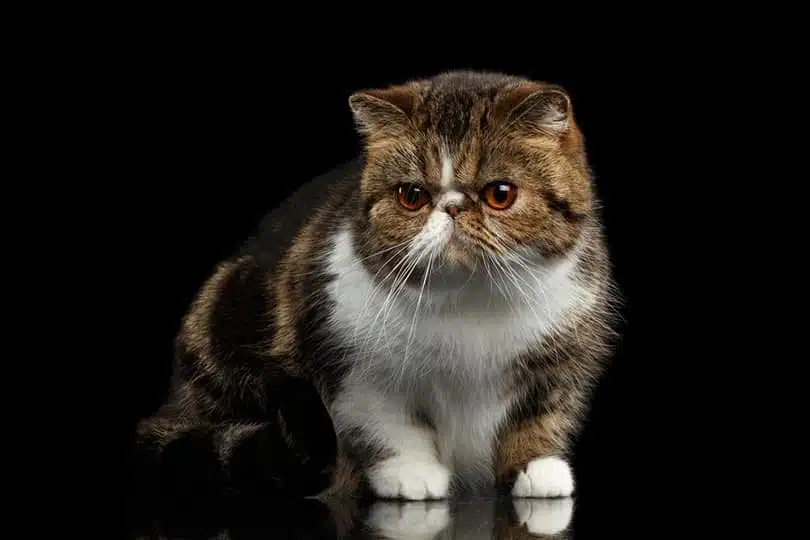
close up of Exotic Shorthair Tabby Cat in black brackground

One of the interesting things about shorthair cat breeds is the diverse range of colors and coat patterns. While the most common shorthair cat breed colors may include black, white, red, cream, brown, fawn, and blue, genetics and selective breeding have also produced gorgeous color patterns.

If you’re interested in learning more about the shorthair cat colors for British, Exotic, and Oriental breeds, we’ve got you covered. Here is a list of the seven most common shorthair cat breed colors and patterns, which isn’t exclusive, as there are numerous other colors and patterns, and it would be impossible to list them all.

divider 2 cats

The 7 Shorthair Cat Colors and Patterns

shorthair cat colors

1. Tabby

Tabby Shorthair Cat
Image Credit: Katzenfee50, Pixabay

Did you know that all cats can be considered tabbies? Well, they are! All domesticated cats carry the tabby gene, but it’s not always visible on their coat.

Tabby patterned cats come in four basic varieties, including:
  • Classic tabbies: Also known as blotched tabbies, these felines have a combination of swirls, blotches, and stripes made up of different colors.
  • Ticked tabbies: These kitties feature banding on either side of their hair shaft with lighter colored fur at the base. This creates an iridescent speckled look. One breed with this specific color pattern is the Abyssinian cat.
  • Mackerel tabbies: These tabbies have continuous vertical lines on both sides of their body, as well as a dark stripe that runs down their backs.
  • Spotted tabbies: As the name suggests, spotted tabbies have different-sized spots on their coats. Bengal cats are considered to be spotted tabbies.

2. Solid

Orange Shorthair Cat
Image Credit: Nynke van Holten, Shutterstock.jpg

Shorthair cats that are just one color are known as solid-colored felines. Sometimes, these kitties have one spot of color that differs from the rest of their coat.


3. Bi-Color

Bi-Color Shorthair Cat
Image Credit: Oleksandr Volchanskyi, Shutterstock

Bi-colored cats have white coats with patches of a different color, including tabby or black, on their bodies, with a varying amount of white. This is due to their white-spotting gene. Bi-colored cats can also be called harlequins (random spots and a colored tail), magpies (random patches), saddle (a colored saddle patch on their back), and capped, while these patterns are not necessarily recognized in all breeds.


4. Pointed

pointed shorthair
Image Credit: guvo59, Pixabay

Breeds such as the Siamese have a color-point pattern gene that gives them light-colored bodies with darker extremity colors, such as their paws, nose, tail, and ears. This type of gene is sensitive to temperatures, resulting in colors being restricted to cooler points of the body. Pointed cat breeds often have a light fawn-colored body with black, chocolate, or even lilac contrast points.


5. Tortoiseshell

Tortoiseshell Shorthair cat
Image Credit: andres felipe Aristizabal, Pixabay

These cats have a unique mixture of black and red coat colors. Torties are mainly female felines.


6. Shading

shorthair cat golden lilac
Image Credit: OksanaSusoeva, Shutterstock

Shaded cat coats are characterized by color at the fur’s tips with a snow-white undercoat. Shaded cats can have fur in smoke, shaded, and chinchilla patterns. These patterns are determined by the amount of shading on the cat’s individual hairs.


7. Tri-Colored

Calico Cat
Image Credit: loicp90, Pixabay

Tri-colored cats have black, white, and red or ginger color combinations. Also commonly referred to as calico, these cats can have diluted colors that present themselves as white, grey, or cream patches.divider 2 cats

What Colors Can Cats Be?

When it comes to cat coat colors, all cats are different colors and patterns because of gene and polygene modification. All cats are essentially black or orange unless they have modified genes and polygenes that change these two basic colors. Because of selective breeding, shorthair cats can virtually be any color known to mammals.

divider 2 cats

Final Thoughts

Whether you pick a solid, bi-colored, tri-colored, or pointed-colored cat, you can rest easy knowing that your kitty’s personality is as unique as their coat pattern. Be sure to brush your cat a couple of times per week to keep their fur sleek and shining.

See Also: 


Featured Image Credit: Seregraff, Shutterstock

Want content like this delivered to you?

Sign Up For Our Newsletter

News, insights, expert advice, and everything cat

* By submitting, you agree to our Terms & Conditions and Privacy & Cookies Policy.


How useful was this post?

Click on a star to rate (you can leave written feedback after clicking submit)

Help us improve Catster for pet parents!

Your feedback really matters.

What did you like about this post? Also how can we improve it?

Join the conversation

Leave a Reply

You’re very welcome to leave a comment or question. Please know that all comments must meet our community guidelines, and your email address will NOT be published. Let’s have a positive and constructive conversation.


Catster's Digital Magazine is Back!

Vet-approved health & behavior advice

Real cat stories & community features

When a Cat Becomes a Water Fountain – Why Cats Vomit After Drinking

Seeing a cat drink water and then promptly bring it back up can be confusing. Sometimes the explanation is fairly simple, particularly if...

Chatting About Sleeping Positions, Loafing & Cats in Tubes | Chatty Cattys, Episode 33

In this episode of Catster’s Chatty Cattys podcast, Dr. Karyn and Nicole dive deep into the fascinating world of feline sleep behaviors. From...

The Bite Stuff: The Truth Behind a Cat’s Sudden Nip

A cat bite that seems to come out of nowhere is one of the more confusing things a cat owner deals with. Everything...

Your Cat’s Purr Proves They’re One of a Kind

There are few sounds more comforting to a cat parent than the familiar rumble of a purring cat. You probably know your own...

More related

Can Cats Drink Wine? Vet-Verified Safety Information

Many cat lovers appreciate a nice glass of wine in the evening to help them relax. Not only is it a crisp and...

Pet Expo (World of Dogs and Cats): Visiting Africa’s Biggest Pet Event

In 2022, the South African pet expo, previously known as WODAC, The World of Dogs and Cats, returned after two desolate years due...

7 Amazing DIY Cat Scratch Boards & Pads You Can Create at Home (With Pictures)

Scratching is an essential activity for maintaining your cat’s health. Scratching provides an outlet for energy, stretching for muscles and tendons, and helps...

Why Do Cats Like Q Tips? 3 Possible Reasons & Vet-Reviewed Safety Tips

If you have ever noticed your cat chasing after strange objects and trying to chew on them, you probably understand how fun it...

Keep reading

How Far Will a Female Cat in Heat Travel? Vet-Reviewed Info

If you have a female cat in heat, it’s common to worry that she might wander too far and lose her way home. Fortunately, female cats usually don’t travel that far in search of a mate. Keep reading while we...

Cat in heat lying down

Can Cats Eat Croissants? Vet-Approved Facts & FAQ

Croissants are delicious baked goods that nearly everyone can appreciate. But even though we humans might enjoy them when we are channeling our inner Parisian at Sunday morning brunch, felines are a different story. Although croissants are non-toxic to cats,...

Can Cats Eat Croissants

Do Air Purifiers Help With Cat Allergies? Vet Reviewed Facts & FAQ

Though around 70% of U.S. households have a pet, many people suffer from animal allergies.1 A whopping 10 to 20% of the world’s population has allergies to cats and dogs. If you’re part of these statistics and want to live...

Close up of a Fluffy Cat Sitting Next to Air Purifier

How Often Should You Take Your Cat to the Vet? What Vets Recommend

One of the best ways to love your kitty is to get regular veterinary care. But how often is “regular?” Unfortunately, there’s a belief that cats don’t need vet care as much as dogs. But as a loving cat parent,...

vet checking up the cat

Can Cats Eat Table Scraps? 6 Vet-Reviewed Things to Consider

You know how hard it is to say no to your beloved kitty when they’re looking up at you at the dinner table with their big eyes, begging for a taste of whatever it is you have on your plate....

Can Cats Eat Table Scraps

Why Is My Cat Peeing on My Bed? 6 Vet-Reviewed Reasons for This Behavior

If you come home to find a damp patch of cat pee on your bed, it can be pretty frustrating. But rather than get annoyed with your kitty, you should figure out exactly why they might be using the bed...

cat-peeing-on-the-bed

Why Is My Cat Not Eating After Our Move? Vet-Reviewed Stressors

Moving can be a very exciting experience, but it is also a very stressful time for all involved. After all, you are packing up your entire life and moving it elsewhere. Regardless of the distance and how smooth the process...

cat in messy house

How to Protect a Cat From a Hot Stove: 11 Vet-Reviewed Methods

Many cats know to keep away from hot stoves. Most can feel the heat coming off of it and can guess that it probably isn’t a good idea to touch it. However, some cats can jump on the hot stoves...

cat following owner to the kitchen seeking for attention

Love Cats? So Do We! Join the Catster Community

Stay informed with expert pet care insights delivered straight to your inbox! Discover professional guidance on animal behavior, feeding tips, trusted product picks, and much more.


Sign up for the Catster Email Newsletter

Stay informed with expert pet care insights delivered straight to your inbox! Discover professional guidance on animal behavior, feeding tips, trusted product picks, and much more.


