Any cat owner whose ankles have fallen victim to a sneak attack from a playful kitty knows that sometimes you can’t hear them coming! But have you ever wondered precisely how cats walk and how they are so stealthy about it? If so, this article is for you!
Keep reading to learn the surprising details of how cats walk and how their unique gait contributes to making them the perfect predators. We’ll also cover some of the problems that impact how cats walk and what medical conditions they could represent.

The Mechanics of How Cats Walk
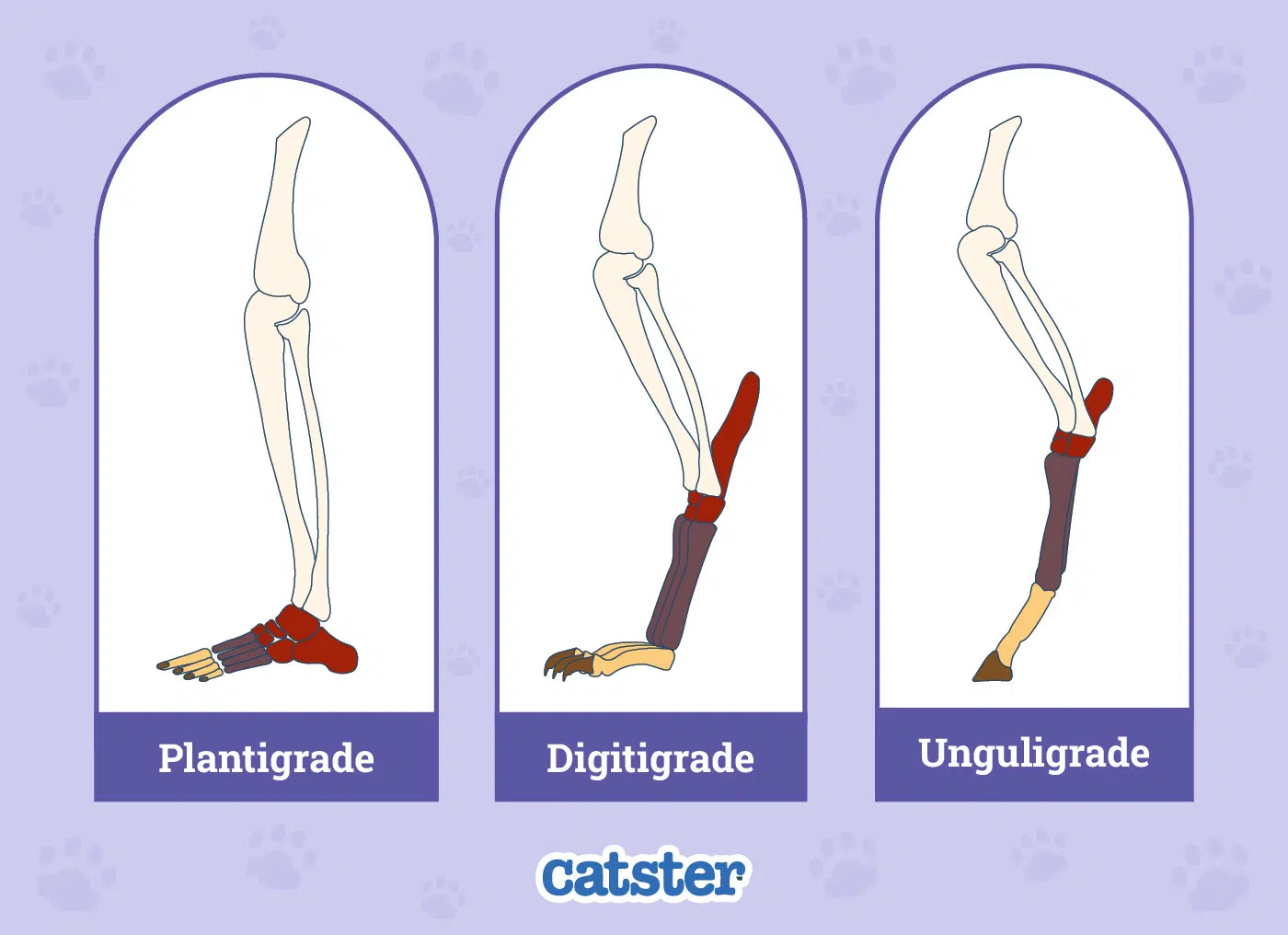
Here’s the first detail of how cats walk that you may find surprising: cats actually walk on their toes. This means that they are what is called a digitigrade species. Learning that cats are constantly tiptoeing may help you understand how they move so quietly. Humans generally use their entire feet to walk but shift to stepping on their toes whenever they need to be quieter.
A cat has several types of gaits, and the mechanics of each of these gaits is different. The gaits identified in cats are as follows:
- Walking
- Trotting
- Swimming
- Galloping
- Jumping
For walking specifically, a cat’s gait is one that all aspiring models are envious of. The term “catwalk” wasn’t a coincidence; the famous runway model is called such because when a cat walks, all four of their paws actually fall on the same line! This trait is what allows cats to so easily walk on very narrow surfaces (such as a fence) with extreme ease. Just as fascinating is the fact that models often wear heels (and, as such, are often walking on their toes). As mentioned above, cats also walk on their tip toes.
Let’s go over how a cat walks.
- The right foreleg moves in coordination with their left hindleg.
- The left foreleg moves in coordination with their right hindleg.
- Depending on the cat’s speed, at any point during their walk, they have either two (usually) or three paws (during a very slow walk) on the ground.
- Each hindpaw lands at exactly the same spot the corresponding forepaw is placed. For example, the left hindpaw would land where the left forepaw was last place.
- All four paws fall on the same line, a trait which has led to their gait being called a “cat walk”.
Do note that the mechanics of their other gaits (such as trotting) are different.

When Cats Have Trouble Walking
As you can see, the cat’s walk is adapted perfectly to its unique needs as an athletic predator. But what if something goes wrong? Here are some problems you may notice with your cat’s walk and what they could indicate.
Limping
Limping or lameness is one of the most common problems you might notice with your cat’s walk. A limping cat doesn’t place the normal amount of weight on a painful leg, resulting in a choppy gait, much different than their usual smooth walk. Proper locomotion in cats (and other animals) requires clockwork coordination between the nervous system, skeletal system, and muscular system. The inability to walk properly means that one or more of these systems are not able to function as intended, leading to an altered gait.
The possibilities as to why your cat is limping are extensive and range from simple issues, such as a sprain, to more sinister pathologies, such as certain cancers. In the cases of an injury, you’re able to either witness or visualize yourself, and ascertaining the cause of a cat’s limp is somewhat easy. For instance, if you notice your cat fall from a height and subsequently notice them limping, it’s fair to assume that the fall injured them. Likewise, if you see a splinter in their paw, it’s relatively easy to make sense of why your cat is limping.
At other times, though, the underlying reasons as to why your cat is limping can be more challenging to decipher. Examples of such scenarios and the signs you might observe in your pet include the following:
- Fever. Interestingly, cats with a fever sometimes develop an unexplained limp in one limb, which seems to spontaneously resolve once the fever is addressed and treated (by your veterinarian, of course).
- Arthritis. Cats with arthritis may not have an exaggerated limp, but you might be able to pick up subtle signs of an altered gait (such as your pet seemingly “holding” one leg very stiffly as they walk). Cats with arthritis may also struggle to run or jump with ease.
- Litter Box Issues. A sudden onset of litter box issues can sometimes be associated with pain in a limb, preventing your cat from properly squatting to relieve themselves or from properly covering up their waste. Cats that associate their litter box with pain or discomfort may start having accidents elsewhere.
- Cancer. Any type of cancer is accompanied by pain, and as such, a cat may limp even when cancer has seemingly nothing to do with their limbs or feet in terms of its location within the body.
- Other Systemic Conditions. Conditions of pathologies that affect a cat’s vital organs can eventually have implications for their gait as well.
Please note that the list above isn’t exhaustive. As a general rule, if you notice your cat limping, you should promptly make an appointment with your veterinarian.
If you need to speak with a vet but can't get to one, head over to PangoVet. It's an online service where you can talk to a vet online and get the advice you need for your pet — all at an affordable price!


Ataxia
Ataxia can be most easily described as “drunk walking.” The cat may be unsteady on their feet, drag their toes on the ground, or lift their paws abnormally high when walking. Ataxia can signify a brain or spinal cord issue or an inner ear issue that disturbs the cat’s balance. See a veterinarian if your cat shows signs of ataxia as soon as possible.
FATE (Feline Arterial Thromboembolism)
Feline arterial thromboembolism, sometimes abbreviated as FATE, is a very serious consequence of heart disease in cats. The term refers to a blood clot that dislodges from one of the major arteries (or the heart) in a cat’s body and eventually clogs another smaller artery, leading to the complete loss of blood supply to the area that the smaller artery is supposed to serve.
FATE is most commonly seen in the hindlegs if it clogs the femoral artery (which supplies the hindlegs) and presents as complete paralysis of one or both hindlegs. The condition is extremely painful, and as oxygen is no longer being supplied to the hindlegs due to a clogged artery, it is considered life-threatening. If you ever observe your cat dragging their hindlegs, they require immediate emergency veterinary care.
Conclusion
While walking may not seem as impressive as some of the cat’s other physical abilities, such as landing on their feet almost every time they fall, it’s still pretty amazing when you learn how they do it. If something goes wrong with their ability to walk, your cat most definitely requires veterinary care.
Featured Image Credit: wilkernet, Pixabay
 The Mechanics of How Cats Walk