How Far Can Cats Fall Without Hurting Themselves? What Science Says



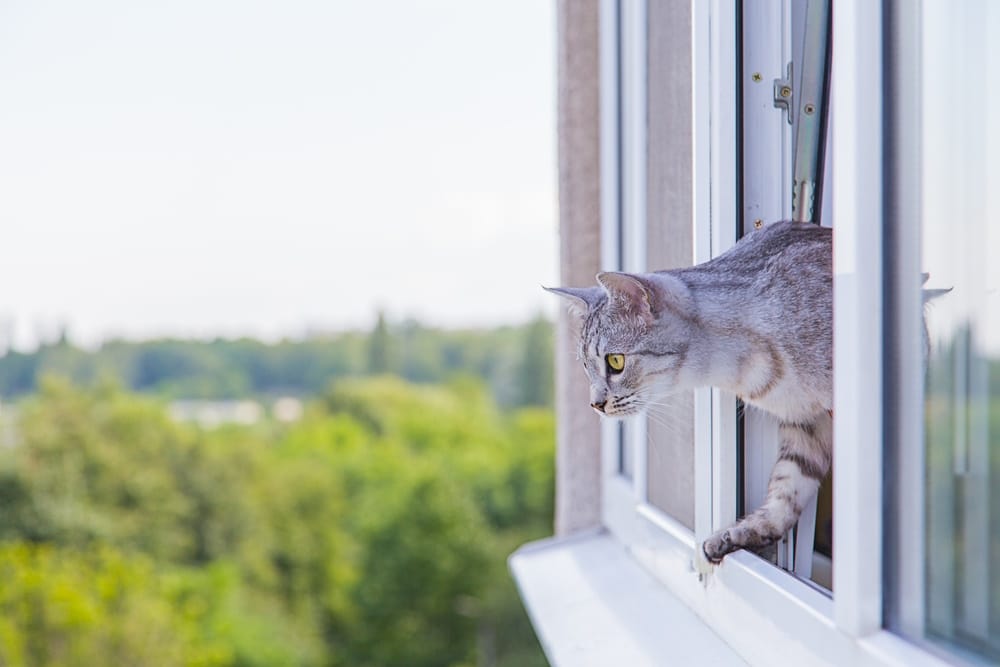
It’s no secret that cats enjoy climbing. As owners, it has the potential to cause a great amount of anxiety to watch our beloved companions reach heights we know would hurt us if we were to fall. You have probably heard of the saying, “Cats always land on their feet,” and many believe it, as cats are notoriously agile and do land on their feet most of the time.
Exactly how far can cats fall without getting hurt? The answer to this question isn’t so simple since there is no exact distance that can be considered safe. In this article, we will go over what has been observed, what the experts have to say, and how to best keep your cat safe.

How Far Can Cats Fall?
The truth is, there is no exact distance a cat can fall without the risk of getting hurt. There are so many different factors at play that there is no way to definitively determine a safe distance.
A study completed in 1987 and published in the journal of the American Veterinary Medical Association studied 132 cats that had fallen from various heights and 90% of them had some sort of chest trauma.1 However, without emergency veterinary care, more than one-third of those cats would have died from the injuries sustained in their falls.
Injuries from falls less than 7 stories actually seemed worse than those 7 stories and above. The researchers believed this was due to the cats reaching terminal velocity and being able to better distribute impact. Cats have been recorded to have fallen over 30 stories and still survived, though this is very rare, and a fall from this distance would typically result in death.
Several studies have looked into high-rise syndrome, which is defined as a fall from a height of 2 or more stories.2 It often leads to various injuries of the chest, abdomen, and face, alongside bone fractures. Animals may fall after slipping from window sills and balconies, attempting to escape to engage in mating behavior, or trying to chase prey. Cats suffer less severe injuries than dogs due to their “righting reflex” and smaller body mass.
Regardless of what the studies suggest, safety measures should always be in place to ensure cats do not fall from any kind of height.

Additional Risk Factors
Age
Cats typically don’t develop their “righting” reflexes until they are at least a month old.3 Young kittens and juvenile cats should not have access to heights and should be in a secure environment. Senior cats are at a higher risk of injury due to falls. This is due to wear on the body because of age or underlying illness, and seniors can develop arthritis and are not as nimble as their younger counterparts.
Younger cats are more curious and more likely to get into trouble by jumping or falling off a balcony or a window sill. The study we already mentioned reported the mean age of the cats that experienced a fall was 2.7 years, meaning the young adult cats are most likely to get injured due to falling from a height.
Weight
Obese cats are going to be at a greater risk of falling just because the extra body weight will not only limit their flexibility and overall agility but there is also more impact behind the fall. It’s important to ensure your cat is at a healthy weight for their size and activity level for the sake of their overall health and to avoid any weight-related health concerns.

Environment
The environment surrounding a fall can have a large impact on the fall itself. This includes surface type, height, surroundings, and more. It is important to always keep your cat securely indoors to best ensure their overall safety.
Neutered Status
Cats that have not been neutered or spayed may have a higher risk of falling from a height, as they will try to get out of the house to find a mate during the mating season. This applies both to males and females. It’s important to get your cat neutered from the age of 4-6 months just before they reach sexual maturity, depending on the individual cat, or according to your vet’s advice, in order to prevent heat related behavior. This also prevents your female cat from getting pregnant, reduces fighting between cats due to territorial disputes and competition for females, and significantly reducing the risk of transmissive contagious feline viral disease.

Do Cats Always Land on Their Feet?
Just like the age-old saying, cats do have a reputation for always landing on their feet when they fall. This can mislead people into believing it’s always true, and while cats are naturally adapted to handle falls from greater distances compared to other species, they do not always land on their feet and can be seriously injured by falls. Here, we will discuss the reasons why cats are so famous for their landing abilities.

Righting Reflex
Cats have what is called a righting reflex. This reflex is an automatic bodily response that corrects the body’s orientation when it is in an abnormal position so that they can safely land on their feet. This is largely due to the vestibular system in the inner ear that controls balance. This reflex has been observed in a kitten as young as 3 weeks of age.
Flexibility
Cats have a unique skeletal structure that makes them extremely flexible. They had to adapt to life in the wild, where they frequent trees and higher surfaces. Cats don’t have a collarbone, and their spine is significantly more flexible than most other animals. The flexibility of the spine also contributes to having agile and graceful cat moves. This allows them to physically twist and turn their bodies when in mid-air during a fall.
Dangers of Falling
Cats do have an impressive knack for landing on their feet and surviving falls from surprisingly high places. It doesn’t always work out that way. Cats are at risk of serious injury and even death if they were to fall.
Falling Risks
If you suspect your cat might be injured, we suggest you speak to a vet.

Keeping Your Cat Safe
One would naturally assume that because cats are instinctively accustomed to navigating heights and have an affinity for climbing up to high places, they would be safe. Falling from any height poses a potential danger to your cat. Thankfully, cats are little survivalists with excellent instincts. They can typically gauge whether they will have a safe landing from any given height.

- Get your cat neutered or spayed
- Discourage climbing
- Use window locks
- Secure your screens
- Restrict your cat’s access to the balcony, by keeping the door to it closed at all times
- Keep your doors tightly shut
- Do not allow them to roam outside unsupervised
- Consider a secure outdoor catio

Conclusion
There is no exact distance from which a cat can safely fall without being injured. Cats are impressive little creatures with incredible reflexes and flexibility that give them a unique ability to land on their feet and survive falls from greater heights than most animals. Falling still comes with great risk of injury and death, and your cat should be kept safe and secure inside the home to prevent any accidents.
Featured Image Credit: Reimar, Shutterstock

Expert cat care, straight to your inbox
Vet-reviewed advice, behavior tips, and the best of Catster. Free, and you can unsubscribe anytime.
By signing up, you agree to our Terms & Conditions and Privacy & Cookies Policy.
Lindsey and her husband enjoy traveling the US with their kids and photographing wildlife. Her passion is to educate others on the importance of proper animal care, with an emphasis on reptiles and exotics since their care requirements can be much more complex. She is also a huge advocate for bully breeds. She feels most at home in the forest either on horseback or in hiking boots.
Join the conversation
Ask a question, share your story, or send private feedback.