How Did My Indoor Cat Get Fleas? 7 Possible Reasons (Vet Verified)


In this article
You might think that your indoor cat would be safe from a flea infestation, but sadly, that’s not always the case. The bad news is that even indoor cats can get fleas. While indoor cats are admittedly at lower risk of getting fleas than outdoor cats, there are still plenty of opportunities for your cat to pick up the unwanted hitchhikers.
Knowing what those opportunities are and doing your best to minimize them are the best ways to keep your indoor cat flea-free and happy.
For every one flea you happen to spot, it’s estimated that there are another 100 fleas that you can’t see. So, having a clear plan of action for how to deal with these little critters is essential!

The 7 Likely Reasons for How Your Indoor Cat Got Fleas
1. You Have Dogs or Other Outdoor Pets
The number-one way for an indoor cat to get fleas is for them to be passed on by another pet–we’re looking at you, dogs!. If you have a multi-pet household and your cat lives indoors, but your dog is free to go outside, then they’re probably the main culprit.
The pets of friends and family coming into your house can also bring with them the risk of fleas. If anyone is planning on bringing their pet into your home, check that their flea treatment is up to date!

2. You Visited Somewhere With Fleas and Brought Them Home
You can definitely bring fleas into your home, too! If you visit anywhere with fleas, they can easily jump onto your shoes or clothes and hitch a ride back to your house. Once there, they can quickly lay eggs, and soon, you’ll be looking at an infestation.
Prevention can be the best approach in this instance. Regularly vacuuming your home and even using a treatment designed to kill fleas on a 6-month basis can reduce the chance of fleas getting a hold in your home.
Fleas can jump over 100 times farther than their own length, so even if you didn’t think that you got close enough to that dog in the park, you could be surprised!
3. You Had to Take Your Cat Out of the House
Indoor cats do have to leave the house sometimes, whether that’s a trip to the vet, to a boarding facility, or on a road trip. Anywhere that’s been frequented by other cats and dogs could harbor flea eggs and larvae. If these get attached to your cat’s fur or your clothes, then you’ll soon have fleas hatching and causing an infestation at your own home.

4. You Bought Items at a Thrift Store
We love a thrift store bargain just as much as the next person! But if you don’t take the precaution of treating and cleaning soft furnishings and clothing before bringing them into your home, you run the risk that they may be contaminated with flea eggs from the store or a previous owner.
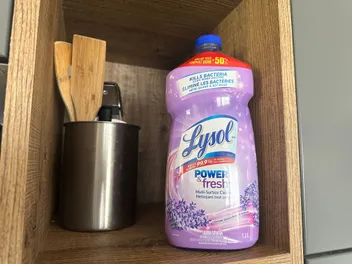
Washable items like clothing should be run through a hot wash and then tumble-dried. Non-washable items can be sprayed down with a flea spray suitable for hard surfaces.
5. You Moved to a New Home
Moving into a new home is super exciting, but that new home might already be home to fleas! Even if the house has been empty for a while, flea eggs can remain dormant yet viable for up to a year. Even after they’ve hatched into flea larvae, they can also survive for months while they wait for a fluffy cat or dog (or human!) to come walking by.
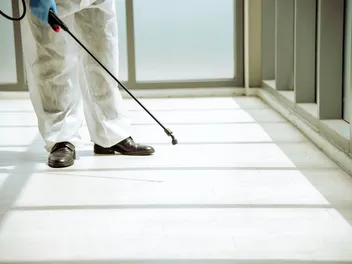
Before you allow your indoor cat into your new home, give the entire house a deep clean, and assume that it has a flea infestation even if it doesn’t.

6. You Have an Outdoor Cat Enclosure
Indoor cats might not go out into the great unknown, but many of them love to spend time “outdoors” in an enclosure. Of course, this brings them closer to nature—and fleas! It only takes one flea to jump onto your cat through the enclosure, and before you know it, that flea has laid 50 eggs and you’re looking at the start of an infestation.
7. You Have Rats or Mice Visiting
Mice are especially smart at sneaking in and out of our houses without us even knowing. Basements and garages are common locations where there could be rats or mice visiting your home, and you wouldn’t even know about it.
Wild animals often have a heavy parasite burden, so any fleas may be super keen to jump off onto your cat instead. They may also shed fur with flea eggs, which then hatch and find their way onto the next warm body that passes by, like your cat!
Keeping your home clean and tidy can reduce the chances of any mice or rats finding anything of interest to hang around for. Never store garbage in bags in your garage or basement, and instead, use a metal or plastic bin with a securely fitting lid. Food scraps should be disposed of quickly. Sometimes, the spot where a rodent is gaining entry to your house can be obvious, while other times, you may need to seek the help of a professional pest control expert. They’ll also be able to suggest strategies for getting rid of your rodent problem, ones that can be safely used around your cat.

How to Tell If Your Indoor Cat Has Fleas
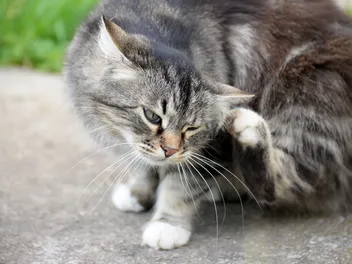
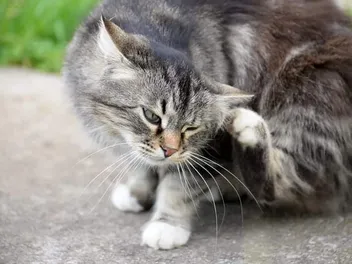
If you’ve got a sneaking suspicion that your cat has fleas, you might have seen them scratching themselves more often than normal. A cat biting their skin as they groom their fur is also a giveaway that they might be irritated by those pesky little insects.
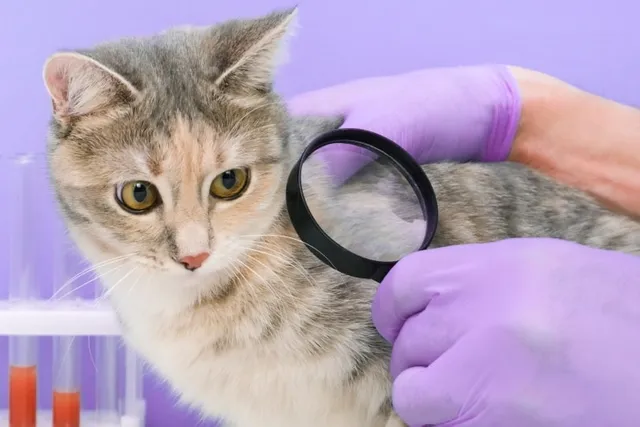
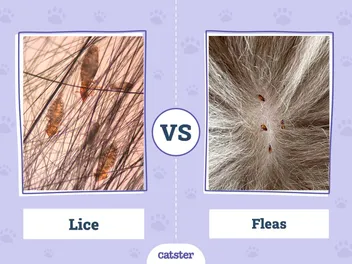
Fleas can usually be found in their favorite spots: on your cat’s head, tummy area, and back. Part the fur along these areas, and see if you can spot any critters running or hopping for cover. You might also see flea dirt or, more accurately, flea poop. These dark spots can look like a large piece of regular dirt but are harder to clean away. Flea dirt can often be found on your cat’s chin.
If you or another family member starts to get irritated by small red bites on your legs, then that’s another sure sign that you have unwelcome visitors in your home.

How to Get Rid of Fleas
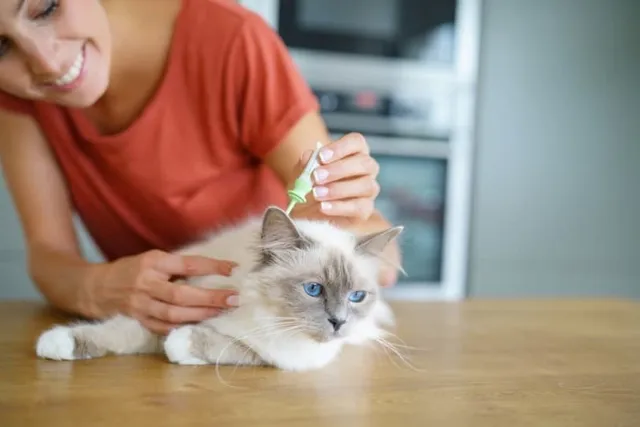
The best thing to do is to speak to your vet and ask them to prescribe anti-flea medication. These can be spot-on liquids dropped onto your cat’s shoulder blades or oral medication. You can also use powders, sprays, and collars, but generally, these aren’t as effective.
Look for a treatment that breaks the life cycle of fleas by killing the eggs and larvae, as well as adult fleas.
Don’t forget to treat your soft furnishings, your cat’s bed, and anywhere else in the house where your cat hangs out.
How to Protect Your Indoor Cat
There is no sure way to prevent a cat from getting fleas, though some owners treat their cats as if they already have them! However, anti-flea treatments might not be necessary for every indoor cat. While the chances of your indoor cat catching fleas are higher than you might have thought due to the wide range of sources, the factors vary from house to house.
Just being observant and having a plan to get rid of the fleas if an infestation does happen can help keep your indoor cat flea-free for good. If you have another pet that does go outside, a preventive flea treatment might be your best choice to keep you and your cat safe.
You may also like some of our other top-trending posts:
Featured Image Credit: fotovictoria, Shutterstock
Expert cat care, straight to your inbox
News, insights, and useful advice, delivered to you.

No spam — unsubscribe anytime.
By signing up, you agree to our Terms & Conditions and Privacy & Cookies Policy.
How useful was this post?
Click a star to rate. You can leave written feedback afterwards. (We read all feedback.)
Emma is a freelance writer, specializing in writing about pets, outdoor pursuits, and the environment. Originally from the UK, she has lived in Costa Rica and New Zealand before moving to a smallholding in Spain with her husband, their 4-year-old daughter, and their dogs, cats, horses, and poultry. When she's not writing, Emma can be found taking her dogs for walks in the rolling fields around their home...and usually, at least some of the cats come along, too! Emma is passionate about rescuing animals and providing them with a new life after being abandoned or abused. As well as their own four rescue dogs, she also fosters dogs for re-homing, providing them with love and training while searching for their forever homes.