Do Cats Fight to the Death? Facts & Prevention Tips (Vet-Verified)



In this article
You might have heard your neighborhood cats yowling into the night and wonder whether these fights ever result in the death of a cat. Maybe your indoor cats have suddenly started fighting, and you’re concerned that they may injure each other.
You’ve probably noticed that your cat comes armed with impressive weapons in the form of their teeth and claws. It’s true that they can do serious damage with these, but is fighting to the death a common problem in cats? It's unlikely, but let’s find out!

Why Do Cats Fight?
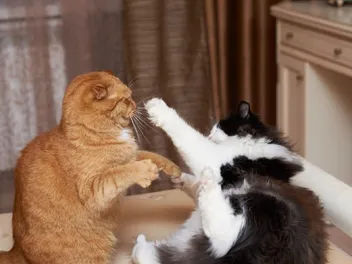
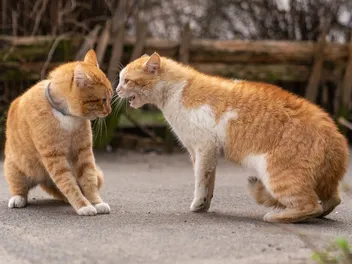
Cats will usually try to avoid physical fights unless there’s absolutely no other option. That’s because as solitary hunters, their ability to survive is seriously compromised if they’re injured. Most cat fights involve more posturing and vocalization than physical contact.
There are several reasons that cats fight. Let’s take a more detailed look.
Territorial
Cats are naturally solitary and territorial. Living in unnaturally cramped conditions with other cats, whether that’s in your neighborhood or inside your home, can inevitably result in fighting. Cats will fight to defend what they believe to be “their” territory, but this often overlaps with what another cat believes is “their” territory!
Cats mark their territory using pheromones and spraying to mark their scent, and any overlapping areas will be up for dispute.

Aggression
Some cats can be more aggressive than others, and this can result in an increase in fighting. Male unneutered cats may be aggressive around other cats, especially if there are females around that they believe that they need to fight over.
Maternal Instinct
Female cats will be protective of their kittens, so if any other cats approach, the mother may feel like she needs to defend her babies. If hissing, growling, and chasing off the other cat doesn’t work, she may resort to fighting. This can happen even with cats that she was friendly with before.
Intact male cats may practice infanticide; a male may kill a litter of kittens if he doesn’t mate with the female. This is part of why a female cat may proactively attack a male who ventures too close to her kittens.
How Do Cats Fight?
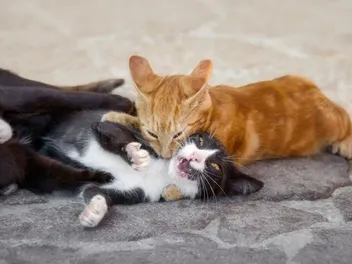
Interestingly, cats prefer no contact with other cats when they’re in an aggressive or territorial state of mind. In fact, most contact wrestling is attributed to play fighting in cats 1.
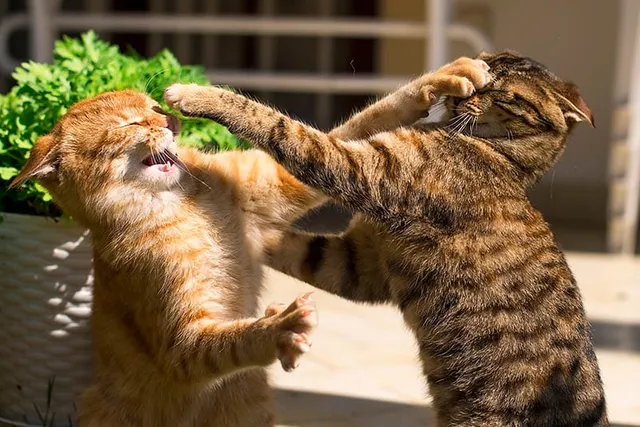
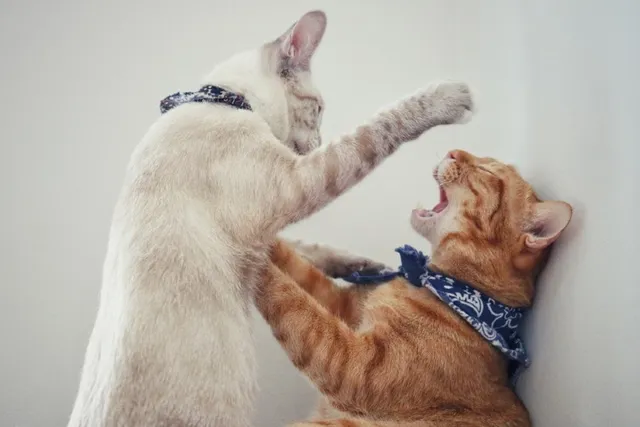
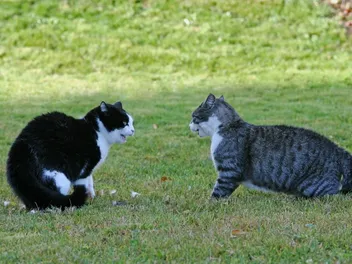
Most cat fights will be non-physical and involve aggressive body language, growling, hissing, and a twitching tail. After a while, the least dominant cat will usually back away slowly and concede defeat. Sometimes, if one cat doesn’t back down, the cats will come to physical blows. This is usually for short periods before they split away and start posturing again.
Even among colonies of feral cats, fights involving sustained physical contact are rare. That’s because cats know that injuries can affect their chance of survival. It’s easier to learn to get along with each other and survive than to come to blows and get injured. Fights are usually the last resort.

Do Cats Fight to the Death?
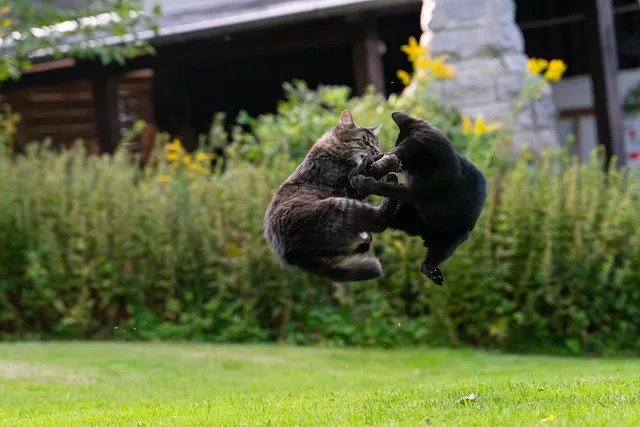
Cats are unlikely to kill another cat during the course of a fight. That includes both domestic cats and feral cats. Cat fights are usually more about posturing and vocalization than actual physical contact.
If cats do come into physical contact during a fight, it’s the injuries sustained as a result that could possibly cause death if left untreated. This is more of a concern for feral or stray cats that don’t have an owner looking out for them.
For your own cat, signs to look for include:
Any open wound in a cat can become infected, which, in turn, can lead to other health issues. Theoretically, if left untreated, this can cause ongoing problems for a cat and could eventually cause death if their body cannot fight off the infection.
Another plausible explanation is that the injuries a cat sustains during a fight can prevent the cat from successfully hunting or finding food. This, in turn, can weaken them and may lead to other issues, including the hypothetical possibility of being weakened to the point of not being able to make a recovery.
Perhaps more realistic is the fact that many cat diseases are transmitted through open wounds. Though a fight may not physically kill a cat, the disease they contract through the fight can lead to a long-term loss of health, which can shorten their lives. Feline Immunodeficiency Virus (FIV), the cat equivalent of HIV, is a great example of one such disease.
FIV can be spread through deep bite wounds from an infected cat. Once a cat is infected, the virus can permanently weaken their immune system and make them more likely to have secondary infections. These secondary infections may then be more challenging for a cat’s immune system to overcome, which would further diminish their quality of life and possibly lead to an earlier death.
The best way to minimize the risk of your cat contracting diseases from other cats is to keep them indoors or only allow supervised outdoor visits.
Cats Fighting Inside the House

How to Prevent Cat Fights
A Note From Our Veterinarian
1. Interrupting the Fight
If your cats are actually fighting (not play fighting), you shouldn’t allow your cats to continue fighting. Once started, this can easily escalate, and there’s a higher chance of a cat becoming injured. If you see your cats fighting, make a loud noise, like clapping, to startle them. You could also try to distract them by rattling a treat bag. Remember that cats do not have a moral understanding of why they are fighting and will not “sort it out” themselves.
2. Separate & Increase Resources
If cats feel like there aren’t enough resources to go around, the chances of them fighting over them increase. It sometimes helps to offer more resources than there are cats. So, if you have three cats, you could try having four feed and water stations and four litter boxes.
That means whenever a cat wants to eat, drink, or do their business, they don’t have to wait for another cat to finish or compete with them for the resource. However, keep in mind that an aggressive or territorial cat may still try to bully another cat, regardless of how many resources there are.
3. Neuter
Hormones can cause cats to become more aggressive, with this being particularly likely for unneutered male cats. Speak to your vet about getting your cats spayed or neutered.
4. Add Enrichment

Make sure to offer plenty of enrichment options, like perches, boxes to hide in, shelves, scratching posts, and toys. When cats have multiple objects to play with, it boosts both their physical and mental stimulation, which is good for overall health. This may help in some circumstances.
5. Use Pheromones
Some cat owners have good results with using synthetic feline pheromones. You can buy diffusers or sprays that release soothing pheromones into the air. However, they may not always work.
6. Give Them Space

Some cats resent having to share their home with another cat. This can sometimes be an issue for older cats when being introduced to a new family kitten. Make sure each cat has an area of the house where they can go and not be disturbed. Cats can also become over-aroused after a fight, so don’t attempt to pick up or soothe your cat, as they may redirect aggression toward you.
Allow them some time on their own to calm down. They will come and see you when they’re ready!
7. Contact a Veterinarian and/or Cat Behaviorist
If you’re concerned that your indoor cats are fighting so much that the risk of injury is increasing, it might be time to contact a registered cat behaviorist. They may be able to suggest strategies to help your cats get along better and to reduce the number of fights.
Finally, remember that not all aggression is caused by behavior issues. As such, having veterinary input is key if you suddenly find yourself with pet cats that are displaying signs of unexplainable aggression.
Conclusion
Cat fights may look (and sound) spectacular when they're facing off with another cat, but these encounters rarely result in physical contact. Most times, one cat will back off and concede defeat after plenty of aggressive body language and vocalizations. Cats instinctively know that physical fights can lead to injuries that may leave them unable to hunt. So, physical fights are the last resort.
Cats will rarely, if ever, kill each other during a physical fight. But the injuries sustained from bite or scratch wounds do have the potential to become infected, and left untreated, these could ultimately lead to a cat’s death. Perhaps more concerning are the diseases that cats can transmit to each other when they engage in physical scuffles.
If your own cats are fighting, rest assured that it’s unlikely that they will injure each other, but it’s worth giving them a quick physical check if you do see them fighting. Speak to your vet if you notice any injuries, and take steps to reduce the chances of your cats fighting again in the future.
See also:
Featured Image Credit: Nils Jacobi, Shutterstock
Expert cat care, straight to your inbox
News, insights, and useful advice, delivered to you.

No spam — unsubscribe anytime.
By signing up, you agree to our Terms & Conditions and Privacy & Cookies Policy.
How useful was this post?
Click a star to rate. You can leave written feedback afterwards. (We read all feedback.)
Emma is a freelance writer, specializing in writing about pets, outdoor pursuits, and the environment. Originally from the UK, she has lived in Costa Rica and New Zealand before moving to a smallholding in Spain with her husband, their 4-year-old daughter, and their dogs, cats, horses, and poultry. When she's not writing, Emma can be found taking her dogs for walks in the rolling fields around their home...and usually, at least some of the cats come along, too! Emma is passionate about rescuing animals and providing them with a new life after being abandoned or abused. As well as their own four rescue dogs, she also fosters dogs for re-homing, providing them with love and training while searching for their forever homes.