Cats and Snow: A Study in Feline Enrichment


Hi, I’m Dr. Lauren! Read my introduction to learn more about me and my two adventurous cats, Pancake and Tiller.
One of my favorite cat memes of all time is this zinger—a simple commentary on such a complicated creature: the cat.

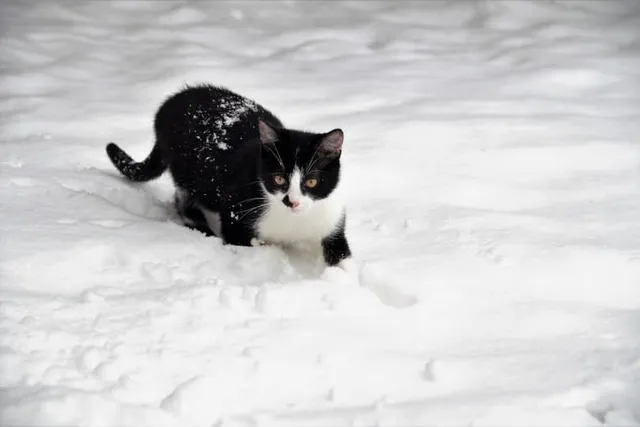
Snow is cold, unpredictable, and wet—all conditions that cats are categorically known to detest. We’re treated to a suggestion that the cat took one look at the white stuff, and marched back inside.
Seems simple, right? But like cats themselves, the subject is complicated below the surface.

Cats & Snow (Shovelling into Feline Enrichment)
This article is about cats and snow, but in reality, it is about a much bigger topic. Unless they are setting foot outside, you can't specifically talk about snow and cats.
It calls for a deeper dig (or shovel, to stick with the snow theme) into the enrichment of the lives of cats, whether via snow, or other means. How do we, as cat owners, best answer the question: how do we best enrich the lives of creatures who so enrich ours?
Feline Enrichment: The Flurries Start
I’ve seen veterinary practice in many different countries, and there seems to be a very definite line when it comes to cats and their lifestyles. Interestingly, many countries in the world agree: it’s borderline barbaric to keep indoor-only cats. It’s a complicated discussion, and in no way to be solved in this forum, but this viewpoint is important to set the scene.
Feline medicine began to embrace feline behavior in the 2000s, a development driven by issues like Feline Environmental Enrichment (EE).
Though definitions vary, this source says:
Environmental Enrichment (EE): The addition of one or more ‘factors’ to a relatively impoverished environment in order to improve the physical/psychological welfare of the animal(s) involved.
As a vet, what I found interesting is that most of these tools (‘factors’) were meant to mimic the things that a cat would encounter in everyday life—if they were allowed to have outdoor access. The implication is that cats were kept solely in impoverished environments, to begin with.
Obviously, it’s not always a simple situation, for instance, enrichment can be hugely important for cats in shelter environments, overweight cats, and cats that must live indoors for medical reasons, to mention a few.
But sometimes, it seems that we overcomplicate things to end up right back where we started.

Does EE Work?
Creative and engaging minds had excellent ideas about providing cats with all sorts of EE:
Fake mouse toys to stuff with food and hide around the house to simulate hunting
Puzzle feeders to engage the brain
Shelving made for cats to increase their living space as well as offer exercise opportunities
They were well-thought-out and crafted ideas. And showed great care and compassion for the well-being of our feline friends.
But little to no discussion was about having cats on leads and taking them outdoors… if anything, that seemed almost taboo. Instead, enrichment seemed focused on trying to bring the outdoors indoors.
But, being inside, no matter how enriched the environment, can never truly replicate the outdoors.
Let It Snow: The Weather Outside Is…Frightful? Really?
In humans, research touts improved mental states, decreased blood pressure, and other positive health effects from spending time in nature or breathing scents from certain plants known as volatile organic compounds. And birdsong has been touted as another positive mental health boost.
Though much remains to be studied and clarified, and obviously, these have not been studied in companion animals such as cats. However, the potential for similar medical benefits isn’t such a leap, as weren’t all creatures genetically derived from living outside, in a natural environment?
Furthering that supposition, studies suggest that the reward centers activated in birdsong are conserved across mammalian species, not just humans.
So, being outdoors seems to have positive, enriching effects. Not surprising, as if you spent your entire life in a house, never to set foot outside, or make new friends, never to eat meals with colleagues, go for a jog, lay out under the stars, or do a cold-water swim in a lake or the ocean, life might end up seeming pretty dull. And if that was the case, would having a PlayStation and the latest cell phone along with the nicest furniture and most tech-savvy appliances really make it that much better?
Many Words For Snow
The dichotomy of how different societies view the best ways to enrich the lives of companion felines is also very interesting. And, I think, a bit like snow, in the sense that every society has a different viewpoint on the matter, just as many societies have varied terminology for different snow based on their geographic location and cultures. Which brings me back to the original topic of this week: snow.
Anything novel, in short bursts, can be entertaining. However, I would argue that anything inherent to one’s evolutionary behavior will have the most profound and lasting impact.
When I first adopted Pancake and Tiller, I had an “indoor-cat-only” mindset. Subsequently, they’ve been paddleboarding, sailing, outdoor walking…and they enjoy it. So I’ve seen both sides of the equation. A new term has also been bandied about for cats that enact such activities: Adventure Cats.

Snow & Cats: Whiteout Or Wonderland?
So, snow. The hazards are certainly real. Just like the neighborhood kids might whack you in the head with the soccer ball when you step foot outside…there are small but potential concerns for leaving the house. But does that stop a kid from playing soccer? Should it? One of my veterinary mentors once said: deal with what is in front of you, not the possibilities of what may happen.
Potential Dangers Of Cats Being Exposed To Snow
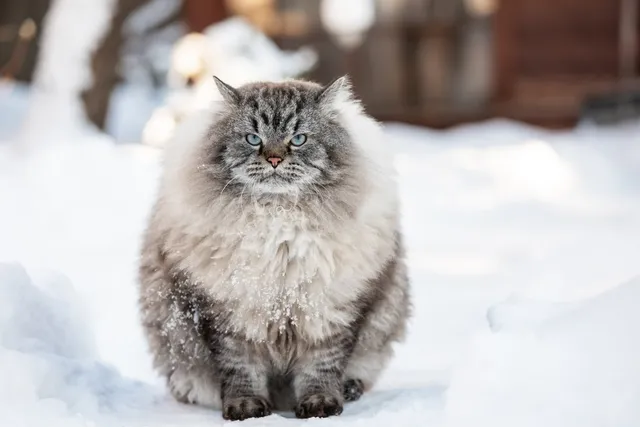
Frostbite: Snow means freezing temperatures. Having worked in the Midwest for many years, I’ve seen frostbitten cats, firsthand. It tends to be paw pads and ears, though other extremities (and indeed, the whole body) are vulnerable to the cold. A simple rule of thumb: if it’s too cold for you, it’s probably too cold for your cat. Just as you might have a quick peek outside for a minute or two, then head back in, your cat should have the freedom to do the same.
Pawpad cuts: Cats, though more frequently dogs, can get cuts from walking on ice, which we tend to forget can be quite sharp, as we wear shoes.
De-icer: Even pet-safe deicers can cause issues for cats, but others can be worse. If your cat will be outside, avoid deicers in areas they will be.
Potential Benefits?
But are there benefits from being exposed to snow? While scientific data regarding cats is lacking, given the above benefits of being exposed to nature in general, I’d argue that the potential benefits should (generally) outweigh the concerns, given appropriate supervision.
I’d go further to argue that potentially novel stimulation, in the true outdoor environment, could be some of the best EE out there. Some might even say: the original EE. The smells, the sounds, maybe a bird or two, certainly must be equally, if not more, enriching than a plastic mouse and a shelf or two. Give me a good snowball fight, over the latest entertainment console, any day. Chasing friends, the feel of the cold (but not too cold) biting your face, the beauty of the snow as you run and the flakes fly…those things are priceless. They make you feel alive.
For humans, and for cats.
This article is a part of Dr. Lauren, Pancake, and Tiller's series.
Expert cat care, straight to your inbox
News, insights, and useful advice, delivered to you.

No spam — unsubscribe anytime.
By signing up, you agree to our Terms & Conditions and Privacy & Cookies Policy.
How useful was this post?
Click a star to rate. You can leave written feedback afterwards. (We read all feedback.)
Dr. Lauren Demos DVM (Veterinarian)
As a veterinarian, Lauren is eager to share her experience in emergency medicine and cats, with our readers. She loves sharing helpful, real life tips for having cats as part of your life, and what to do in critical situations with your pets.
Lauren is a vet with over a ten years of experience in cats and dogs, along with infectious diseases. She enjoys teaching, and lectures for students, pet owners, and clinicians, on various topics.
Lauren received her degrees from Murdoch University, in Perth.