How High Can a Savannah Cat Jump? Vet-Verified Facts & Info


In this article
Savannah cats are beautiful and magnificent cats that are quite uncommon in the pet scene. Although domesticated, Savannah cats have an exotic DNA due to their wild lineage. Regardless, this intriguing and mysterious cat breed has a friendly temperament and playful personality!
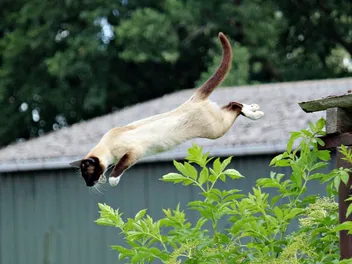
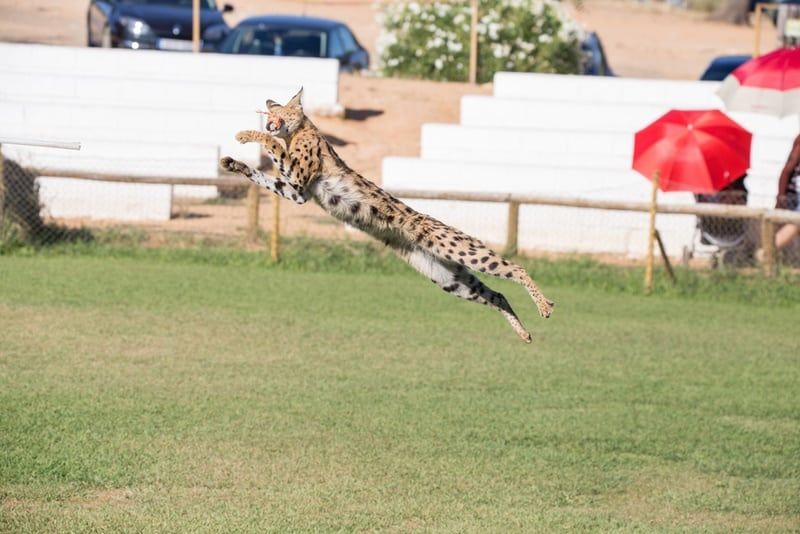
With their wildcat DNA, the Savannah cat is more agile and athletic than other domesticated cats. In fact, Savannah cats have a vertical jump of approximately 8 feet! With their athleticism, agility, and increased wildcat hunting instincts, some owners may have concerns about how to keep their Savannah cats contained.
Read on to find out more about the Savannah cat’s athletic feats and how to deal with them at home!

Types of Savannah Cats
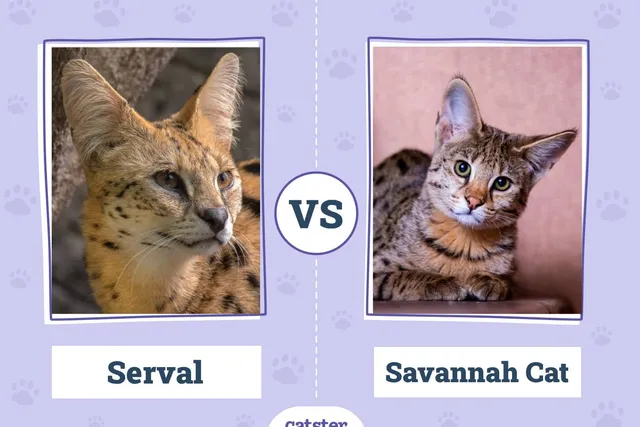
Savannah cats are descendants of the wild African Serval (Leptailurus serval) crossed with a domestic cat. There are different types of Savannah cats depending on how much African Serval DNA they have in them, which ranges from F1 to F5, depending on their generation.
The first generation, the F1 Savannah cat, has an African Serval parent and a domestic cat parent. The F2 is the second generation, which has an F1 parent and a domestic cat parent, and so on and so forth for the succeeding generations!
The F1 and F2 cats have the most Serval DNA, making them larger and more athletic, along with stronger hunter instincts. The F3, F4, and F5 have more diluted African Serval DNA, making them progressively smaller and more similar in temperament to domestic cats.
Jump Comparisons of Savannah Cats vs. Other Species

With their African Serval DNA, Savannah cats have an increased hunting drive, along with impressive physical ability. Savannah cats can jump up to about 8 feet in the air, making containment a concern due to their athleticism.
Large dog breeds, such as the Great Dane, Golden Retriever, and Labrador, have an average jump of around 5 to 6 feet, while the tiny rabbit has a jump of 2 to 3 feet. The horse, a large animal, also has an 8-foot jump record. But comparing the larger-sized horse with the much smaller Savannah cat, a jump of around 8 feet is most impressive.
Savannah cats can even jump higher than the average human and the average NBA player—further showcasing the athleticism of the Savannah cat!
Physical Properties of the Savannah Cat
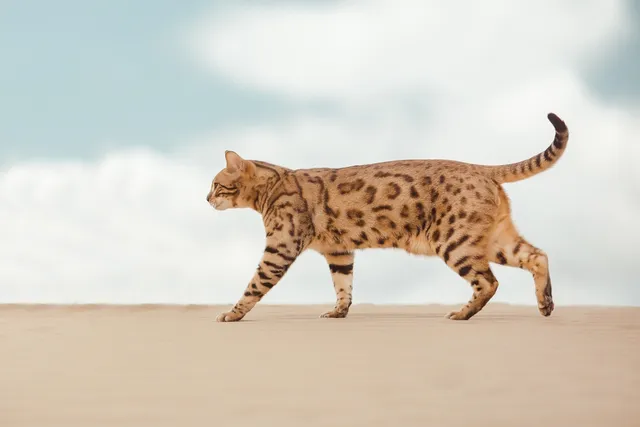
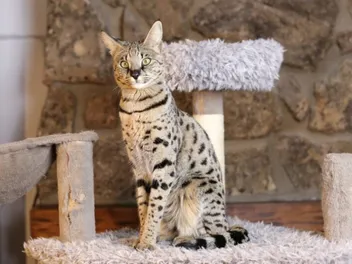
Savannah cats are among the tallest domestic cats, with some individuals reaching about 16–17 inches at the shoulder, but their typical weight ranges from 12 to 20 pounds, depending on sex and generation. Savannah cats may be slender in appearance, but they are also muscular with well-defined shoulders, chest, and hindquarters. They are strong, agile, and light on their feet, just like their wild parents!
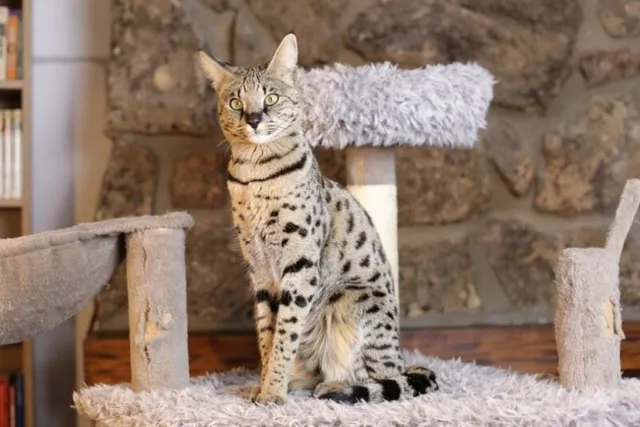
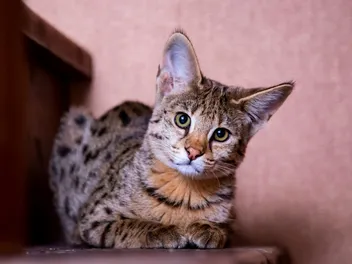
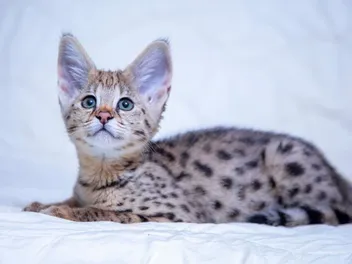
Savannah cats also have a beautiful, exotic appearance. They have a triangular-shaped head with upright ears and a narrow muzzle that greatly resembles the African Serval.
They have a short, soft, and silky coat that comes in a variety of colors and patterns, such as brown, silver, black, and spotted. Their appearance and coat give them their distinct “wild” appearance inherited from their African Serval lineage. The Savannah cat may be a domestic cat, but they most certainly look like the natural hunters that they are!

Are Savannah Cats Dangerous?

Depending on their generation type, from F1 to F5, Savannah cats will definitely inherit some of the behavior and physical properties from their wild African Serval lineage. The F1 Savannah cat is considered 50% wild since they are the direct hybrid offspring of an African Serval and a domestic cat. They will have the behavior, hunting instincts, physical attributes, and athletic ability closest to their wild parents.
Despite being 50% wild, the F1 Savannah cats are not considered inherently dangerous, but are not suitable pets for every household. Their temperament can vary, and they require highly experienced owners who can provide structured environments, enrichment, and containment. They are also incredibly intelligent, curious, and independent, often doing their own thing while exploring their environment.
The most important thing to pay attention to when owning a Savannah cat is their increased hunting tendencies and physical abilities. As direct descendants of wild African predators, they are energetic and strong, and may easily get carried away with their hunting behaviors. They require lots of attention and exercise to keep them properly stimulated, and may even find themselves stalking one animal after another, putting them at risk of getting lost.
Overall, the Savannah cat is not a truly dangerous pet to have, but there are certain considerations that need to be kept in mind, given that they have wild DNA in their genes.
How to Keep Savannah Cats Contained
Because of their African Serval characteristics, keeping a Savannah cat contained can be pretty tricky. They have a higher tendency for hunting, so they can easily get carried away when stalking smaller animals, such as mice or birds, before realizing they’re far away from home. They are also strong and agile with an impressive jumping ability, making it easy for them to escape by jumping over fences and barriers.
Savannah cats are highly intelligent and energetic. Keeping them properly exercised and stimulated can reduce their urge to hunt and explore the outdoors, so try to give them as much attention and play time as possible! Providing materials to keep them entertained and stimulated is also recommended, such as toys, cat trees, scratching posts, and the like.
To prevent any accidental escapes and spontaneous hunting urges, it is best to keep your cat indoors. Savannah cats are also known to work well on a leash, so leash training is a good way to give them the much-needed outdoor exercise they need without worrying about them escaping!


Final Thoughts
Savannah cats are a beautiful cat breed with a wild lineage that can make excellent companions with their exotic appearance and personality! They are friendly and affectionate, though temperament varies by generation and individual, and they are best suited for experienced cat owners. Their wild genes give this pet cat a freakishly athletic body, allowing them to jump as high as 8 feet!
Because of their more-than-usual hunting tendencies and physical abilities, keeping a Savannah cat contained can be challenging for owners. They can easily jump and escape barriers, and may get carried away chasing prey. Because of this, it is best to keep them indoors while still providing them with proper stimulation to burn their energy.
Featured Image Credit: PabloBenii, Shutterstock
Expert cat care, straight to your inbox
News, insights, and useful advice, delivered to you.

No spam — unsubscribe anytime.
By signing up, you agree to our Terms & Conditions and Privacy & Cookies Policy.
How useful was this post?
Click a star to rate. You can leave written feedback afterwards. (We read all feedback.)
Christian started writing for a local newspaper as a teenager, and he's been involved in the publishing industry for most of his adult life. Combining his love of writing with a passion for animals, he is currently the Director of Editorial at Pangolia and the Editor-in-Chief at Catster.
Christian lives in the Philippines with his wife, son, and four rescue cats: Trixie, Chloe, Sparky, and Chopper.