Do Savannah Cats Get Along With Dogs? Our Vet Answers & Provides Introduction Tips



In this article
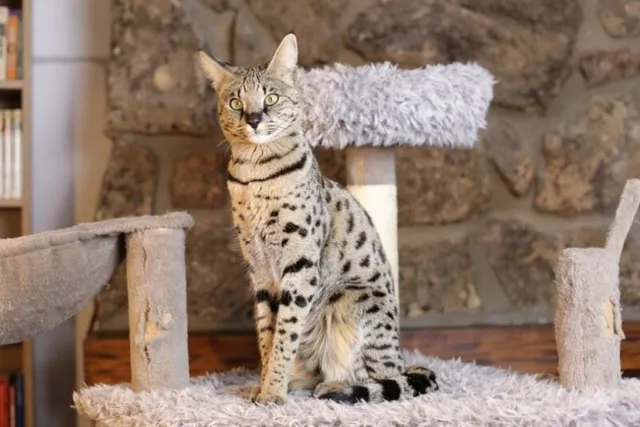
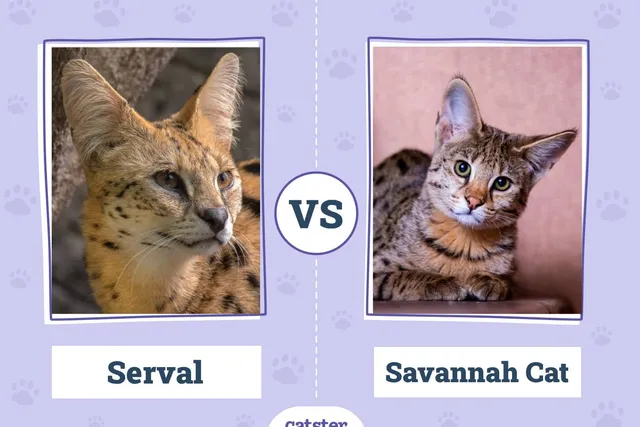
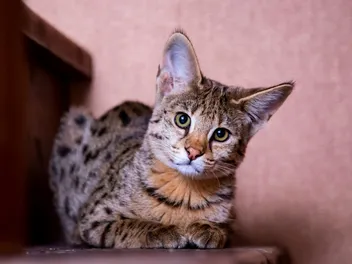
The Savannah cat is a hybrid breed originally created by crossing a domestic cat (Felis catus) with a serval (Leptailurus serval). Most present day Savannahs aren’t crossed in this way, but are instead offspring of the original hybrid crosses. They are known for their wild appearance and dog-like personality traits. This has made many wonder if Savannah cats get along with dogs. The answer is that it depends.
Every cat is different and has different levels of tolerance for dogs. For most Savannahs, the filial designation would play a huge role in determining their compatibility with pet dogs. If you are considering getting a Savannah cat, it is crucial to research their background to ensure they will be compatible with your lifestyle.

Do Savannah Cats Get Along With Dogs?
The individual personalities of our pets often do play a part in determining compatibility with different species. However, for Savannahs specifically, the filial designation would be a very strong determining factor for compatibility with dogs. The filial designation is a number which denotes the generation of the Savannah.
For example, a Savannah that’s produced by crossing a serval and domestic cat is termed as F1. These cats are 50% serval and therefore, still retain much of their wild heritage and are very difficult to integrate with other pets. In fact, they’re very difficult to obtain as pets, both from a financial and legal perspective.
F3–F7 Savannahs are much more likely to get along with dogs and are also easier to acquire, however, legal implications might still be involved (depending on where you stay). The higher the filial designation number of a Savannah, the more likely they are to be less “wild” and therefore easier to integrate with your pet dog.
It is not uncommon for F3 onward Savannah cats to get along with dogs since they are both active, trainable, and anecdotally seem to enjoy interacting with each other. Many Savannah cat owners report that their cats and dogs get along famously. While every animal is different, and there are no guarantees, the chances of a Savannah cat getting along with a dog are quite good, provided they are from a high filial designation.
Of course, it is always important to introduce new pets slowly and carefully, giving everyone time to adjust to the new situation. If you have concerns about whether your dog and Savannah cat will get along, talk to a veterinarian or a professional trainer for advice.
Introducing a Savannah Cat to Your Dog
When introducing a Savannah cat to your dog, it is vital to keep some key information in mind. The steps involved in the process are slightly different depending on which pet you already have in your house, and which pet is new. However, some things remain the same. Let’s explore the introduction process in more detail.
The Basics of an Introduction
Before introducing your pets to each other, there are some key pieces of information to keep in mind.
First, it’s very important to thoroughly understand and research the implications of a new pet coming into your house. This involves doing your research on the newcomer’s species, breed, requirements, and ensuring that everyone is dedicated to the process of a new pet in the house. Keep in mind that cats are not small dogs (and likewise, small dogs aren’t cats) – their food requirements, training, medications, vaccinations, care, and house training is quite different.
Whenever you bring a new pet to a house with existing pets, it’s very important to quarantine them for a period of at least 2 weeks. This means that for these 2 weeks, your new pet will not share the same physical space as your existing pet. In addition, all their worldly possessions, such as their bowls, toys, beds, etc., cannot be shared with your existing pet either. In addition, you should ensure that you thoroughly wash your hands before and after interacting with each pet. Your new pet should be seen by a veterinarian ideally both before and after the quarantine period. The checkup after the quarantine period is much more important, as your veterinarian will be able to tell if your new pet is in good health and not at risk to transfer something contagious to your existing pet(s).
Please note that many Savannah breeders discourage keeping F1 or F2 cats with other pets (including other cats), as these cats have a very high tendency to be aggressive towards other animals. Though cats of a filial designation of F3 are deemed acceptable in multiple-pet households, your odds of success increase with even higher filial designations (for example, an F5 cat would likely be a better candidate for a multiple pet household than an F3).
Introducing a Savannah to Your Dog
If your cat is a newcomer to the house, your chances of a successful introduction are best if you’re introducing a kitten to a well-adjusted house trained dog.
It goes without saying that your dog’s personality will play a very large part in the introduction process. If your dog has a high prey drive, we do not recommend introducing a cat to the house, as they may seriously injure or even kill a kitten or cat.
If your dog is well socialized and is friendly towards other pets, you can begin the process of introduction by rubbing a soft towel (or any other soft fabric) on your Savannah and then allowing your dog to smell the fabric.
For a physical introduction, it’s best to place one pet in a crate or carrier and allow the other to explore them at their own discretion. As a dog is often much larger and stronger than a cat, it’s best to do this by first tiring your dog out with a walk, playtime, or exercise and then placing them in their crate. This allows the kitten the freedom to safely explore, sniff, and interact with the dog without risk of injury.
Depending on how your pets respond to each other’s presence, you can eventually attempt an introduction without a barrier in between them. It’s best to have your dog on a leash (and perhaps even muzzled) for this process. Remember that dogs that are excited to meet a new pet can sometimes inadvertently injure them by playing too roughly.
For the first few interactions between the pets, it's strongly advised to supervise them at all times. Gradually, you can increase the amount of time they spend together. Leaving them alone unsupervised should be done at your discretion and judgment, depending on how each pet is reacting to the process.
With lots of patience, care, and of course a little bit of luck, you may end up with a cat and dog that are comfortable with each other.

Introducing a Dog to Your Savannah
Introducing a puppy or dog to your Savannah is considered slightly different. This is because depending on your cat’s personality, they may or may not be accepting of a newcomer. The sudden change in their environment (the presence of a dog) can lead to stress in some felines. Stressed cats can unfortunately display undesirable behavior, and at times can even develop health issues, such as urinary blockages! Therefore, you’d have to be extra cautious and patient. In addition, if your cat does seemingly act out or begin to show signs of stress, you should have them looked over by a veterinarian and also seek the services of a professional cat behaviorist and trainer.
Signs of Stress In Cats
A puppy is perhaps your best bet for such an introduction. The general flow of events is the same as those explained above (desensitization, a physical introduction with a barrier, and an introduction without a barrier). However, you need to keep a very close eye on your cat, as they may suddenly lash out and swipe at your puppy. In addition, what’s interesting about Savannahs in particular is that they are often easily leash trained, if your cat is such a cat, it’s best to have them on a leash for the first few interactions between your cat and your new puppy or dog.
Do Savannah Cats Get Along With Other Cats?
Yes, Savannah cats with a high filial designation (F3 onward) generally get along well with other cats, even those that are not Savannahs. Such Savannahs are considered similar to domestic cats in terms of their care, sociability, and other needs as pets. Of course, there may always be an exception to the “rule” (which in this instance is merely a reference to a unique circumstance), but for the most part, Savannah cats get along excellently with other cats with proper precautions and slow introductions.
Are Savannah Cats Friendly?
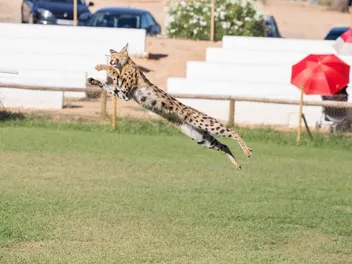
The Savannah cats that are often up for adoption as pets almost always have a filial designation of F3 or higher. Such cats are considered very amicable and make great family pets. However, they are exceptionally active cats and do require a lot of time and attention to ensure that they exercise enough. If their exercise needs and socialization needs are not met, then just like other cats they are prone to destructive or undesirable behavior.
Nonetheless, given how Savannahs are often the result of controlled breeding programs, they are almost always well socialized as kittens and are generally considered to be exceptionally friendly.

Final Thoughts
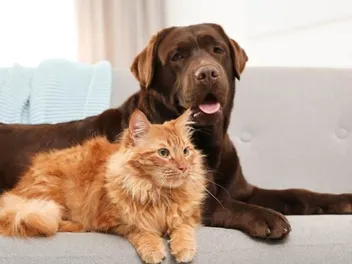
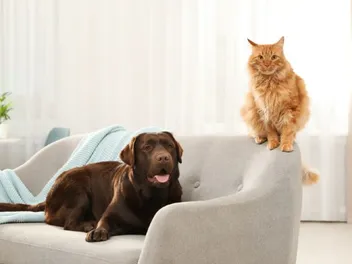
Savannah cats often do get along with dogs with a proper introduction. However, a large part of the chances of success depend on your pet’s filial designation. The higher their filial designation, the better your odds of success with the introduction of your cat to a dog (or vice versa).
As always, if you find yourself struggling with the process, it’s best to seek professional advice on the matter. Though these animals can coexist in the correct environment and circumstances, it’s important to keep in mind that your pets’ personalities will definitely play a huge role in determining the outcome of an introduction and the prospects of a long term cohabitation.
See Also:
Do Maine Coons Get Along With Dogs? Cat Socialization Explained
Do Munchkin Cats Get Along With Dogs? – The Interesting Answer!
Do Savannah Cats Get Along with Other Cats? Facts & Care Tips
Featured Image Credit: AJR_photo, Shutterstock
Expert cat care, straight to your inbox
News, insights, and useful advice, delivered to you.

No spam — unsubscribe anytime.
By signing up, you agree to our Terms & Conditions and Privacy & Cookies Policy.
How useful was this post?
Click a star to rate. You can leave written feedback afterwards. (We read all feedback.)
Chelsie is a freelance writer who is passionate about helping owners and cats live their best lives. She currently lives in rural Alberta, Canada with her husband and two children, and is currently a pet parent to four horses, four cats, and a border collie.