The Gift of Anticipatory Grief: How to Start Healing Before a Pet Dies
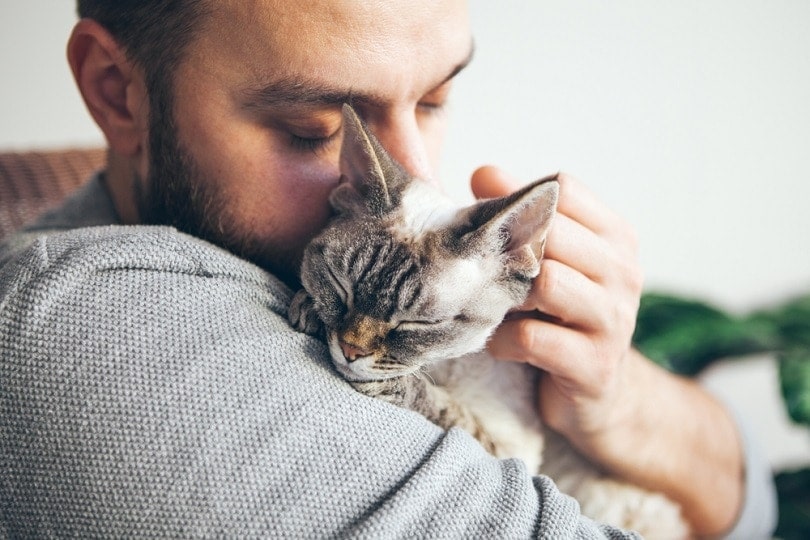
Anticipatory grief is grief that arises before a death—when you know it’s coming, but your cat is still alive. On one end of the spectrum, anticipatory grief can cast a shadow over the time you have left with a sick or senior cat. But this “grief in advance” can also be a gift, if we can recognize it and work with it.

How to Start Healing Before a Pet Dies
1. Our time together is scarce
As humans, we tend to value things that are scarce. This is usually applied to material goods (because we live in a consumer culture), but the psychological principle behind it is the same: Our lives, and the lives of all beings, are limited. Most of the time, most of us live in denial of this fact. When we can accept that death is inevitable—and admittedly, that’s a big “when”—we are free to appreciate each moment so much more.
When we adopt a kitten, or even a healthy young cat, we’re not thinking about sickness, illness, palliative care, or death. At a certain point, though, we all get a wake-up call, a reminder that the feline lifespan is shorter than the average human lifespan. Most cats, if they live long enough, will develop kidney disease. Many develop diabetes and/or hyperthyroidism. Usually, these are detected long before they become life-threatening, and treatments can either reverse the illness (as can happen with diabetes), cure it (some treatments for hyperthyroidism) or at least slow the decline. Yet for many cat guardians, especially those who haven’t had a geriatric cat before, just the words “kidney disease” can bring on anticipatory grief, even if the cat lives for years following the diagnosis. The awareness of death is both painful and a gift.

2. The gift of anticipatory grief
The opportunity inherent in anticipatory grief is to work with what psychologist William Wordon calls “the first task of mourning,” to accept the reality of the (impending) loss. If we can do this before our cat’s death, then the experience can be much less traumatic—and even peaceful or sacred.
To be clear, I’m not talking about “getting over” a loss—grief is a lifetime experience that comes in waves and nonlinear zigzags. I’m talking about healing in a way that allows us to move forward in our own lives.
3. Stay in the moment as much as possible
If you’re reading this, you’ve made it through 100% of the worst days of your life so far. We humans have a surprising ability to handle whatever arises in the moment, no matter how challenging or painful. The future, though, is just a thought, and focusing on “what it will be like” only makes us suffer more.
That said, if you’re experiencing anticipatory grief, you likely are having to strategize—Do I continue treatment? What’s best for my cat? Should I get a second opinion? Is it time?—and strategizing, because it’s an intellectual process, can lead directly to worry and regret. This is why it helps to come back to the present moment—rather than our stories about it—multiple times a day.
By “the present moment,” I mean the sights, sounds, scents and tactile facts. The wind on your face. The cushion beneath your bottom. The honking cars or chirping birds outside. Look, listen, smell, touch—without labeling any experience “good” or “bad.”
Although you might be overwhelmed by anticipation of what’s to come, try to remember that in this moment, your cat is still with you. Feel her fur. Give him a butt scratch. If you have stopped treatment and aren’t concerned about what they eat, this is the time to spoil your cat with treats. Talk to him or her about your favorite memories together. Take note of your cat’s quirks and tell them the things you love about them.

4. Focus on feelings more than thoughts
In my experience, anticipatory grief involves a whole lot of crying. And that’s a good thing—we cry because we love these beings, and the pain wants to come out.
If your cat is young, or even with an older cat, you may have thoughts like, “This shouldn’t be happening” or “He’s too young.” Those thoughts, while completely understandable, are a form of resistance. As long as we resist what is happening, we create more pain for ourselves. It sounds counter-intuitive, but our minds try to protect our hearts by distracting us from pure pain. Yet the only way for pain to work its way through our bodies is to feel it directly. No matter how big or intense the waves, if you allow them, they will pass.
Start by observing your thoughts. Then ask yourself whether the thought is based in fact, or whether you’re interpreting your thoughts in a way that adds to your distress.
Focus on the sensations in your body. You may have to redirect your attention away from your thoughts hundreds of times. Don’t beat yourself up—this is totally normal. Keep bringing attention back to what you’re feeling physically. Close your eyes and scan your body for areas of tension. A shortcut, if you’re in public, is to close your eyes and focus intensely on the feeling of your hands. When you focus on the hands, eventually you’ll feel a kind of tingling in the nerve endings. Focus on that sensation, just for a moment. And then the next moment.
The physical experiences underneath your emotions—a racing heart, a heaviness in the chest, brain fog—probably won’t kill you. Your thoughts, though, can keep pain entrenched much more deeply and for much longer than the natural lifespan of an emotion.
5. Find support from those who understand
Not everybody understands how painful it is to face the final days or months with a companion animal. Find people who have been through it; give yourself some distance from those who don’t get it or who might be dismissive.
If there’s nobody in your immediate community, look online for a group like Tuna Tributes. There are counselors and therapists who specialize in pet loss, and many veterinary schools have pet loss support hotlines.
If your mind and heart are reeling, give yourself some compassion—treat yourself the way you would treat a kitten in distress. What you’re going through is intensely painful and difficult.
I grieved so much in advance of Hedda’s death that afterwards, I didn’t cry nearly as much (though of course, I grieved in other ways). I believe that anticipatory grief gives us a grace period, and making the most of that, in turn, allows us to have the fewest regrets possible.
Featured Image Credit: Veera, Shutterstock

Expert cat care, straight to your inbox
Vet-reviewed advice, behavior tips, and the best of Catster. Free, and you can unsubscribe anytime.
By signing up, you agree to our Terms & Conditions and Privacy & Cookies Policy.
Ingrid King is an award-winning author, former veterinary hospital manager, and veterinary journalist who is passionate about cats.
Join the conversation
Ask a question, share your story, or send private feedback.