My Cat Ate a Ribbon: Is It Dangerous? Our Vet Explains

In this article
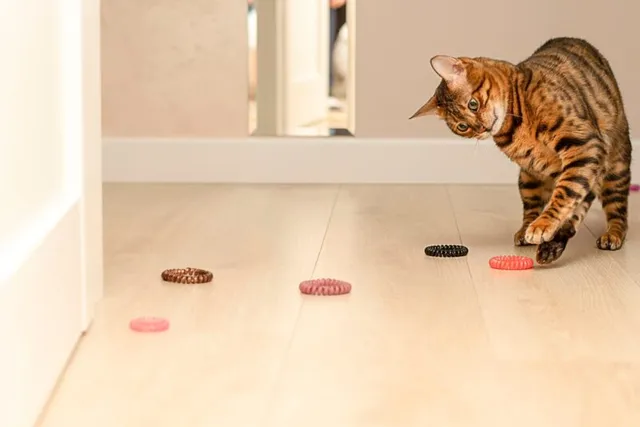
Cats like to play with many things, including laces, threads, hair bands, rubber bands, tinsel, or ribbons. Although cats playing with these items are extremely fun to watch, it is recommended to always supervise them because ribbons and similar items can be dangerous if ingested.
If your cat has swallowed a ribbon, contact your veterinary clinic immediately for advice. Depending on the width and length of the ribbon and how much time has passed since it was swallowed, the vet will make a recommendation on your next steps and the urgency.

What Could Happen If My Cat Ate a Ribbon?
Cats can swallow foreign, inedible objects from time to time. Some individuals are more prone to doing this than others. Many foreign objects can cause severe problems in the digestive tract resulting in the need for surgery. One of the most troublesome situations is when cats eat linear foreign objects, such as ribbon, yarn, sewing thread, laces, fishing nylon, string, etc.
If the piece of ribbon is short, it may be eliminated along with the feces or vomited in a few days after ingestion. However, this is a judgment that your veterinarian should make as there can be life-threatening intestinal problems after eating a ribbon or similar object.
There is potential for severe intestinal injury with these types of object and any ingestion of a long thin, (linear), foreign body should be discussed with your veterinarian urgently. The danger is that sometimes one end of the ribbon (or string etc) becomes anchored at one end and intestinal movements pull the other end along with them. The intestines will keep moving the other end further along the intestinal tract resulting in the intestines becoming bunched up and a cheese-wire type effect where the tension on the linear object starts to cut through the intestines.
If this occurs the ribbon will cause damage to the mucosa (inner layer) and even eventually the deep layers of the intestine. This can lead to damage, perforation (a hole), and intestinal necrosis (impaired blood flow and tissue dying off). All of the above can result in the leakage of gut contents and bacteria into the abdominal cavity, peritonitis and sepsis are common consequences, which can be fatal.
Clinical Signs That Your Cat Ate a Ribbon or Another Linear Foreign Body
You may or may not have seen your cat eat the ribbon. If you didn't see your cat do it but you suspect that this happened, a few clinical signs will tell you that something is wrong with your pet and that you need to go to the vet. It is worth keeping in mind that cats are good at hiding their suffering and pain, so their signs may be subtle at first.
Clinical signs may include:
These signs should always prompt a consultation with your veterinarian urgently.

How Will My Vet Know If My Cat Ate a Ribbon?
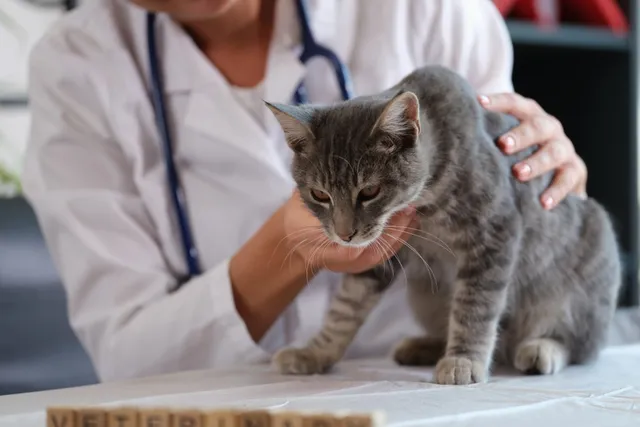
Once you arrive with your cat at the veterinary clinic, the vet will ask you a series of questions which is called history taking. This helps them to gather information about what has happened (if you know) and what signs your cat is showing.
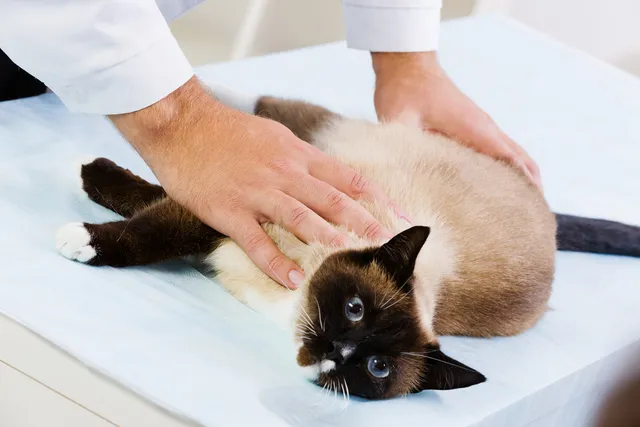
They will evaluate your pet as thoroughly as possible. This will involve an examination including feeling your cat's abdomen, checking for the presence of abdominal pain or other abnormalities. Often temperature, gum color and heart rate will also be checked. Depending on the outcome of these initial checks your veterinarian may recommend that further testing is necessary. This can include abdominal ultrasound and/or X-rays and blood tests. In some cases, it will be recommended that exploratory surgery or endoscopy, to locate and remove the ribbon (or another foreign body) is necessary.

What if Your Cat is Passing the Ribbon?
It can happen that you did not know your cat had eaten something indigestible until it started to make its own way out of their system. If you see a ribbon starting to come out little by little from your cat’s anus, do not pull it. Never pull on a ribbon or any other linear foreign body, whether it’s coming out of your cat's mouth or the anus. You can cause serious damage to the digestive tract and more problems for your cat.
Contact your veterinarian because they can give you the best advice depending on your cat's situation. Hopefully the ribbon will come out as your cat passes feces so keeping them in a room with a litter tray until you are sure they have safely passed the ribbon may be what your veterinarian recommends.
Is Ribbon Safe for My Cat to Play With?
Prevention is better than cure in this scenario. Ribbons are only safe for cats to play with if they are supervised. Do not let your pet play with ribbons or other stringy items without monitoring them. Also, make sure you put away the ribbon when you are not home or when they are done playing.
Some cats may chew on the ribbon and ingest small parts of it, others may just play with it, and still others might ingest it whole. Even if you know that your cat plays nicely with ribbons and string, it is always safer to make sure you put them away after playtime. It’s better to be safe than sorry!
The same applies to cat toys that have string parts attached (such as toy mice) or have other components that can be chewed and swallowed.
Conclusion
If your cat has swallowed a ribbon contact your veterinarian as soon as the incident occurs. They are best qualified to advise you on what to do next. Linear foreign objects such as ribbon and yarn can cause severe intestinal injury. Clinical signs you may see include vomiting, diarrhea, drooling, being hunched up, lethargy, and lack of appetite. It is possible for ribbon to pass through the digestive tract but with the high risk of complications, it is best to talk things through with your vet.
See also:
Sources
Featured Image Credit: Ermolaev Alexander, Shutterstock
Expert cat care, straight to your inbox
News, insights, and useful advice, delivered to you.

No spam — unsubscribe anytime.
By signing up, you agree to our Terms & Conditions and Privacy & Cookies Policy.
How useful was this post?
Click a star to rate. You can leave written feedback afterwards. (We read all feedback.)
Dr. Iulia Mihai, DVM MSc (Veterinarian)
Dr. Mihai is a vet with over 13 years of experience in laboratory, pet pathology, and cancer. She studied at the University of Agronomical Sciences and Veterinary Medicine of Bucharest, Romania (EAEVE member), where she worked in the laboratory of the faculty clinic after graduation. She has a master’s degree in equine and pet pathology and studied epithelial cancer for her Ph.D. Iulia has a passion for internal medicine and parasitology and started volunteering at the faculty’s clinic in her third year of college. She has worked in a couple of veterinary clinics over the years as an internal medicine specialist. She enjoys writing and teaching people about cat disease prevention, nutrition, behavior, and treatment.