My Cat Ate String! Our Vet Explains What to Do

In this article
In general, cats tend to be fussier about what goes in their mouths than dogs. This means cats are less prone to eating things that they shouldn’t. However, cats can still swallow household objects by accident, and they have a curious preference for long, thin, soft items like string, thread, and ribbons. If these are attached to other objects, like a needle or a roll attached to a thread, then unfortunately, the other objects might get swallowed, too!
The major problem is that strings are so common around the house and often form part of common cat toys, so there is no shortage of opportunities for cats to get hold of them. Although this can be a serious and dangerous situation for you and your cat, there are lots of interventions we can make to get the problem fixed, so read on for more information about what to do if your cat swallowed string.

The 4 Reasons Why Threads, Strings, and Ribbons Are Dangerous for Cats
Lengths of string, thread, and ribbon can be dangerous for your cat in a number of ways:
1. Obstructions in the Mouth
They can get trapped in the mouth and cause an obstruction. The movements of the tongue and the barbs on top of a cat’s tongue can essentially reel in the string and wrap it around the base of the tongue. The barbs stop it from coming back out again. The string may then get stuck in the mouth or in the throat, causing choking and distress.
2. Foreign Body in the Stomach
If your cat swallowed string it can lodge as a ball in the stomach. Most strings, ribbons, and threads are not easily digestible and will sit unchanged in the stomach. This causes irritation and damage to the lining of the stomach, which will make your cat feel nauseous and prone to vomiting.

3. Linear Foreign Body
If the length of string makes it into the intestines, then it can form a linear foreign body. A typical foreign body (like a stone or a toy) blocks the guts and causes an obstruction by itself. Linear foreign bodies are not an obstruction by themselves, but they cause the gut to bunch up around them, and this forms a bowel obstruction that is even more dangerous.
Let’s look at how this happens:
4. Dangerous Objects
The strings, thread, or ribbon might have other dangerous objects attached to them. It is not impossible for cats to also swallow a needle attached to a thread, which may cause internal damage by poking through the digestive tract. Cats can also swallow the reels that thread comes with, which can act as typical foreign bodies and cause bowel obstructions.

My Cat Ate String - What Do I Do?
There are various ways that this might come to your attention. You might see your cat eat the string, thread, or ribbon. Alternatively, your cat may appear in some distress with thread or string hanging out of their mouth or even out of their bottom. If you see string hanging out of your cat at either end, you must not pull on it. There is a significant risk that this could make any gut plication or intestinal damage much worse.
If your cat has eaten a string, you should:
What Happens if a Cat Eats String? What Are the Signs?
Unfortunately, the signs of this problem can be really variable based on what has been eaten, where it is in the body, and when it was eaten.
If the string is stuck in the mouth or wrapped around the tongue, your cat may be acting as if they are choking. Cats will be retching and pawing at their mouth, trying to bring something back up again. You might see thread or string hanging out.
If the string is stuck in the stomach, your cat will be lethargic, less keen on food (or not eating at all), and vomiting.
If the string is starting to cause gut or intestinal problems, then cats will be very flat and lethargic. Most will not be eating at all and may be vomiting and passing diarrhea. The tummy can also be very tender and painful when touched, and cats will usually guard it. Unfortunately, as this continues, cats will become dehydrated, septic, and can die quite quickly if peritonitis develops.
Very lucky cats will have the string leave their guts at the other end, and it usually takes 2-5 days to pass, but this is not to be taken for granted! Early intervention is far better for your cat, so don’t wait for string to pass on its own.

What Is the Treatment if My Cat Swallowed String?
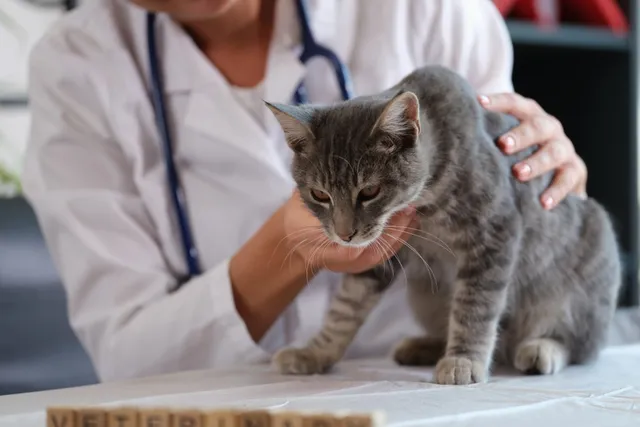
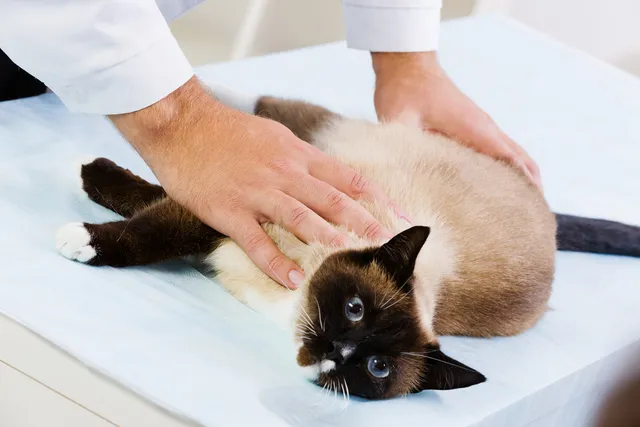
Initially, the veterinarian will take all the details of the situation from you and perform a full external examination on your cat. This is important for assessing the overall health of your cat and looking for any of the signs mentioned before. Signs of pain and dehydration will need more intensive treatment, for example.
Most cats are strong characters, and this means they don’t tolerate being poked and prodded as much as dogs do, even if the poking is in their best interest. Most cats need a sedation or anesthetic to allow a full examination, so don’t worry if this is what your veterinarian advises. It can be fiddly and painful to resolve issues related to string, so anesthesia is definitely a kindness.
You might not always notice right away if your cat has consumed something they shouldn't have. It is important to watch your cat’s behavior afterward to see if they are showing any symptoms of irritability or poisoning.
String Stuck in Your Cat’s Mouth
If the string is stuck in the mouth, the veterinarian will carefully unwind and remove it once your cat is under anesthetic. The mouth can be checked for damage at the same time. If the string hasn’t gone any further than this and there is no major damage, most cats will recover very quickly from this with minimal assistance.
String That Has Been Swallowed
If the string that the cat ate is stuck further down from the mouth, then your veterinarian needs to know what is happening in your cat’s tummy. This will usually involve either X-rays or ultrasound of the abdomen under anesthetic. The string or thread itself does not show up on X-ray pictures, but obstructions or plication usually produce characteristic patterns of tissue and gas. These patterns may take time to develop, so if they are not immediately obvious, your veterinarian may recommend careful monitoring of your cat, often in a hospital, and then repeating the images a little later on.
All strings, threads, and ribbons need to be identified and removed because they do not digest and are a very high-risk problem. Typically, if string is causing a problem in the abdomen, then the only way to reach it is by a surgery to explore the tummy. The idea of surgery is always a scary one, but actually, this is a routine (and very common) procedure for veterinarians. Although it carries risks like all surgeries, it is often a very quick way to resolve a problem. Sometimes string in the stomach can be reached by endoscope (a flexible long video camera that goes via the mouth), but usually, surgery is best for access.

Surgery for Bowel Obstruction Caused by String
String in the stomach is reached by a simple surgical incision, and this usually carries a really good outcome for cats with a quick recovery over the following days.
If string has reached the intestine, the surgery can start to become trickier. Linear foreign bodies are unfortunately the most dangerous type of foreign object, and treating the problem can be complex.
Where most foreign bodies can be removed with one incision in the intestine, linear foreign bodies need multiple incisions along their length. If they were pulled out by the surgeon through one hole, they would cause further plication and damage. Sadly, although multiple incisions are necessary, this also increases the risk of post-surgery complications, and it means that recovery takes longer. Recovery from bowel obstruction surgery for a linear foreign body like string usually takes 10 to 14 days.
If the intestine is already plicated, damaged, or ruptured, then this is the worst-case scenario. Sometimes, the gut is so damaged that it needs to be removed completely, and two healthy ends of intestine joined back together again. These are the hardest surgeries for the veterinarian and the complication rates are high. Cats may not survive the procedure or may die in the post-surgery period. These cases often need the longest hospitalization after surgery and the most supportive care before they recover. Recovery here may take 2 to 4 weeks, but mortality is high.
Will My Cat Be Okay After Eating String?
In most cases, cats will make a full recovery after eating string with no long-term complications. However, this depends entirely on owners identifying the problem and seeking professional veterinary help at an early stage.
The longer a problem is left, the more likely it is to turn into a severe problem with a damaged intestine, which means a longer recovery period and far greater chances of complications for your cat. Naturally, more intensive surgeries and post-operative care are also more expensive, so it is more cost-effective to seek help early.
Unfortunately, for cats with linear foreign bodies, plication, and peritonitis, there is a significant risk of complications both short- and long-term. Cats can die from eating string if these occur, and a high percentage of them sadly do.
How Do I Stop My Cat From Eating String?
Prevention is the best strategy for your cat’s well-being here. It is important to keep strings, threads, ribbons, tinsel, and other similar items away from your cat, especially while unsupervised. If you unwrap strings from meat, make sure they go in a sealed bin. Other items should be put away when not in use somewhere where your cat cannot access them. This is especially true of kittens, who are the worst offenders for eating string!
Conclusion
String, ribbon, and thread can pose a real risk to your cat, and it is vital to make sure your cat does not have easy access to these around the house, especially while unsupervised. Cats love string, and if swallowed by accident, it can damage the base of the tongue, the stomach, and the intestine. String forms a linear foreign body, which can cause obstruction and death of the gut and lead to severe, life-threatening consequences. If your cat has swallowed string, it is vital to seek professional veterinary advice at an early stage to give your cat the best chance of a rapid recovery.
Related Reads:
Featured Image Credit: Ermolaev Alexander, Shutterstock
Expert cat care, straight to your inbox
News, insights, and useful advice, delivered to you.

No spam — unsubscribe anytime.
By signing up, you agree to our Terms & Conditions and Privacy & Cookies Policy.
How useful was this post?
Click a star to rate. You can leave written feedback afterwards. (We read all feedback.)
Dr. Joanna Woodnutt BVM BVS (Veterinarian)
Joanna is an experienced veterinarian working in the UK. She has written about pets and their health for many blogs, pet magazines and pet websites and loves to help readers understand their pets through her writing.
She has started her own freelance company so she can help more pet parents than just the one standing in front of her in a consultation room.
She enjoys teaching and educating clients, so a career in writing, public education and pet health is the perfect combination for her.