My Cat Ate a Sewing Thread, What Do I Do? Our Vet Answers

In this article
Cats love playing with long, thin materials like string, tinsel, and sewing thread. This is likely because it excites and mimics their natural predatory instincts. And who doesn’t love the image of a cat or kitten bounding around the house, pouncing and swiping at a harmless ball of colored fabric?
Unfortunately, items like sewing thread pose a significant risk to cats if they are swallowed. They can become lodged in the mouth or stomach, causing bunching and perforation of the bowels as the body tries (but fails) to pass the lodged thread. Worse still, cats can swallow the sewing needle attached to the thread, causing serious injury to the mouth or digestive tract. This article will explain what you can do, and what your vet can do, to fix the problem of cats ingesting sewing thread.

My Cat Ate Sewing Thread, What Do I Do?

If you’ve seen your cat eat some sewing thread, it’s important to stay calm. While it’s best to act fairly quickly, ingested sewing thread is not immediately life-threatening. Follow the below three-step “do” and “don’t” guides to ensure the best outcome for your feline friend.
What to Do:
- Remove any access to sewing thread.If the thread is dangling from the mouth, cut the thread several inches from your cat’s mouth.
- Determine if the needle was ingested. If the thread was attached to a needle, do your best to locate the needle. This is important information for your vet.
- Contact your veterinarian.Your vet clinic will be able to advise you on how to proceed and make an appointment to have your cat examined. If it is late at night, contact either your nearest vet emergency center or local after-hours service.
What Not to Do:
- Do not attempt to manually pull the thread from your cat’s mouth. Though it feels counter-intuitive to leave the thread there, attempting to remove it will usually cause more harm than good. This can cause damage to the esophagus or mouth, as well as aspiration pneumonia. Additionally, it almost never works.
- Do not feed your cat. It might seem like a good idea to feed your cat to help move the thread through their digestive tract. Again, if it is lodged in the mouth, esophagus, or stomach, this is unlikely to work. If the vet later decides to pass an endoscope (camera) into your cat’s mouth and stomach to attempt the removal of the thread, it is going to be much more challenging to visualize the thread with a stomach full of food.
- Do not “wait and see.”While it will usually take at least 24 hours for cats to become unwell as a result of the thread ingestion, the longer you wait, the harder it is to fix the problem. Early intervention leads to the best outcome.

Why Are Sewing Threads Dangerous?
There are two main reasons that sewing threads are dangerous to cats:
1. Linear Foreign Body
A piece of sewing thread can become wrapped around the base of the tongue or lodged at the pylorus (the narrow outflow region of the stomach). This often leaves a length of thread dangling further down in the digestive tract. In veterinary circles, this situation is referred to as a linear foreign body. As the bowels naturally contract and relax in an effort to pass food and the sewing thread, they end up being pulled together by the anchored thread. This causes bunching and, further down the road, perforation of the bowels. Vomiting, lethargy, drooling, reduced appetite, and abdominal pain are the most common signs of a linear foreign body.

2. Sewing Needle Trauma
Cats will often eat the sewing thread right up to, and including, the needle attached at the end. This needle is sharp and metallic. It can cause lacerations of the tongue and oral cavity. It can also perforate right through the esophagus in the neck or lower down the digestive tract in the stomach or bowels. The latter can lead to life-threatening infections of the abdomen called peritonitis.
What Can Vets Do to Help?
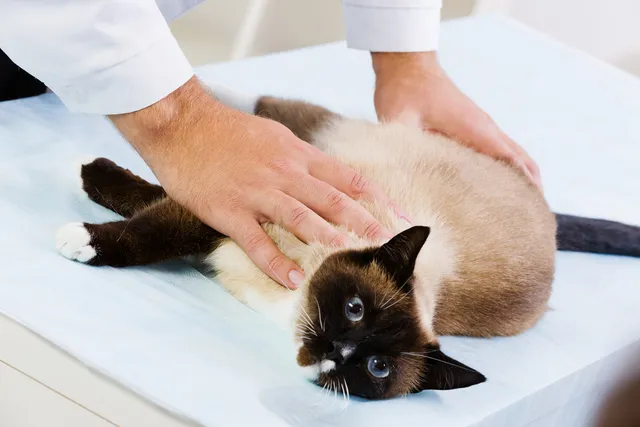
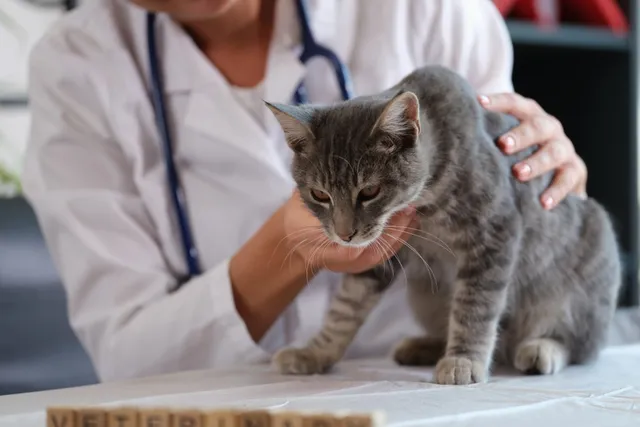
Vets will start by conducting a full physical examination. They will inspect the mouth and under the tongue and palpate (feel) your cat’s abdomen. They will check for any neck pain or signs of malaise.
If you are unsure if the sewing needle was ingested, vets may recommend taking an X-ray. Needles, being metallic, will usually show up quite clearly as an opaque object compared to the other soft tissue structures of the chest and abdomen.
Once it is determined that sewing thread was ingested, there are three main options. If the thread is small and there is no evidence of it being stuck, it may be reasonable to wait and watch carefully. The thread should pass in 2–5 days, and if your cat becomes unwell before then, an urgent re-check is warranted. If vets are concerned about the length of the thread, or if the thread is known to be lodged somewhere, they may be able to use an endoscope to remove the thread, guided by a camera. This requires a general anesthetic. If endoscopy is not available, either surgical retrieval by entering the abdomen and cutting into the stomach or intestines may be the best option.

How Long Does It Take for Cats to Show Signs?
Most cats will not develop signs of a linear foreign body for 24–48 hours from the time of ingestion. This does not mean that you should wait for signs to develop before seeking veterinary attention. If the sewing needle was ingested, damage can occur much faster, either directly following ingestion or after a few hours.
You might not always notice right away if your cat has consumed something they shouldn't have. It is important to watch your cat’s behavior afterward to see if they are showing any symptoms of irritability or poisoning.
Can Cats Pass Sewing Thread?
If the ingested piece of thread is very small and has not become lodged in the mouth or stomach, it may pass in 2–5 days. However, it can be very hard to know exactly how long the ingested thread is, and almost impossible to know if the thread will become stuck somewhere in the digestive tract.

Conclusion
When it comes down to it, the most important thing you can do if you notice that your cat has consumed a sewing thread is to get them to the vet as soon as possible. The vet will be able to determine the following steps and ensure your kitty stays safe until the thread passes or can be removed.
Sources
Featured Image Credit: Ermolaev Alexander, Shutterstock
Expert cat care, straight to your inbox
News, insights, and useful advice, delivered to you.

No spam — unsubscribe anytime.
By signing up, you agree to our Terms & Conditions and Privacy & Cookies Policy.
How useful was this post?
Click a star to rate. You can leave written feedback afterwards. (We read all feedback.)
Dr. Joe Mallat DVM (Veterinarian)
Joe is a veterinarian from Sydney, Australia. When he's not at his office, he enjoys cooking, exercising, and exploring the wilderness in Australia. He has worked for 2 years at a mixed-species practice on the mid-north coast of New South Wales, treating animals of all sizes. His areas of particular interest include internal medicine, wound management and oncology. Joe's love for the profession comes not only from helping cats, but also from helping their parents and working with wonderful teams of people.
Joe completed his Bachelor of Veterinary Biology and Doctor of Veterinary Medicine at the University of Sydney in 2020.