How To Communicate With Your Cats: Talking & Understanding Your Pet



In this article
Just because you and your cat may not speak the same language doesn’t mean you can’t communicate with them. By learning how to communicate with your cat, you can understand them better and how they feel or express their wants and needs. Cats can also benefit from this and learn to respond to consistent cues through their body language and vocalizations.
If you want to find ways to communicate with your cat, this article is for you.

Understanding Cat Communication
Cats primarily communicate with us through their body language and vocalizations. However, they rely on other forms of communication, such as olfactory and tactile (grooming or biting) methods with other felines. They use it to communicate their needs, such as food and attention. A cat’s body language and behavior can also give you an indication of how they are feeling, such as playful or stressed.
Vocalizations
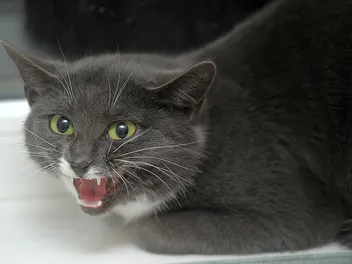
According to a study published in the Journal of Veterinary Science, cats can produce up to 21 vocalizations for communication.1 These vocalizations range from purrs, hisses, meows, trills, and murmurs. These vocalizations can provide clues about a cat’s emotional state or intent, but they are not always exact indicators of a single emotion. For example, a cat hissing is likely feeling threatened or scared. Cats who are trilling or purring are often in a relaxed or affiliative state, although purring can also occur in other contexts, such as stress or pain.

Body Language
Their vocalizations are often matched with their behavior and body language, which makes it easier for us to interpret what they are trying to communicate. A cat that is purring while lying outstretched on their back feels relaxed, whereas a snarling cat with a hunched posture and flattened ears does not.
Other Communication Clues
Another way to understand your cat's communication is by paying attention to their environment. A cat sitting by a food bowl and meowing is probably signaling that they are hungry. They are using vocalizations and body language to communicate this, but their environment allows you to make the connection that they are hungry.
The 7 Ways You Can Communicate With Your Cat
Here, we will discuss seven ways you can communicate with your cat to understand them better.
1. Spend Time Observing Them
We can learn a lot about our cats just by watching them. Try to spend a few moments observing your cat and seeing how they communicate with other people and pets in the home. This can give you insight into your cat's preferred ways to communicate. Some cats are more vocal than others, while others aren’t very social and keep interactions to a minimum. These observations can also help you understand your cat’s personality and preferences. Communicating with your cat will be much easier once you understand them.

2. Understand Their Body Language
A cat’s body language can provide insight into exactly how they may be feeling. Body language has a major role in cat communication, so it's essential to understand it. Once you become familiar with how feline body language works, communication will be easier.
3. Identify Their Vocalizations and Possible Meanings
Cats have many types of vocalizations with different meanings. These vocalizations usually go hand-in-hand with your cat’s body language. However, sometimes, you can get an indication of what your cat is communicating by listening to their vocalizations alone, although context and body language are still important for accurate interpretation.
It is worth reading up and learning about different cat vocalizations and what your cat communicates through them. Otherwise, you could pay attention to your cat’s vocalizations in response to specific situations or interactions to gauge their meaning.
4. Check Their Tails
Although this falls into the same category as body language, your cat’s tail is a silent form of communication on its own. Decoding your cat's tail movements and positioning can give you insight into how they may be feeling.
A swishing tail low to the ground could indicate your cat is feeling stressed or in pain. An excited cat may quiver their tail in an upright position, while an annoyed cat will thrash and thump their tail. A friendly and relaxed cat will have an upright tail with a slight curve at the end, whereas a puffed-up tail signals that your cat feels threatened.

5. Bond With Them
If you want to improve communication between you and your cat, working on your bond and building mutual trust is crucial. Cats will feel comfortable communicating with us when they feel safe and understood in our presence. By bonding with your cat, you allow them to be more likely to communicate comfortably with you and feel more comfortable doing so.
6. Talk to Them During Interactions
Cats might not understand us when we speak, but it can be helpful to talk to them. You could talk to them about how your day went or tell them everything you love about them. Your cat will likely listen despite not knowing exactly what you are saying.
It is possible that your cat recognizes your tone of voice to understand how you are feeling. Furthermore, some cats can be taught verbal cues like dogs can, which are helpful during training or when giving commands. These commands range from sit, stay, or come here.
7. Acknowledge Your Cat When They Communicate With You
You want your cat to be understood when communicating with you. This is why you should try to acknowledge your cat when they try communicating with you. Avoid ignoring them when they try to interact with you and catch your attention.
You don’t want to ignore their signals of stress or fear, nor do you want to punish them for expressing them. You should at least try to respond using your words or stop to look at or pet them when necessary.
If your cat is communicating that they want to be left alone or feel negative emotions, it's important to give them their space and not force an uncomfortable interaction.


Conclusion
Communicating with our cats is possible with plenty of patience and mutual understanding. Your cat's body language and vocalizations provide the biggest clues into what they want to communicate. Communicating with your cat doesn’t need to be complicated, so take the time to understand your cat and allow them to do the same with you.
See also:
Featured Image Credit: evrymmnt, Shutterstock
Expert cat care, straight to your inbox
News, insights, and useful advice, delivered to you.

No spam — unsubscribe anytime.
By signing up, you agree to our Terms & Conditions and Privacy & Cookies Policy.
How useful was this post?
Click a star to rate. You can leave written feedback afterwards. (We read all feedback.)
Sarah Psaradelis is an avid young writer with dual passions for literature and animals. She enjoys sharing knowledge of animal care and helping others. Sarah has over 8 years of writing experience and is currently studying veterinary science. She resides in South Africa where she takes care of fish, aquarium snails, dogs, and rodents. Sarah is a passionate vegan activist and animal rescuer pursuing her path to make the world a better place for humans and animals alike.