Get

In Your Inbox

Catster is reader-supported. When you buy via links on our site, we may earn an affiliate commission at no cost to you. Learn more.

Why Do Cats Like Laser Pointers? Our Vet Explains Feline Instincts & Safety Tips

Share

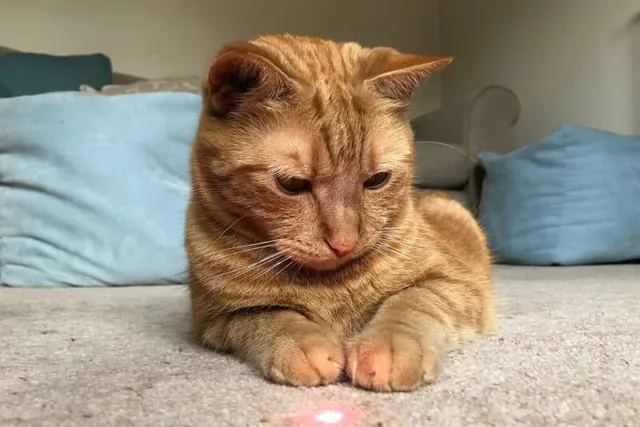
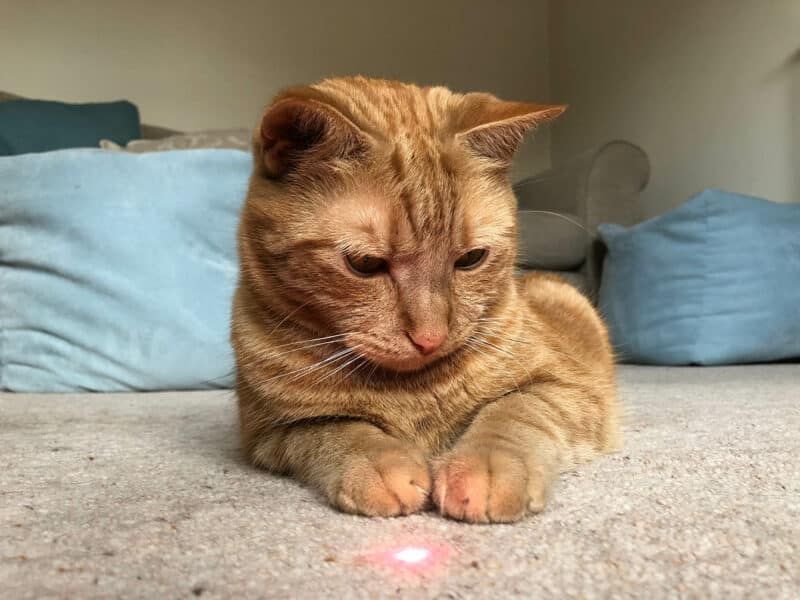
Cat staring on laser

For cats, laser pointers are incredibly entertaining but sometimes frustrating since they can’t catch the beam. Most felines can’t help but chase the beam of red or green light around the floor, no matter their age or inclination to play. Why do cats seem obsessed with laser pointers? Cats like laser pointers because their instinct is to chase after anything that moves. In this article, we’ll discuss the scientific reasons that explain why cats love chasing lasers.

divider cats oct 2024

A Cat on the Hunt

Why are cats instantly inclined to follow a laser pointer?

Cats are predatory animals, and they are made to be top-notch hunters. Their instinct is to chase anything that moves quickly around them since something in their brains tells them it is prey. Almost all species of cats, including large wild cats, are more inclined to chase after something that moves. Coincidentally, this is why it seems odd to us when prey doesn’t immediately run in nature documentaries. Staying perfectly still is less likely to entice a cat to chase!

A cat’s predatory instinct is to chase anything that moves quickly. It is ingrained into their very anatomy. House cats are not far from their wild descendants, the African and European wild cats, and their hunting instinct is still strong. In addition, pet cats that are well-fed still enjoy hunting, and do it for enrichment and fun even if they are full. They are, after all, opportunistic hunters.

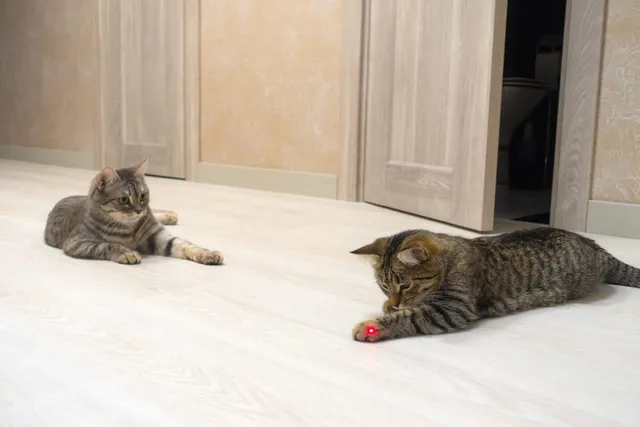
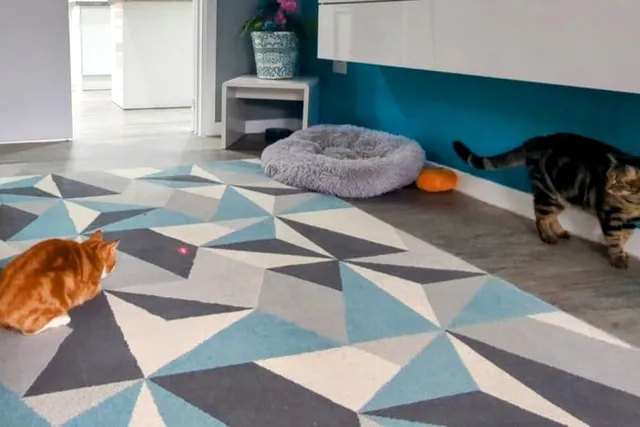
Therefore, a quick moving laser pointer that appears out of nowhere and rapidly darts around is sure to catch the attention of a curious cat. What ensues is well documented all over the internet, a cat going crazy trying to catch the dot as it moves around.

Cats’ Eyes: Laser Sharp

An eye has several functioning parts, including the retina. The retina is at the back of the eye and captures incoming photons (light particles) and transmits them along neuronal pathways as both signals for the brain to perceive a visual picture.

The retina contains both cones and rods, each specialized for different visual tasks. Cones are more active for vision at higher levels of light and are capable of color vision. Rods are responsible for vision at low light levels and they do not mediate color vision. In addition, rods are responsible for motion detection. Cats have a high number of rods, which means that they are able to detect rapid movement (a laser pointer) because their retina is optimized for this.

Blue golden shaded british shorthair cat with green eyes
Image Credit: Anna-Azarenko, Shutterstock

The Ethics & Safety of Laser Pointers

Though cats are notorious for chasing after laser pointers, there are ethical concerns with allowing cats to chase a laser pointer.

Safety Concerns

As a safety precaution, you should never point a laser directly into an eye. Whether the eye belongs to an animal or a human, even low-powered lasers can cause eye damage if the beam enters into the pupil and focuses on the retina.

Important

You should never use a cat laser toy outdoors or point it out a window, at people, or at cars or planes. Cat lasers are indistinguishable from laser sights on guns or more powerful lasers that can cause eye damage, even from long distances. Many places also prohibit the public use of lasers of any kind.

Mental Health Concerns

Another concern with lasers is that they can lead to aggression issues and frustration in cats. Persistently chasing after a laser without actually catching it can lead to a frustrated animal. Many times, a cat is very focused and at a high state of energy when they chase a laser. If the game suddenly ends, they could potentially chase, bite, and scratch a person or other animal in the house. This is also referred to as redirected aggression. For these reasons, laser pointers are not considered the best toys for cats. Other toy options might be better and safer for most cats.

If you are concerned about the health and well-being of your pet, seek veterinary advice for the best course of action.

If you need to speak with a vet but can't get to one, head over to PangoVet. It's an online service where you can talk to a vet online and get the advice you need for your pet — all at an affordable price!

PangoVet_Mention-in-Content for PangoVet2 save money

divider cats oct 2024

Conclusion

A small beam of light moving quickly on the floor or wall is too tempting for most cats to ignore. Felines enjoy playing with laser pointers because they have a strong instinct for hunting, and their eyes are designed to detect quick movements. However, laser pointers are not without their concerns, and recent studies have shown that other toys might be more appropriate for your pet.


Featured Image By: Laurav1984, Shutterstock

Want content like this delivered to you?

Sign Up For Our Newsletter

News, insights, expert advice, and everything cat

* By submitting, you agree to our Terms & Conditions and Privacy & Cookies Policy.


How useful was this post?

Click on a star to rate (you can leave written feedback after clicking submit)

Help us improve Catster for pet parents!

Your feedback really matters.

What did you like about this post? Also how can we improve it?

Join the conversation

Leave a Reply

You’re very welcome to leave a comment or question. Please know that all comments must meet our community guidelines, and your email address will NOT be published. Let’s have a positive and constructive conversation.


Talk With A Vet Online

Peace of mind,
anywhere, anytime

Affordable vet advice

Why Chicken Bones Are More Dangerous for Cats Than Most Parents Realize

Chicken bones seem harmless enough, but for cats, they can cause serious damage quickly. Whether your cat swiped a piece off the counter...

Fantastic Pet Pantries and Where to Find Them

Let’s face it: times are really tough right now, and those of us in the 99% are struggling with the cost of just...

Ask Dr. Paola – Help! My Cat Refuses to Drink Water! (April 13, 2026)

Welcome to our “Ask Dr. Paola” series, where every Monday we bring expert advice straight from Dr. Paola Cuevas (MVZ) to help our...

Why Healthy Cats Still Vomit Sometimes (And How to Respond)

A cat that just vomited needs a specific kind of care, and the feeding decisions you make in the next few hours actually...

More related

Telepathic Communication With Your Cat: How Olga Anticipates My Actions

Hi, I’m Christopher! Read my introduction to learn more about me and my silly Russian Blue cat, Olga. Cats have a reputation for...

British Shorthair Cat vs Ragdoll Cat: What’s the Difference? (With Pictures)

If you are looking to get a pet cat, whether it’s your first or your fifth, you’ll know by now that there are...

St. Gertrude, The Patron Saint of Cats: Facts & History Explained

When March 17th rolls around, most people are gearing up for Saint Patrick’s Day celebrations. It’s a time to feast, drink, wear green,...

How Long Can a Cat Be in Labor? Vet-Approved Feline Birth Facts

Most veterinary professionals recommend getting your cat spayed or neutered to help control the feral cat population, reduce disease transmission between cats, and...

Keep reading

Why Do Cats Smell Other Cats’ Butts? Vet-Reviewed Behavior & Communication Facts

Cats are meticulous, extremely clean creatures that act elegant and sophisticated most of the time. That’s why it’s a bit surprising to cat owners to see their cat smelling another cat’s butt. While this might seem like weird behavior, it’s...

Gray cat sniffing another cat butt

Can Cats Eat Salmon Skin? Vet Reviewed Facts & Health Guidelines 

Salmon is an all-time favorite treat for many cats thanks to its tantalizing aroma, but can cats eat salmon skin? As long as the salmon is thoroughly cooked (plain, not with seasonings) and your cat doesn’t have a sensitive stomach,...

Can Cats Eat Salmon Skin

Will a Cat Only Purr for Humans? Do They Do it for Other Cats? (Vet-Verified)

You may have heard that cats only purr for humans. Well, how true is that? As adorable of a sentiment as it is, cats do not purr for humans exclusively. Cats have been observed purring for other cats and even...

british shorthair cat yawning and purring

Can Cats Eat Cheez-Its? Vet-Verified Nutrition Facts & Considerations

Our pets are like family members to us. They join in on quality time with the rest of the kids and adults and often become the center of attention with their hilarious antics. However, when it comes to sharing your...

Can Cats Eat Cheez-Its

Does Baking Soda Kill Fleas on Cats? Vet-Approved Effectiveness & FAQ

Baking soda is an effective and inexpensive home remedy for several problems, and you may have heard that baking soda can kill fleas on cats. The idea is that baking soda creates an environment that the fleas cannot survive in...

baking soda in a glass bowl

Why Do Cats Like Feet? 8 Interesting Reasons

Cats can be quite quirky, often making toys out of the most ordinary objects that they can find. One mundane thing that cats seemingly love to sniff, rub against, and play with is the feet of humans. Some cats seemingly...

cat smells, lick feet and toes in bed

Why Does My Cat Bite Their Feet? 7 Vet-Verified Reasons

Cats do all sorts of strange things! The motivations of most feline behavior remain, for the most part, opaque at best, with cat lovers reduced to playing with educated guesses when attempting to explain their pets’ various quirks. They intentionally...

bengal cat biting its paw

My Cat Is Not Eating But Acting Normal, What’s Wrong? 7 Vet-Reviewed Issues

It is understandable to feel worried if your cat is not eating much but acting normal. Although cats can be finicky about mealtimes and their food preferences, a poor appetite could indicate that something is wrong. There are various reasons...

vet examining the sick cat with stethoscope

Love Cats? So Do We! Join the Catster Community

Stay informed with expert pet care insights delivered straight to your inbox! Discover professional guidance on animal behavior, feeding tips, trusted product picks, and much more.


Sign up for the Catster Email Newsletter

Stay informed with expert pet care insights delivered straight to your inbox! Discover professional guidance on animal behavior, feeding tips, trusted product picks, and much more.